
Author: Marielle Mekkaoui

Integrated vs. Embedded Payments: What’s Best for Your Vertical SaaS?

Key takeaways:

  • Embedded payments give vertical SaaS platforms full control over merchant onboarding, pricing, branding, and data, whereas integrated payments hand those functions to third parties.
  • Under an integrated model, a platform processing $50 million in annual volume may earn only 5 to 15 basis points in referral fees. In contrast, under embedded payments, the same volume can generate 5 to 10 times more revenue.
  • By using embedded payment strategies, SaaS platforms can retain customers at 2.5 times the rate of traditional payment providers, and their merchants embrace 18% more value-added services (BCG 2025).
  • Vertical SaaS platforms can achieve PayFac-Level economics without full PayFac registration. PayFac-as-a-service provides the same margin control and merchant ownership while eliminating the compliance burden.

In the ever-evolving world of vertical SaaS platforms, choosing the right payment strategy can be a make-or-break decision, not just for platform growth but also for customer experience and monetization. Two terms often used in this conversation are integrated payments and embedded payments. While they may sound similar, the difference is profound, and so are the benefits of getting it right.

In this blog, we’ll break down the distinction between integrated and embedded payments, examine the market data behind each approach, and explain why embedded payments are the gold standard for vertical SaaS platforms looking to scale efficiently and profitably.

Integrated payments with disconnected components across multiple vendors compared to embedded payments unified under one platform

What are integrated payments?

Integrated payments refer to the approach where a SaaS platform connects to a third-party payment provider (such as Stripe, PayPal, or Authorize.Net) using APIs or plug-ins. While the integration enables payment functionality, the actual experience, like merchant onboarding, transaction monitoring, or settlement, is still handled largely outside of your platform.

SaaS company’s control over the pricing, user experience, and monetization is limited by this model. Software platforms now manage 60-70% of their clients’ payment processing contracts according to a 2025 BCG report on merchant services. Platforms using integrated payment models often give up this control to the third-party providers, along with the linked revenue.

What are embedded payments?

Embedded payments go a step further by deeply integrating the entire payment experience within the SaaS platform. From merchant onboarding and KYC, to accepting payments, managing payouts, and delivering insights, everything happens natively in the software interface.

Fully embedded payments within your platform mean that merchants onboard, transact, and access real-time reporting without ever leaving your software. This ensures a seamless, consistent experience that feels like a natural part of your product, not an external add-on.

This model is often powered by becoming a Payment Facilitator (PayFac) or by partnering with a PayFac-as-a-Service provider. 

The financials for embedding payments are well documented. According to Bain & Company, the embedded finance revenue is projected to increase from $21 billion in 2021 to around $51 billion by 2026. The embedded payment market alone reached $24.7 billion in 2024 and is growing at a 30.3% CAGR through 2034.

Integrated vs. embedded payments: A side-by-side comparison

The significant difference between the two models extends across onboarding, revenue, data ownership, branding, and compliance. The table below summarizes how each approach performs on capabilities that matter most to platform administrators.

Integrated payments vs. embedded payments comparison across onboarding, branding, pricing, revenue, data ownership, compliance, and time to launch.

For a practical walkthrough of what it takes to go live with embedded payments, see Payabli’s Embedded Payments Launch Checklist.

Why do embedded payments win on user experience?

For vertical SaaS platforms, user experience is everything. Embedded payments dramatically enhance the merchant journey and unlock new business value in ways integrated payments simply can’t.

1. Frictionless onboarding

Say goodbye to third-party forms and redirection. Merchants can sign up and start accepting payments right inside your platform, often within minutes. Payabli’s Creator tool enables platforms to apply branded onboarding without any coding, further reducing time to first transaction. 

2. Unified UI and experience

The payment flow stays consistent with your platform’s design. This creates a branded, trustworthy experience for your users.

3. Faster time-to-revenue

While integrated options may involve multi-day approval processes, embedded payments often enable instant and/or bulk onboarding and activation, meaning your users start transacting sooner. This speed directly translates to faster payment volume growth for platforms serving high-volume verticals.

4. Deeper data visibility

With embedded payments, your platform owns the entire data flow, transaction history, user behavior, and payout activity, which means better analytics and smarter customer engagement.

5. New revenue streams

Rather than handing over valuable payment margins to third parties, you capture a share of the transaction revenue. This high-margin income can transform your SaaS business model. According to Andreessen Horowitz, revenue per user can be increased 2 to 5 times by adding embedded payments.

6. Streamlined compliance (with the right partner)

PayFac-as-a-Service solutions help you deliver a native experience without taking on the full regulatory or administrative burden of being a registered PayFac yourself.

Three key embedded payments statistics: 2.5x higher customer retention, 2 to 5x more revenue per user, and $51 billion in projected embedded finance revenue by 2026

How to evaluate your payment model

The perfect payment model depends on your platform’s technical resources, stage, and growth goals. Not every platform is prepared for full PayFac registration, but most can benefit from PayFac-as-a-Service immediately. The table below outlines the four primary models and what each requires.

 Comparison table showing four embedded payments models: Referral/Integrated, Hybrid Partnership, PayFac-as-a-Service, and Registered PayFac, evaluated across platform control, revenue potential, compliance burden, and best-fit use case.

What to look for in an embedded payments provider

If you’re ready to embed payments into your SaaS platform, the provider you choose will have a massive impact on both your product experience and your bottom line. Here are four key things to look for:

1. Unified Pay In and Pay Out capabilities

A common limitation among many embedded payment providers is the inability to support both payments and disbursements under one roof. This can create friction when trying to manage sub-merchants, service providers, or vendor payouts. Choose a provider that bridges both sides of the money movement, ensuring faster settlement, seamless fund distribution, and better cash flow control. The ability to earn revenue on both inbound and outbound payment flows, including virtual card rebates on vendor payouts, is what distinguishes a payments feature from a payments business.

2. Flexible integration options

Your development team shouldn’t have to force-fit your platform into rigid SDKs or templated flows. Look for providers that offer modern, modular APIs, webhooks, and event-driven architecture, and clear documentation and sandbox environments. This allows you to tailor the payment experience to your platform’s design and business logic.

3. Hands-on, expert support

Payments can be complex, but your journey shouldn’t be. The right provider offers proactive, strategic guidance from discovery to go-live, and everything in between. That includes technical integration support, merchant onboarding optimization, compliance and risk workflows, and ongoing product and go-to-market strategy. Unlike most providers, the right partner will also offer merchant-level support.

Beyond launch, you should expect responsive, hands-on support from experts who understand your industry. The right partner will help you and your customers resolve issues quickly, optimize operations, and provide guidance tailored to your vertical, whether you’re serving contractors, gyms, law firms, or property managers.

4. Cost and pricing transparency

A strong payment partner doesn’t just present pricing, they help you understand it and turn it into a strategic revenue stream. Look for transparent rates and no hidden fees, flexible monetization options, simple easy-to-read billing, tailored pricing strategies by vertical, flexible pricing structures, and granular monthly statements to optimize margin at scale.

For vertical SaaS platforms, payments are more than a back-end utility, they’re a strategic lever for growth, retention, and monetization. While integrated payments may offer a quick start, embedded payments create long-term value through a smoother user experience, stronger brand ownership, and deeper monetization opportunities.

Choosing the right partner is just as important as choosing the right model. With the right embedded payments provider, your SaaS platform won’t just process payments, it will own them.

From integrated payments to a payments business

Most vertical SaaS platforms started with an integrated payment model because it was the fastest path to offering payments. But as your merchant base grows, the gap between what integrated payments deliver and what embedded payments unlock becomes harder to ignore: more revenue per transaction, full brand ownership, and a merchant relationship you control. See how the two models stack up in our full comparison table above.

Payabli helps platforms make that transition. Whether you are moving off a referral model, replacing a fragmented multi-vendor setup, or embedding payments for the first time, Payabli’s unified Pay In, Pay Out, and Pay Ops infrastructure gets you live in weeks with PayFac-Level economics.

Book a demo to see how platforms like Sunbound made the switch.

What Good Underwriting Looks Like for Vertical SaaS Platforms

By Cathy Livingston | Compliance, Risk & Underwriting Specialist, Payabli

I’ve spent nearly three decades in financial risk – starting in personal lending, moving into payment processing about ten years ago. The shift changed everything. Instead of evaluating individual consumers, I’m now evaluating businesses and their financials, transaction patterns, and risk profile within a payments ecosystem.

If you’re a vertical SaaS company bringing payments to your customers, here’s what good underwriting actually looks like – and why it matters more than most platforms realize.

Underwriting Isn’t a Bottleneck. It’s a Foundation.

The ‘underwriting is a bottleneck’ conversation comes up a lot, and I understand it. But here’s the reframe: a bottleneck holds back everything. Underwriting, when it’s done right, holds back the right things – the merchants who would have generated chargebacks, the fraud that would have hit your platform, the risk that would have slowed your growth far more than any approval process ever could. And with AI-powered risk tools now part of the equation, the gap between thorough and fast is closing faster than most platforms realize.

What I wish more people understood is that good underwriting protects our SaaS partners just as much as it protects Payabli. If a merchant is approved for limits they can’t sustain, or if there are risk factors we didn’t catch upfront, it’s the SaaS platform who feels that downstream. Chargebacks, disputes, fraud exposure – those land on everyone. When underwriting is done well, it’s almost invisible. Everything just works.

Vertical SaaS Changes the Equation

Here’s what makes underwriting for vertical SaaS platforms different: you’re not bringing one merchant to a payments processor. You’re bringing hundreds or thousands of merchants, all operating in the same industry vertical.

Every vertical has its own financial fingerprint, and you have to know what normal looks like before you can spot what’s off. A roofing company might show very low deposit activity in January and February – that’s not a red flag, that’s winter. A childcare center is going to show steady, predictable monthly deposits that look very different from a construction contractor’s project-based cash flow. Understanding that distinction is what separates good underwriting from slow underwriting.

At Payabli, our SaaS partners serve specific verticals, so over time we develop real fluency in what their merchant portfolios look like. That context makes an underwriter a faster, more confident reviewer – and a better resource for the SaaS platform when they have questions about a decision. 

How a Merchant Application is Evaluated 

When a merchant application comes through your platform, here’s what I’m evaluating:

Business owner and business information.

Who is behind this business, how is it structured, and what industry are they operating in? Certain business types carry higher inherent fraud or chargeback risk, and ownership details can surface red flags early, before even getting to the financials. This context helps shape every other part of the review.

Bank statements and processing history. 

These aren’t always required – but when a merchant’s volume request needs additional support, this context can help tell the real story of a business. Average balances, deposit consistency, how volume has trended. If a merchant is requesting a $500K monthly processing cap but their bank statements show $80K in average monthly revenue, that gap needs an explanation.

Consistency across documents. 

Does the business description match the financials? Does the requested volume make sense for the size of the operation? Red flags in underwriting are often about inconsistency more than any single data point.

Fraud indicators. 

In payment processing, underwriting is often the first line of defense – we’re reviewing these applications before a merchant ever processes a transaction. Catching something early protects your platform, your merchants, and the entire ecosystem you’ve built.

Where AI Is Changing the Underwriting Equation

At Payabli, we use AI to help review information-dense documents (think: bank statements, processing history, financial statements) and run deeper analytics than would be practical manually. It surfaces what needs attention faster, so the underwriting team can spend more time on the judgment calls that actually require experience.

Because here’s what AI can’t do: interpret context. It might flag irregular deposit activity – but a person who knows the industry understands whether that’s a real concern or just seasonality. Automation makes us faster and more thorough. It doesn’t replace knowing what you’re looking at. For vertical SaaS platforms, that combination means faster approvals for clean merchants and earlier intervention on the ones that need a closer look. The bottleneck gets smaller. The diligence doesn’t.

The Bottom Line

The best partner relationships are ones with real back-and-forth – they understand what we need to make decisions, and we understand the merchants they’re bringing on. SaaS platforms who invest in understanding the underwriting process see fewer follow-up requests and smoother onboarding overall.

Payabli wants merchants to succeed – and underwriting is one of the first ways we set them up to do exactly that. 

Introduction to Embedded B2B Payments

Key Takeaways:

  • Embedded B2B payments enables vertical SaaS platforms to bring the entire payment experience natively inside their product, capturing economics on both sides of money movement without full PayFac registration.
  • The embedded B2B payments market is projected to grow nearly fourfold by 2030, shaped by demand for integrated workflows and the decline of paper-based payments.
  • The fastest-growing B2B payment method is virtual cards, with transaction volume projected to grow from $3 trillion in 2024 to $11 trillion by 2028, yet they represent only 2% of accounts payable transactions today.
  • Embedding Pay In and Pay Out under a single unified API enables vertical SaaS platforms to capture both sides of money movement while building deeper customer stickiness.

B2B transactions still rely on manual invoicing, paper checks, and disconnected systems. More than half of all B2B invoices are currently overdue, and the downstream effects (reconciliation failures, delayed cash flow, and strained supplier relationships) are symptoms of the same root problem: payments that operate outside the software where business actually happens.

Vertical SaaS platforms that embed payment acceptance (Pay In) and accounts payable (Pay Out) directly into their product don’t just add a feature. They remove the friction that’s costing their customers real money and unlock a revenue stream that scales with every transaction.

Embedded B2B payments address this by integrating payment capabilities directly into the software platforms businesses already rely on. Instead of toggling between third-party payment tools, portals, and accounting systems, payments happen inside the workflow. This blog covers what embedded B2B payments are, why the market is accelerating, and what to evaluate in an infrastructure partner.

What Are Embedded B2B Payments?

Embedded B2B payments refers to bringing the entire payment experience natively inside the software platforms businesses already use. Through a PayFac-as-a-Service model, your platform captures the economics and controls the experience end to end, with no full PayFac registration required. Rather than context-switching to separate tools, all money movement happens inside the workflow, under your brand, on your terms.

For vertical SaaS platforms, embedded payments are often the foundation of a broader financial services strategy that can expand to include lending, insurance, or banking services over time.

When a property management company logs into its platform to collect HOA dues and then opens a separate banking portal to pay a vendor, those are disconnected B2B payments. With embedded B2B payments, both transactions happen inside the same platform, with the invoice, reconciliation, and payment all connected.

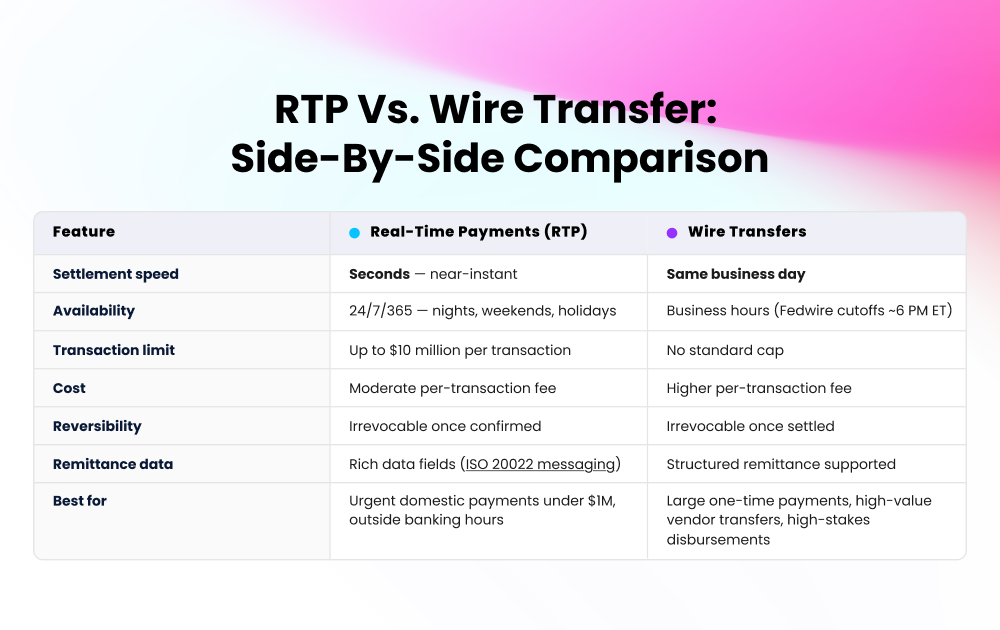
When working with the right payment infrastructure provider, embedded B2B payments can cover both sides of money movement for your platform. On the acceptance side (Pay In), merchants collect via cards, ACH, checks, and digital wallets. On the disbursements side (Pay Out), they pay vendors through ACH, wire transfers, virtual cards, and real-time payments (RTP), generating interchange revenue on every vendor payment. Pay Ops, the operational layer connecting both, handles underwriting, risk management, reconciliation, reporting, and compliance across the full payment lifecycle.

The key distinction in B2B payment workflows is that transactions involve invoices with multi-party approvals, large dollar amounts, payment terms, and compliance obligations that require purpose-built infrastructure to manage.

To explore how vertical SaaS platforms are layering additional financial products on top of payments, see Beyond Embedded Payments.

Why embedded B2B payments are one of the highest-value opportunities for vertical software platforms

Embedding payments isn’t just a feature add. It’s a revenue stream that grows with every transaction processed on your platform. Larger transactions, longer customer relationships, and deeper workflows makes embedded B2B payments one of the most significant monetization opportunities in vertical software platforms today.

  • New revenue streams on both sides of the money movement. Embedded B2B payments unlock transaction-based revenue across Pay In and Pay Out, two channels most platforms leave on the table. On the Pay In side, every card payment, ACH transfer, or digitized check collected through your platform generates transaction revenue. On the Pay Out side, virtual cards are among the highest-margin disbursement methods available, generating interchange revenue on every vendor payment, often exceeding 100 basis points. Virtual cards represent just 2% of accounts payable transactions today, while 80% of buyers prefer them (Tearsheet). That gap is the opportunity.
  • Larger transactions mean more revenue per payment. B2B transactions routinely run into thousands or tens of thousands of dollars. A platform processing a $50,000 vendor payment captures significantly more per transaction than one handling a lower-value payment. The underwriting and risk models that support those larger amounts also deepens the value your platform delivers, giving businesses meaningful financial controls built directly into their workflow.
  • Better data makes your platform stickier. B2B payments generate rich transaction data: remittance details, invoice matches, ledger entries, and purchase order records. Surface that through reconciliation feeds and Level II/III transaction support, and your platform becomes the financial system of record your customers won’t switch away from.
  • Faster onboarding and simplified compliance. The right embedded payment infrastructure provider handles KYB verification, underwriting, and risk monitoring natively, so your team can focus on the product and your customers can start transacting quickly, without the friction of managing it separately.
  • More control over the customer experience. When payments live inside your platform, you control the full experience. Branded payment flows, configurable payment terms, automated reminders, and real-time reporting all happen inside your product, not in a third-party portal your customers have to navigate.

The Market Opportunity: Why Now?

The market is massive, underpenetrated, and moving fast. Embedded B2B payments are growing at a 25% CAGR, projected to reach $15.6 trillion by 2030 (Edgar, Dunn & Company). According to PYMNTS Intelligence, 62% of businesses now expect ERP integration for their accounts payable solutions, and 36% of executives identify adopting in-platform payment capabilities as a top priority for staying competitive. For vertical software platforms, that pressure is an opening: businesses are actively consolidating financial operations inside the tools they already use.

The shift away from legacy payment methods is accelerating. In September 2025, the U.S. Treasury moved away from paper checks for most disbursements, and similar digital-first mandates are emerging globally. Virtual cards and real-time payments are replacing manual AP workflows, and AP automation adoption is driving disbursement volume onto higher-margin rails.

A longer-term force is also taking shape: agentic fintech. As AI agents execute financial workflows autonomously, the platforms that have already embedded payments will be positioned to absorb that automation layer naturally. Payments won’t just be a feature your customers use. They’ll be a function AI operates on their behalf, inside your platform.

Vertical SaaS platforms that move now, embedding Pay In, Pay Out, and Pay Ops under a single unified API, are building payment businesses, not just adding features.

Comparison table of five common B2B payment methods including paper checks, ACH, wire transfers, virtual cards, and real-time payments, evaluated across speed, cost, fraud risk, and best use case.

What to evaluate in a B2B Payments infrastructure partner

B2B embedded payments require capabilities that go well beyond standard payment processing. The right partner should be purpose-built for these workflows.

Vertical-specific payments expertise

Payment workflows aren’t generic, and neither is the infrastructure that should support them. A construction platform managing progress billing and subcontractor disbursements has fundamentally different requirements than a property management platform collecting rent and HOA dues, or a healthcare platform navigating patient billing and insurance reconciliation.Your infrastructure partner should be purpose-built for vertical software, not a horizontal processor retrofitting generic tools to your use case.

Integration that meets your engineering team where they are

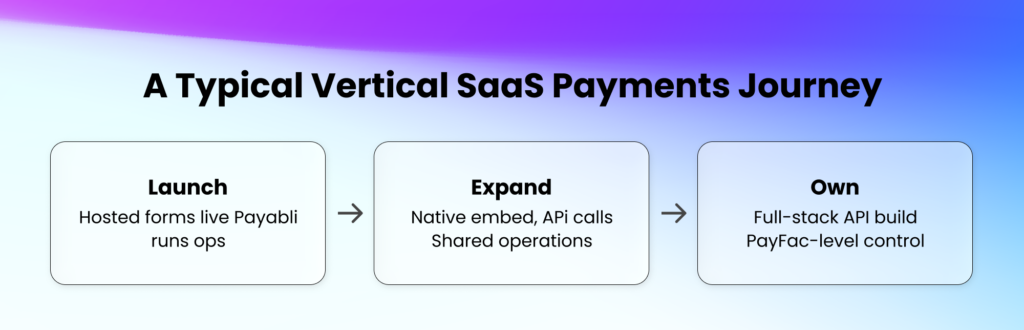
Embedding payments should accelerate your product roadmap, not slow it down, and the right partner gives you optionality based on where you are in your payments journey. The right partner supports a crawl, walk, run approach: launch with pre-built tools, embed with configurable components, then build a fully custom experience when you’re ready. And if you’re starting with Pay In but want to layer in Pay Out down the road, that expansion should be straightforward, not a separate conversation.

Compliance built for B2B payment workflows, not bolted on after

B2B payments carry requirements that go well beyond standard PCI DSS and NACHA obligations. KYB verification for onboarding multi-entity merchants, positive pay for check fraud prevention, and Level II/III data submission for interchange optimization are baseline B2B expectations, not edge cases. Look for a partner that handles these natively and engages directly on underwriting, not one that hands you a questionnaire and walks away. That distinction keeps your engineering team focused on your product roadmap and your compliance posture intact.

Dedicated support and implementation partnership. 

The implementation phase is where most embedded payments programs succeed or stall. The right partner assigns a dedicated team, not a ticketing queue, from onboarding through launch and beyond. The right partner understands your platform before integration begins, not just after something breaks. Proactive monitoring, clear escalation paths, and a partner invested in your long-term success, not just your go-live date, are the markers of a provider worth trusting.

Merchant adoption, conversion, and monetization strategies.

Embedding payment capabilities is only the beginning. Revenue is directly tied to how many customers activate and how deeply they engage. Look for a partner with proven merchant adoption playbooks and launch checklists, friction-reducing onboarding flows, and in-platform prompts that drive activation at the right moment. The right partner works alongside you to increase payment volume and deepen engagement across your customer base, so your payments program compounds as your platform grows.

A self-assessment table for vertical SaaS platforms covering ten key areas of payment infrastructure readiness, from platform architecture and monetization control to branded experience and API flexibility, helping teams identify gaps before evaluating an embedded payments partner.

From Payment Features to a B2B Payments Business

Platforms that embed B2B payments capture margin on both sides of every transaction, build a revenue stream that scales with their software, and deepen the merchant relationships that drive long-term retention. The opportunity ahead is significantly larger than what has already been captured.

Payabli works with vertical SaaS platforms across property management, HOA, field services, construction, education, healthcare, legal, and government to design and launch B2B payment strategies specific to their vertical. If you’re exploring how to embed and monetize B2B payments into your platform, Book a demo today.

Embedding Payments in SaaS: Best Practices

Key Takeaways:

  • The best practice to embed payments in SaaS is to find an infrastructure partner that unifies payment acceptance, disbursements, and operations within a single API, with seamless merchant onboarding, white-labeled user experience, and a scalable pricing strategy.
  • The three essential decisions include merchant onboarding flow, integration model (API, no-code, or white-label), and the pricing model. Missteps in any of these would delay adoption.
  • White-labeling the entire payment workflow keeps merchants inside your platform, resulting in reduced churn rate and driving higher payment adoption rates.
  • Payment operations (onboarding, compliance, risk, billing) are just as important as the payment technology; however, 70% of the platforms still treat payments as a commodity. 
  • SaaS platforms that combine acceptance, disbursement, and operations under a single API eradicate vendor fragmentation and go live in weeks instead of quarters. 

Embedding payments in SaaS is one of the most consequential decisions a software platform can make — and one of the most misunderstood. The technical lift of adding a payments layer is only part of the equation; the real complexity lies in architecting an experience that drives merchant adoption, scales with your business, and captures the full revenue potential payments can unlock. Platforms that treat embedded payments as a feature rather than a strategic capability often find themselves rebuilding from scratch. Getting it right the first time requires a clear-eyed understanding of where the pitfalls are — and how to avoid them.

Meanwhile, platforms that follow proven implementation strategies are doubling their payments revenue within three months of launch (EY-Parthenon). The gap between doing it and doing it well is worth millions, as it is projected that with embedded payments transaction value would surpass $2.5 trillion by 2028 (Juniper Research). This guide covers eight best practices that distinguish platforms generating real payment revenue from those still figuring it out.

Scattered vs organized payment components showing execution impact

1. Choose the Right Integration Approach

There are three paths to embedding payments, each with different tradeoffs around control, speed, and engineering lift.

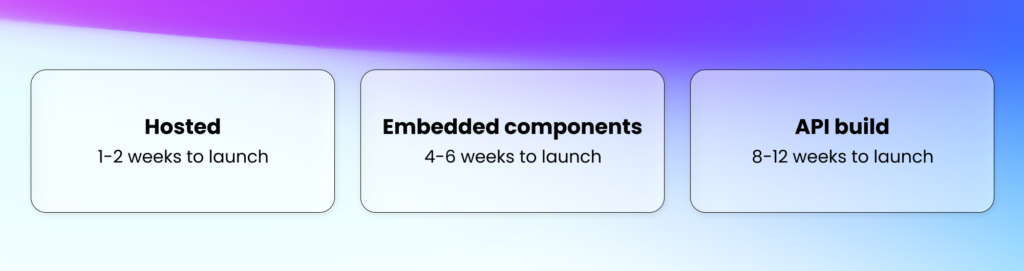
  • Pre-Built Payments Portal: The fastest entry point. Payabli’s ready-made portal and hosted tools let you start accepting and managing payments without building much yourself. Payments are functional from day one, with white-label opportunities to keep it on-brand.
  • Embedded Components: Pre-built JavaScript UI modules (payment forms, boarding links, merchant dashboards) that drop into your platform with minimal development effort. Launch in weeks with full functionality and CSS-level branding control. This is where most SaaS platforms land when they want payments inside their product without heavy infrastructure work.
  • Full API: Complete control over every screen, data point, and workflow. The right choice for platforms with dedicated engineering teams that want a fully tailored payment experience. It takes longer to build, but you own every interaction.

Partners shouldn’t have to start at the most complex integration. Payabli supports a natural progression: launch quickly with hosted tools, embed payments with configurable components, then build a fully custom experience when you’re ready.

2. Make Merchant Onboarding Frictionless

The first experience your customers will have with payments on your platform is merchant onboarding. If the process feels disconnected from your product or adds unnecessary friction, adoption can stall before it even begins.

The most effective onboarding workflows share a few core principles. Use existing platform data — tax ID, business name, address — to pre-fill the merchant application, so customers aren’t re-entering information they’ve already given you. Keep the form completable in a single session. Deliver the experience through a white-labeled boarding workflow so merchants stay within your platform from start to finish. Leverage automated KYC/KYB verification to remove manual bottlenecks, and surface real-time application status updates so merchants always know where they stand — reducing drop-off and accelerating activation.

According to BCG, a higher activation and retention rate is observed on platforms that have seamless onboarding, as it reduces friction in merchant experience.

3. White-label Everything

The payment experience should feel native to your platform. For you and for every merchant you serve. When a merchant onboards, submits a payment, checks a dashboard, or receives a receipt, that interaction is a direct reflection of your product. Friction at any one of those touchpoints isn’t just a UX problem, it’s a retention risk. 

Every step should carry your brand: checkout pages, payment forms, reporting dashboards, onboarding applications, transactional receipts, email notifications, and settlement communications. When merchants see consistent branding across every interaction, payments feel like a core feature of your platform — not a third-party service bolted on. That consistency builds trust, drives adoption, and reduces churn.

With more than 60% of vertical SaaS platforms already embedding payments (EY-Parthenon), your merchants expect this level of consistency. The bar for what “native” looks like is only rising.

4. Cover Both Sides of Money Movement 

Payment acceptance (Pay In) is table stakes for most platforms, but merchants also send money, like paying vendors, suppliers and subcontractors. This is the account payables (Pay Out) option, and it represents a substantial revenue opportunity. 

For example, in a construction management platform, a general contractor collects payments from the property owners (Pay In) and then is required to pay plumbers, electricians, and other suppliers (Pay Out). Similarly, in property management, a platform’s client collects rent from tenants, then pays utility companies, maintenance vendors, and property owners. The platforms that only monetize one side of payments are leaving potential revenue on the table, as both sides of the payment carry a margin. 

The best practice is to choose a platform with a single unified API offering both acceptance and disbursements. A unified view of all money movement across your platform is enabled, without the need to manage two separate vendors. When Pay In and Pay Out share the same reconciliation, reporting, and billing layer, the operational friction reduces critically.

5. Don’t Ignore Payment Operations

Payment operations are the backbone of a scalable payments strategy — and the most underestimated part of it. Getting live is the easy part. Pay Ops is what ensures merchant underwriting, chargeback management, risk and fraud monitoring, compliance reporting, pricing and billing configuration, and funding and settlement management run efficiently — freeing your team to focus on growth instead of back-office overhead.

Most software platforms treat payments as a utility. The ones that treat it as a strategic lever — investing in the operational layer, not just processing — are the ones that drive retention, unlock new revenue, and build durable competitive advantage.

The takeaway: choose a partner that offers operational depth alongside a payments API, not just processing capability. Onboarding templates, billing engines, risk controls, and reporting dashboards are just as important as accepting a card payment.

6. Offer Multiple Payment Methods

Your merchant’s customers expect multiple payment options at checkout. At minimum, platforms should provide support for credit and debit cards (Visa, Mastercard, Discover, Amex), bank transfer and ACH, digital wallets (Google Pay, Apple Pay), SMS pay links, and checks, such as RDC (remote deposit check capture) for verticals that need it. 

Your payment methods should match your vertical. A property management platform needs ACH and remote deposit check capture — how most homeowners and tenants prefer to pay. An education platform benefits from recurring billing and flexible payment schedules. A field service platform needs Tap to Pay and digital wallet support for fast, on-site transactions. And regardless of vertical, any modern payment stack should include digital wallets: Juniper Research cites “global digital wallet users will exceed 5.2 billion by 2026, growing by 35% between 2025 and 2030.”

7. Build a Pricing Strategy That Scales

Instead of simply passing through processing costs, treat payments as a standalone P&L — built to optimize operations, maximize revenue, and scale your business.

Pay In: Your pricing model determines how much of the payments opportunity you capture. IC+, tiered, flat rate, or zero-cost processing — configure the right model for the right customer across your entire portfolio.

Pay Out: Every vendor payment your platform sends is a transaction — and every transaction is a chance to capture margin. Virtual cards generate interchange. ACH can carry per-transaction fees. Checks have issuance economics. Platforms that monetize only one side of money movement leave revenue on the table.

The opportunity is significant. Edgar, Dunn & Company estimates embedded B2B payments will grow from $4.1 trillion in 2024 to approximately $15.6 trillion by 2030 — nearly a fourfold increase at a 25% CAGR. The pricing decisions you make today will directly shape your margin at that scale.

8. Plan for Compliance from Day One

Compliance is a significant part of any payment platform, not a secondary consideration. PCI DSS (Payment Card Industry Data Security Standard) for card data security, NACHA rules for ACH transactions, KYC/KYB verification for merchant identity, and state-level money transmitter regulations are some of the requirements for handling payments.

The best practice would be to work with an infrastructure partner that handles compliance as a part of the platform itself. Encryption, tokenization, and fraud detection should be part of the backbone of the platform. With the right partner, engineering overheads, risk exposure, and ongoing audit costs could be avoided, which are usually faced by platforms trying to manage PCI scope internally. 

Build Your Embedded Payments Strategy with Payabli

Payabli’s unified API consists of Pay In, Pay Out, and Pay Ops, providing vertical SaaS companies with a single integration for acceptance, disbursements, and operations. With white-labeled onboarding, transparent revenue sharing, and no-code components, platforms can go live within weeks rather than quarters.
100+ vertical SaaS platforms and 60,000+ merchants across education, fitness, construction, property management, field service and government are powered by Payabli. Whether you are initially launching payments or replacing a legacy integration, Payabli’s team can help you build a custom payment strategy for your vertical.

Talk to Payabli’s team and see how embedded payments can work for your platform.

GDPR Compliance in Payment Processing: What SaaS Platforms Need to Know


Written by: Emilio Sepulveda, Director of Engineering @ Payabli

The General Data Protection Regulation (GDPR) is the European Union’s landmark data privacy law, and one of the strictest in the world. It sets comprehensive standards for how organizations collect, process, store, and protect the personal data of EU residents. But GDPR’s influence extends far beyond Europe.

Although the United States has no single federal privacy law of comparable scope, 20 states have enacted comprehensive privacy laws, many of which draw directly from GDPR principles. That growing patchwork of regulation, combined with increasing enterprise buyer expectations, has made GDPR the de facto benchmark that US-based SaaS companies follow when building data privacy programs.

We’re proud to announce that Payabli is GDPR compliant. The supporting documentation is available in our Trust Center.

The cost of getting data privacy wrong

Non-compliance with data protection regulations is not just a legal risk. It is a financial one. According to the CMS GDPR Enforcement Tracker (2025), European data protection authorities have issued a total of 2,245 fines since GDPR took effect, totaling approximately €5.65 billion. That figure grew by over €1.17 billion in just the past year, with the average fine across all countries reaching €2.36 million.

The financial exposure goes beyond regulatory penalties. IBM’s Cost of a Data Breach Report (2025) found that the global average cost of a data breach reached $4.44 million, with US organizations facing a record $10.22 million per breach. Customer PII was the most frequently compromised data type, involved in 53% of breaches studied.

And the reputational damage may be even harder to recover from. According to the same IBM report, nearly two-thirds of breached organizations are still recovering more than 100 days after an incident. For SaaS platforms that embed payment processing, where sensitive financial and personal information flows constantly, a gap in data protection can erode trust fast.

Why GDPR compliance matters for SaaS platforms

When you embed a payments processor into your platform, you inherit its data practices. If your processor cannot demonstrate how personal data is collected, stored, and protected, that liability flows upstream to you.

This is not a theoretical concern. According to DLA Piper’s 2026 survey, European regulators issued approximately €1.2 billion in GDPR fines in 2025, with aggregate fines since 2018 now reaching €7.1 billion. Meanwhile, breach notifications surged 22% to an average of 443 per day. For SaaS companies, compliance is no longer optional. It is a baseline procurement requirement.

Enterprise legal teams now routinely require proof of GDPR compliance, including completed data processing agreements, SOC 2 reports, and documented security controls, before signing contracts. Recent research shows that 99% of organizations consider external privacy certifications important when choosing a vendor.

That’s why at Payabli, we consistently map data from ingestion through storage, tracing where personal information enters our environment, how it flows across systems, what controls protect it, and the legal basis that allows us to process it. The result is more than a compliance checkbox: it’s a genuine understanding of what we collect, why we collect it, and how we safeguard it.

When a regulator, auditor, or enterprise customer asks how you handle personal data, your payments layer cannot be a gap in your answer.

What GDPR means for your platform’s customers

GDPR gives individuals specific, enforceable rights over their personal data. One of the most important is the Data Subject Access Request (DSAR). A DSAR is a formal request from an individual asking:

  • What personal data do you hold about me?
  • How are you using it?
  • Can I get a copy?
  • Can I correct or delete it?

These requests are legally time-bound and must be handled carefully and consistently. Organizations must respond within 30 days under GDPR, and the demand for Data Protection Officers (DPOs) has surged more than 700% since the regulation took effect.

Payabli is built to help platforms support and manage these requests, so that when your merchants or their customers exercise their rights, you have the infrastructure and documentation in place to respond with confidence.

The US regulatory landscape is catching up

While GDPR remains the global standard, the US privacy landscape is evolving rapidly. Twenty states now have comprehensive privacy laws, with eight new laws becoming enforceable in 2025 alone, nearly doubling the number of states with active statutes. Maryland and Minnesota, in particular, introduced obligations that go further than many existing frameworks.

For SaaS platforms operating across state lines, especially those in PCI DSS-regulated industries like payments, this patchwork creates real complexity. Building to a GDPR-level standard today positions your platform to meet not only European requirements but the growing mosaic of US state regulations as well.

How Payabli embeds privacy into our infrastructure

GDPR compliance doesn’t live in a single document or team. At Payabli, privacy by design is integrated into how we build and operate:

  • Role-based access controls limit who can access personal data and when.
  • Recurring access reviews ensure permissions stay accurate over time.
  • Documented processing activities create a clear record of what we do and why.
  • Defined retention and deletion standards mean data doesn’t linger longer than it should.

These are not annual audit exercises. They are operational practices that run continuously, reflecting the principle that compliance is sustained through execution, oversight, and accountability.

This matters especially in payment processing, where sensitive financial data (card numbers, bank account details, billing addresses) flows through every transaction. IBM’s 2025 research found that customer PII was the most frequently compromised data type, involved in 53% of all breaches studied. At Payabli, we are committed to eliminating gaps in data protection entirely.

What’s next for data privacy in payments

This milestone strengthens our foundation, but it is not the finish line. Regulatory requirements, especially in fintech and digital payments, will continue to evolve. The EU has already proposed additional measures to streamline enforcement cooperation between data protection authorities, and new frameworks like the EU AI Act are introducing fresh governance expectations for platforms that use AI in data processing.

Meanwhile, in the US, roughly half of states with existing privacy statutes approved significant amendments in 2025 that either expanded coverage, refined key definitions, or enhanced enforcement tools. The compliance landscape is not slowing down. It is accelerating.

We will continue strengthening controls, expanding visibility, and deepening our data protection practices as our platform grows.

In payments, trust is the transaction. Strong data protection practices are essential to earning and maintaining that trust with customers and partners. That is the standard Payabli is committed to upholding.

Ready to work with a payments partner that takes data privacy seriously? Learn more about Payabli or visit our Trust Center to review our compliance documentation.

Beyond Embedded Payments: How Vertical SaaS Platforms Expand Their Fintech Stack with Purpose

Payments used to be the differentiator. Today, they are table stakes. 

Over 60% of vertical SaaS platforms have already embedded payments, according to a survey by EY-Parthenon, and adoption continues to climb. Embedded payments work because they’re intuitive, sticky, and powerful. When executed well, payments can increase revenue per user up to 5x

More than 80% of the embedded-finance market remains untapped. There are massive opportunities with payouts, working capital, insurance, spend management, and embedded marketing automation. These offerings are natural extensions of how a vertical SaaS platform can solve customer problems in high-complexity, need-to-pay verticals like healthcare, field services, property management, hoa and retail. 

The real question for founders isn’t whether to embed payments—it’s how to move beyond them without losing momentum.  As Ershad Jamil, former Chief Growth Officer at Service Titan, noted in his recent article,Moving Beyond Payments: When & How to Expand Your Fintech Stack, a lot of companies launch payments successfully—and then stop there.  How do you evolve your vertical SaaS platform from including payments as a feature into a purpose-built embedded ecosystem?

Payabli recently hosted a discussion with leaders across the embedded fintech landscape to dig into how founders can think beyond payments while staying focused on their core product and customer? 

The Biggest Misconception: We can add more embedded fintech later

Many founders and vertical SaaS platform leaders underestimate how early they should be thinking about a multiproduct strategy.  According to Ershad Jamil, “If you’re selling $50–100K ACV, you should be multiproduct from day one.”

During his time at ServiceTitan, Ershad’s team  launched nine fintech-adjacent products, which collectively grew to represent roughly one-third of total revenue. They didn’t wait for payments to reach saturation to begin exploring new products, instead, they watched customer adoption on payments as a guide and leading indicator. 

A practical rule of thumb:

  • If 5–10% of customers have adopted payments, you are building momentum.
  • That’s enough signal to start building—or partnering on—the next offering.
  • You can leverage your existing payments team to fast-track the next embedded product offering.

Founders often wait for “perfect adoption” before moving forward. In reality, momentum compounds faster when platforms layer products early, leveraging existing customer trust, data, and GTM motion.

Evaluating embedded fintech: Table stakes or Value add?

When it comes to deciding which embedded fintech products to add next to your platform, many founders struggle with deciphering what’s mandatory vs. what is monetizable. In this quickly evolving landscape customer expectations are also changing rapidly, so something that was a game-changer two years ago may be table-stakes today.  

Table stakes are defined by your vertical, your customer’s daily workflows, and what competitors already provide. Two years ago, embedded payments, basic reporting and reconciliation, and some form of cash-flow visibility felt like “nice to have” features, and today they are expected. 

“Accounting is extremely complementary to payments. Customers don’t want to leave their platform to understand their money.”

Raj Bhaskar, CEO, Tight

Accounting is a good example. As Raj Bhaskar, CEO of Tight, noted, “why hand over your customers to QuickBooks in the last mile?”  Customers are reluctant to move payments onto a platform unless it also helps them understand where the money went. Handing them off to QuickBooks breaks the experience—and increasingly feels outdated.

On the flip side, value added products unlock measurable business outcomes like faster cash flow, business growth, or reduced operational burden. That’s where categories like working capital and marketing automation come into play as accelerants. While there is an abundance of SMB focused marketing automation tools, embedding marketing into your platform brings greater convenience, data integration and visibility of actual marketing spend that wasn’t possible before. 

Table Stakes Embedded ProductsValue Add Embedded Products
Accounting
Marketing Automation
Financing and Working Capital
Spend Management
Insurance

As you evaluate additional fintech offerings, keep in mind that AI is not a stand alone offering. Integrated AI capabilities and automations are becoming the expectation for how your platform will work as a system of action.  As Raj says, “Why open a report and drill down into the data when you could open a chat and ask what is my month over month revenue increase and what should I do next?” AI will raise the bar across every embedded product:

  • Accounting that works in real time
  • Marketing that optimizes itself
  • Capital that’s proactive, not reactive

The question isn’t whether to add AI. It’s whether your product is intentionally designed to use it.

When evaluating if a new offering will strengthen your core platform or differentiate it, keep these questions in mind:

  • What job are customers still leaving your platform to complete?
  • What critical business decision are you forcing customers to make outside your platform today?
  • What manual workarounds signal unmet demand inside your product?
  • Does this offering increase customer dependency?
  • Does this offering directly compound payments volume or retention?
  • If you don’t offer this, who will your customer turn to?

Evaluating embedded fintech: Follow customer pull or competitor push?

Should roadmaps be driven by what customers ask for—or by what competitors force you to react to? Consensus among embedded fintech leaders leans strongly toward customer pull, with an important caveat. 

Customers will tell you their pain points: Cash-flow gaps, time spent reconciling books or difficulty growing revenue.  At times you need to respond to those direct pain points and at other times you need to listen to the signals. Your customers won’t always tell you what’s possible. It’s your team’s role to ask, what can we do differently?

“Customers didn’t ask us for embedded financing—but it became one of the most powerful products we launched.”

Ershad Jamil, Former CGO, ServiceTitan

At ServiceTitan, embedded financing succeeded precisely because customers didn’t ask for it. The team understood the business, the workflows, and the opportunity to solve the pain customers had simply learned to tolerate.

The real unlock is marrying together these elements to inform your embedded fintech roadmap:

  • Direct signals: Surveys, feedback, usage data
  • Indirect signals: Offhand comments, workarounds, hack
  • Internal conviction: Knowledge about what technology can now make possible

Keep in mind listening blindly to customers could lead to incrementalism. And, ignoring customers will lead to irrelevance. The balance is where innovation lives. As Ershad says, “Be careful to listen, not march directly – and miss innovation.”

Product Consideration: Three Offerings that Compound Payments

While there are dozens of potential fintech offerings to consider adding to your multi-product approach, three categories stand out as compelling “next steps” beyond payments.

Start thinking about not only what product to offer, but what product meets the needs of various customer segments. And, just like payments, each additional product should have its own TAM, P&L, and adoption goal. 

Accounting 

“Accounting is extremely complimentary to payments”, says Raj Bhaskar – CEO, Tight.  It extends payments, it doesn’t replace them. 

Embedded accounting provides automated reconciliation and real-time reporting. It reduces labor, increases retention, and drives higher payment volumes (hundreds of thousands of ACV). With embedded accounting, you can connect all money in and money out in one platform.

“No business owner started a company because they love managing the books. Accounting should work for you—not the other way around.”
Raj Bhaskar, CEO, Tight

If customers are doing accounting on your platform, you’ll have great retention.  

Working Capital

Mike Barbosa – CEO, OatFi, frames access to capital as a core element of your business in this way: 

  • Growth capital is the protein and nutrients.  It’s what you need to invest in long-term to grow and build strength.
  • Working capital is the blood and air. It’s what’s necessary to smooth out the cash flow and thrive organically.

If your platform already helps customers manage supplier or business customer payables or receivables, embedded working capital can:

  • Smooth cash flow – extend payables outstanding
  • Strengthen payments usage
  • Drive 20–40%+ revenue uplift, even up to 100%

If your customers have a working capital problem and can only access it through your payments tool, it will provide a significant uplift.  You can market working capital the same way as payments.  It fits seamlessly. It’s not just another product—it supercharges the ones you already have.

Marketing

At first glance, marketing may feel adjacent to fintech. In practice, it’s a force multiplier.  Marketing belongs in the fintech roadmap because growth compounds everything else.

Platforms offering marketing tools often see 20–30% adoption in year one and $1–2K ACV uplift. Their customers will replace software spend and reduce costs with agencies.  SMBs with embedded marketing could be growing double-digits and increasing payments yield.

Embedded marketing automation:

  • Helps customers grow
  • Makes customers stickier
  • Increases payment volume as a second-order effect

“Embedded marketing is a force multiplier. Businesses that grow stay on the platform—and transact more.”
Teddy Liu, Co-Founder, Pocketflows

GTM Strategy: Build or Partner?

The right question isn’t can you build—it’s should you. Keep your goal of speed to value in mind.

Additionally, rebuilding products like accounting or marketing would require massive investments in infrastructure. 

As Raj states emphatically, “What is the last thing you would ever want to do?  Would you want to build QuickBooks again?  I’ve never heard of a business owner raving about QuickBooks, even though it’s the market leader.”  

Teddy notes that to build marketing automation in-house, “ you would have to build connectivity, mail deliverability, compliance and more – would you really want to rebuild all that infrastructure? Is that core to your platform?” 

Instead, consider leveraging partners to embed your new offerings. Evaluate these partners based on:

  • Level of internal effort required
  • Proven customer references in your vertical
  • Ability to support you through launch, iteration, and scale

4 Steps for Moving Beyond Payments in the Next 30 Days

If you’re early in this journey, start here:

  1. Define what’s table stakes vs. value-add for your platform
  2. Talk to customers about what tools they’re actually using—or what workflows they are hacking together
  3. Map customer spend to understand share-of-wallet opportunities
  4. Pick one next move that compounds payments

Payment Security Testing That Scales With Engineering Teams

How Payabli approaches fintech security to support SaaS platforms embedding payments at scale.

Written by Emilio Sepulveda

When you’re building embedded payments for vertical SaaS platforms moving millions of dollars, security testing isn’t optional. It’s the basis of trust between your platform, your customers, and the people using it every day. That’s why, when I joined Payabli a few months ago, I was immediately impressed with how seriously security testing is taken here.

Payabli’s dedication to continuous security testing, talking about issues openly, and just the general seriousness about security is a huge deal. It’s absolutely vital in the payments world, and it’s a major win for a team this size.

What also became clear is how heavy a constant stream of security findings can feel for a small, fast-moving engineering team. Even when testing is working as intended, the volume and timing of findings can turn useful signals into noise – landing outside of sprint planning, breaking focus, and arriving without the context needed to move quickly.

The challenge is not security testing itself – it’s how that testing fits into day to day engineering work.

When continuous testing creates friction

Continuous security testing is powerful, but without structure it can create unintended friction for engineering teams:

  • Findings arrive with little predictability
  • Engineers are pulled into constant alert triage
  • Remediation work lands outside of planned sprints
  • High-impact findings compete with low-value noise

Over time, this makes it harder to focus on the work that actually reduces risk. And for SaaS platforms embedding payments, this friction doesn’t stay internal. It shows up as delayed launches, last-minute fixes, and surprise issues at the worst possible time.

The challenge isn’t security testing itself – it’s how that testing integrates with how products are built.

How we’re maturing our fintech security testing

We continue to run continuous security testing at Payabli, but we’ve changed how it shows up for engineering – and, in turn, for our SaaS partners.

Instead of testing everything all the time without context, we focus security testing on what teams are actively building. Assets, endpoints, and APIs are clearly defined and owned, and testing is mapped directly to that inventory. This ensures findings arrive with context, accountability, and clear remediation paths.

Security testing is planned around engineering sprint cycles. Teams know what is being tested, when it’s happening, and why it matters. Expectations are set in advance, and findings are reviewed together with shared understanding of impact and priority.

This approach keeps security testing continuous while making it predictable. Engineers can plan fixes, absorb findings, and reduce risk without disrupting existing workflows. For SaaS platforms leveraging Payabli’s embedded payments infrastructure, that predictability translates directly into fewer surprises and a more resilient platform.

Why this alignment matters

Effective fintech security programs ensure SaaS platforms can scale payments confidently, without compliance friction or unexpected risk. When security testing aligns with how engineers plan and build, everything works better:

  • Remediation can be scheduled instead of rushed
  • High confidence findings stand out clearly
  • Alert fatigue is reduced
  • Security feels like support, not interruption

Most importantly, risk is addressed earlier – while features are being built, not weeks before launch. That means fewer last-minute issues, smoother audits, and greater confidence as platforms scale.

The outcome

Security testing that scales isn’t about running more scans or generating more findings. It’s about focusing on impact instead of volume.

By reducing noise and aligning timing and context, security testing becomes something engineering teams rely on – not something they work around. Engineers stay focused, risk is reduced earlier, and Payabli can scale security in a way that strengthens engineering velocity rather than slowing it down.

For the SaaS platforms we partner with, this means working with an embedded payments provider whose security program is mature, transparent, and built to scale alongside your growth.

How Embedded Payments Helped Sunbound Scale to $1B With Payabli

Modernizing Senior Living Finance: Sunbound’s Vision

Founded by Manny Corminsky and Stuart Mason who had each witnessed the challenges of senior living firsthand, Sunbound emerged with a clear mission: to modernize the financial operations of an industry stuck in the past. With roots in Utica, New York, where Corminsky’s family helped found an assisted living nursing home, Corminsky saw both sides of the senior living experience – the operational pain points facilities faced with making payments and the frustrations families encountered during the transition process.

Sunbound’s platform automates revenue processes across both private pay and insurance claims, improving profitability and cash flow speed while creating a seamless payment experience for families. Their ability to scale depended heavily on having reliable, flexible, and user-friendly payment integration that matched the complexity of senior living. Today, Sunbound serves regional and national senior living operators across the full continuum of care.

The Challenge: What Happens When Your Payments Infrastructure Can’t Scale With You?

Senior living facilities face unique payment complexities: over 50% of families still pay by check, financial processes are heavily paper-based, and operators navigate a complex mix of private pay, Medicare, and Medicaid on thin margins. Adding further complexity, a majority of payments come from third parties (relatives, friends, or trusts), creating friction around accessibility and security.

When Sunbound launched embedded payments in June 2023, they integrated to Stripe combined with JP Morgan’s ACH collections. But their initial payment integration wasn’t designed for the volume, variability, or user needs of the senior living market.

Within just three to four months, critical payment challenges emerged:

Rigid Transaction Thresholds: Despite providing detailed projections and advance notice, Stripe consistently failed to adjust processing limits proactively. Sunbound experienced some months where 20-30% of transactions were blocked, forcing emergency escalations to get final batches approved.

Customer Interface Barriers: Approximately 50% of Sunbound users couldn’t adopt Stripe’s OAuth-style login – particularly third-party payers without online banking access. This forced Sunbound to maintain a separate manual ACH process through a separate processor.

Operational Drain: With payments fragmented across two systems, Corminsky and his co-founders spent upwards of 50% of their time on payment reconciliation and crisis management.

Additional Pain Points: 5-7 day settlement times created cash flow strains, and the manual ACH process introduced compliance risks around sensitive banking information.

By Fall 2023, just months after launch, Sunbound knew they needed a new embedded payments solution that could scale with them. Payments were too core to their business to continue struggling.

The Payabli Solution: Embedded Payment Infrastructure  and True Partnership

Recognizing the need for more flexible and reliable embedded payment solutions, Sunbound turned to Payabli for their unified API, modular payment components, and powerful documentation. What stood out most wasn’t just Payabli’s robust payment infrastructure – it was the partnership mentality.

“We were impressed by co-founders Jo, Will, and the Payabli team,” Cominsky shared. “They didn’t just sell us a platform. They became advisors, guiding us through onboarding, compliance, and scaling best practices.”

Together, Sunbound and Payabli designed an embedded payments experience that integrated seamlessly into Sunbound’s platform. Key improvements included:

  • Flexible ACH and card payments on a single API designed for both families and operators.
  • Accelerated payout times that improved cash flow reliability.
  • Proactive monitoring and flexible adjustments to navigate transaction limits with minimal disruption.
  • Simplified compliance and KYC processes recognized by operators for its ease and reliability.

Implementation with Payabli was quick and seamless, with Sunbound processing payments in under two months.

“The Payabli team was quick to hop on calls, troubleshoot issues, and help us think through every detail,” said Cominsky. “They offer a true partnership invested in our growth.”

The Impact: From Crisis Management to Peace of Mind

Since partnering with Payabli for embedded payment solutions, Sunbound has grown from a five-person startup processing hundreds of thousands monthly to a 35-person company processing over $1 billion annually in payments and claims.

“We haven’t had a single issue with payment limits or scaling since switching to Payabli,” said Cominsky. “Payabli gives us peace of mind and allows us to focus on what makes us unique, while Payabli handles the payment side they specialize in.”

The results:

  • Zero payment disruptions during rapid growth phases.
  • 50% reduction in operational workload for reconciliation and manual payment management.
  • Faster customer onboarding and improved family satisfaction.
  • Seamless compliance experience through Payabli’s guided KYC processes and implementation support.

Today, Sunbound’s customers benefit from streamlined payment experiences that improve cash flow and operational efficiency. Families can pay seamlessly regardless of tech comfort level, operators have complete transparency, and Sunbound has reclaimed valuable time to focus on innovation rather than payment crisis management.

Looking Ahead: Scaling Financial Solutions for Senior Care

Sunbound’s vision extends beyond revenue processes – they’re building the complete financial operating system for senior living. Next on the roadmap: payout API and account payables functionality to manage vendor payments, subcontractor disbursements, and other money-out operations that are just as critical to operators’ cash flow.

Payabli’s platform breadth makes this expansion seamless. “What’s really nice is when we move into accounts payable, we can already just turn on the AP module with them,” Cominsky explained. “Payabli built such a robust platform that enables us to easily add on value-added services to double or triple our growth rate without needing a new vendor or partner.”

By leveraging Payabli’s payout API, Sunbound will close the loop on senior living financial operations – from collecting payments to disbursing funds – all within a single, unified platform.

A Partnership Built on Trust and Support

Payabli has proven to be more than payments infrastructure for Sunbound – they’re a trusted partner that provides the support and peace of mind essential to every stage of their growth journey. Their embedded payments technology is the foundation that allows Sunbound to eliminate operational bottlenecks and enable billion-dollar payment volumes without friction.

Whether onboarding new clients, managing complex payment mixes, or troubleshooting unique customer scenarios, Sunbound’s team knows they can rely on Payabli’s proactive partnership and customer-centric approach. In an industry where trust and reliability are paramount, that partnership is the ultimate differentiator.

Building Your Payments Team: A Hiring Guide for Vertical SaaS Platforms

Embedded payments have evolved from a “nice-to-have” revenue booster to one of the fastest-growing opportunities in vertical SaaS – often contributing 30-50% of total company revenue within just a few years of launch. But here’s what separates the platforms generating millions in payment revenue from those struggling to gain traction: how they approach the build.

The most successful platforms treat payments as a core product, not just a feature. They recognize that delivering a seamless payment experience requires the same level of strategic investment, technical sophistication, and operational rigor as their primary software offering. And as payment volume scales – from processing a few million to hundreds of millions annually – the need for dedicated payments expertise becomes unavoidable.

So how do you know when it’s time to bring on your first Head of Payments? And what should you look for when you do?

This article addresses these critical questions and outlines how to build an effective payments team for your vertical SaaS platform, starting with your first hire: a Head of Payments or Payments Lead. We’ll cover the capabilities that matter most for this foundational role, then explore when and how to add specialized positions as your payments program matures.

The Biggest Mistake Vertical SaaS Teams Make When Hiring for Payments

Many vertical SaaS platforms start payments hiring with an impossible wish list for their first payments leader – whether titled Head of Payments, Director of Payments, or Payments Lead. They are searching for a “payments unicorn” – someone who knows everything from risk and underwriting to product, go-to-market, and compliance. That bar isn’t realistic, and it’s not necessary. 

The better question is: what do we need most right now? Before writing the job description, identify the single capability that matters most at your current stage – hiring for payment adoption and go-to-market, customer management, operations, or product. Listing every payment responsibility dilutes strategic focus and scares away strong candidates when they don’t hit every checkbox. 

Start with leadership focused on your core needs. As payments volume grows, you’ll likely add specialized roles like payments sales reps, merchant support, or a payments product marketer – but those come later, after you’ve proven the model with your Head of Payments or Payments Lead.

What to Look For In Your First Payments Hire: Your Hiring Evaluation Guide

As you evaluate candidates for your Head of Payments or Payments Lead, here are the critical capabilities that separate strong payments leaders from poor fits:

Cross-Functional Influence: Payments leaders rarely have large teams. They work across finance, product, technology, and sales without direct authority. Look for examples of aligning teams, securing product bandwidth, or enabling sales to position payments correctly – all without direct reports.

Partnership Management: Your processor relationship directly impacts success. Merchant onboarding is typically the biggest hurdle to activation. Strong candidates understand processors as true partners, maintain direct communication channels, and collaborate on complex merchant situations rather than managing them as vendors.

Merchant Relationship Building: The best payments leaders develop personal relationships that go beyond what large processors offer. Look for experience building direct merchant relationships, providing personal support, and showing up at industry conferences or maintaining direct support channels.

Data-Driven Decision Making: Strong candidates use data to identify friction, improve workflows, and drive adoption. They should talk about outcomes with specific numbers and demonstrate how they’ve taken customer feedback and turned it into actionable improvements.

What Strong Candidates Look Like (vs. Red Flags)

Strong payments leaders demonstrate:

  • Excitement about successes backed by specific numbers
  • Clear explanations of complex concepts across audiences  
  • Deep merchant understanding and what drives adoption
  • Examples of productive processor partnerships

Watch out for:

  • Speaking in generalities without owning outcomes
  • Overusing jargon instead of clear explanations
  • No concrete metrics around adoption, retention, or boarding
  • Treating payments as isolated from the broader product

How to Set Your Payments Leader Up For Success

Hiring the right person is only half the equation. Your payments leader needs:

Company-Wide Buy-In: When sales, customer success, and product support payments as a priority, payment adoption improves immediately. Without this, your payments leader can’t get the bandwidth they need.

Honest Expectations: Be transparent about where you are in your payments journey. Are you ready to commit resources, or still exploring? It’s only fair for candidates to understand your real stage and constraints.

Strong Processor Partnership: Clunky boarding processes or poor communication will sabotage even the best hire. Your payments leader needs a responsive, collaborative embedded payments partner.

Leadership Chemistry: This relationship becomes the backbone of how quickly you can scale. Find someone you work well with.

When to Scale Your Payments Team

Once your Head of Payments has established your payments foundation and proven the model, you’ll likely need additional support. Here’s when to consider new payment hires:

  • Payments Sales Rep: When adoption becomes a bottleneck and your leader spends a majority of time on sales calls rather than strategy.
  • Payments Support Rep: When onboarding volume and support tickets pull focus from strategic work (Note: Some embedded payments partners like Payabli offer dedicated merchant support options, eliminating this headcount need).
  • Product Marketer: When you need dedicated resources for sales enablement and customer education materials

The sequence matters less than the trigger: hire when a specific function becomes a clear bottleneck to growth. When building a payments team, most companies start with leadership, add sales support next, then layer in specialized roles as volume scales.

Ready to Hire a Payments Leader? Next Steps

Before you start interviewing, answer these questions honestly:

  1. What’s our most critical need right now? Go-to-market, operations, product, or partnership management?
  2. Where are we in our payments journey? Early exploration, ready to scale, or looking to differentiate?
  3. What resources can we commit? Sales bandwidth, product development capacity, budget, and executive attention?
  4. What does success look like? Define concrete milestones – monthly, quarterly, and annually.
  5. How will we support this person? Company buy-in, processor partnership, and realistic expectations?

Once you can answer these clearly, you’re ready to write a focused job description that prioritizes what actually matters, interview payments candidates against the capabilities that drive success, and build a team that will transform your embedded payments program into a lucrative competitive advantage.

Ready to go deeper? Download our complete Embedded Payments Launch Checklist for a comprehensive guide to everything you need for a successful payments launch within your vertical SaaS platform.

Stop Searching, Start Building: Payabli’s Enhanced Documentation Architecture

Written by: Casey Smith, Docs @ Payabli

Finding the right doc shouldn’t feel like a scavenger hunt. That’s why we launched some big changes to how Payabli’s docs are organized. We completely reimagined the navigation and content organization to make it easier for our readers to find what they need and get on with their day.

Here’s what’s changing, why it matters, and what’s coming next.

What’s changed

Navigation that matches how you actually work

Before: Four separate sections (Home, Learning, Developers, Product docs) that forced you to guess where content lived. API guides in one place, UI guides somewhere else, concepts scattered across a “Learning” section you probably didn’t know we had.

Now: Three clean tabs organized by what you’re trying to do:

Changelogs: Version history and updates

Guides: Concepts, procedures, and troubleshooting for everyone

Developer Tools: API reference, SDKs, and testing resources

No more hunting across multiple sections. No more “is this in Developer docs or UI docs, or is it Learning?”

Shallower navigation, less hunting

We flattened the navigation hierarchy. Some things that took 5-6 clicks now take 2-3. Others went from 5 to 3. But the real difference is you’re not jumping all over the screen anymore.

For example, getting to the V2 Transaction Endpoints used to look like this:

Product tab (top nav) → Developers → API Reference → 

scroll down → Pay In Endpoints → V2 Transaction Endpoints

Now it’s:
Developer Tools → Pay In Endpoints → V2 Transaction Endpoints

Three clicks instead of five, and they’re all in the same navigation area. Less clicking, less hunting, less confusion.

Old way:

Animated GIF

New way:

Animated GIF

Reference materials where you need them

Some of the biggest complaints we heard were “I can’t find the test cards” and “where are the error codes?”

So, we moved all reference materials (like our test cards, API schemas, error codes, status definitions) out of a separate “References” section and put them next to the guides where you’d actually need them.

You can find all references for a product area at the end of the section navigation. They have names like “Pay In references” so you can find them fast.

Animated GIF

One source of truth

We eliminated over 20 duplicate pages.

Before, searching for “boarding overview” returned a few similar-looking guides (one for API, one for UI, one in “Learning”). You’d have to guess which one was the one you needed, or you’d have to click through all of them.

Now, we strive for one authoritative overview page per topic. When you search, you’ll know you found the right answer. We still have separate docs for UI and API tasks, clearly labeled so you know exactly what you’ve found.

URLs that tell you what you’re getting

Page URLs are more descriptive now. Instead of vague slugs, you’ll see exactly what a page covers before you click:

  • /pay-in-ach-cycle-overview (not just /ach-process)
  • /pay-ops-boarding-field-explorer (not just /boarding-fields)

If you’re bookmarking pages or sharing links with your team, this makes everything more predictable.

Better starting points

Each major section now has a comprehensive overview page that explains what’s possible, links to relevant content, and helps you get oriented quickly. No more landing on a page and wondering “okay, now what?”

What didn’t change

Developer Tools stayed put. All the SDKs, API references, and testing resources are still in one place under the Developer Tools tab. If you know exactly which endpoint or SDK you need, you can go straight there (with fewer clicks).

Search works the same way. The search bar is still in the same spot and searches the same content. We didn’t change how search works, the changes just make the results more useful with less duplicated content.

Why we restructured it

Our old structure was organized around our product divisions (Pay In, Pay Out, Pay Ops) and audience (developers vs non-technical users). That made sense internally, but it didn’t match how you actually think about your work. You don’t think “I need to do a Pay In operation.” You think “I need to process a payment” or “I need to refund a customer.”

We’re also scaling fast. Payabli is building a lot of cool stuff this year, and we needed an information architecture that could keep up, one where new content has an obvious home and gaps are easy to spot and fix.

So we reorganized the entire navigation and information architecture around tasks and user intent instead of product categories. The result is documentation that works the way you work.

What’s coming in 2026

The Payabli Docs team has some big plans for 2026! Here’s a sneak peek of what this reorganization made room for.

Recipes and cookbooks

We’re going to be creating practical recipes and cookbooks for workflows throughout the year. Keep an eye out for easy-to-read recipes for workflows like:

  • Handling failed payments with retry logic
  • Setting up a new vendor and paying them with a virtual card
  • Implementing split funding across paypoints

You can think of these as the simple “just show me how to do it” guides for when you want to move fast.

Then, when we’ve got recipes published, we’ll start combining them into opinionated cookbooks to help guide you through implementing and using Payabli.

Filling the gaps faster

The new structure makes it obvious where we’re missing content. That means we can fill those gaps faster instead of discovering them six months later when someone asks “wait, is this documented?”

What you need to know

Your bookmarks still work. We implemented permanent redirects so all old URLs will continue to work.

We’re listening. If you have suggestions, let us know. We’re monitoring how you use the docs and making adjustments based on what we learn.

The numbers

We touched 837 files and removed over 51,000 lines of redundant content to make this happen.

Whether you’re integrating our API for the first time, learning to run a transaction in the Payabli Portal, or looking up a specific endpoint, you should be able to find what you need in fewer clicks with less confusion.

The new docs are live at docs.payabli.com. Try searching for something you use regularly—test cards, boarding fields, refunds—and see the difference. Questions or feedback? Email us at docs@payabli.com