
Category: Product

Vendor Payment Links: Stop Losing Payout Volume to Manual Vendor Outreach

If you’re building embedded payables into your SaaS platform, you’ve likely hit the same bottleneck: getting vendors paid once a bill is approved.

Your merchants approve a bill and are ready to disburse, but the vendor hasn’t shared how they want to be paid. So the AP team starts calling and emailing to collect bank details and routing numbers, and an automated payout becomes days or weeks of back-and-forth.

This is where embedded payables stalls for most vertical SaaS platforms. The bill is approved and the funds are available, but the payment waits because collecting the vendor’s payment details is still a manual process. Your merchants fall back on chasing and check-cutting, your payables volume stays flat, and the revenue embedded in every transaction goes unrealized.

Vendor Payment Links remove the manual chase, making them the easiest way to get any vendor paid.

The manual chase that stalls every payout

Embedded payables only work when the payment can move, and that depends on collecting payment details from every vendor, one at a time.

For high-volume, repeat vendors, this is manageable. Many are glad to set up their payment preferences once and keep them on file, and a Vendor Portal is a strong fit for those ongoing relationships.

But much of your merchants’ vendor base doesn’t work that way. They’re one-time or infrequent payees serving dozens of customers across different platforms. Asking them to create a portal account for a single payment is friction they won’t accept, and the alternative – having AP teams collect details by phone and email – is slow, error-prone, and difficult to scale.

When that chase drags on, the effects compound:

For your merchants: Bills sit in “pending” while AP teams trade calls and emails to track down bank details. When a vendor is slow to respond, teams cut a manual check to close it out, and the automation your platform promised becomes a partial solution.

For your platform: Every payment stuck in manual limbo is a payment that doesn’t move through your rails – less transaction volume, less payment revenue, and a weaker position heading into renewal conversations.

For the vendor: They’re caught in the back-and-forth too, and often wait on a mailed check anyway. The slowest, least reliable method wins by default, simply because collecting their details took too long.

The answer isn’t forcing every vendor down the same path. High-touch vendors are well served by a portal, while one-time and infrequent payees need a faster, self-service way to get paid. Supporting both ensures every vendor is enrolled, regardless of how engaged they are.

How Vendor Payment Links work

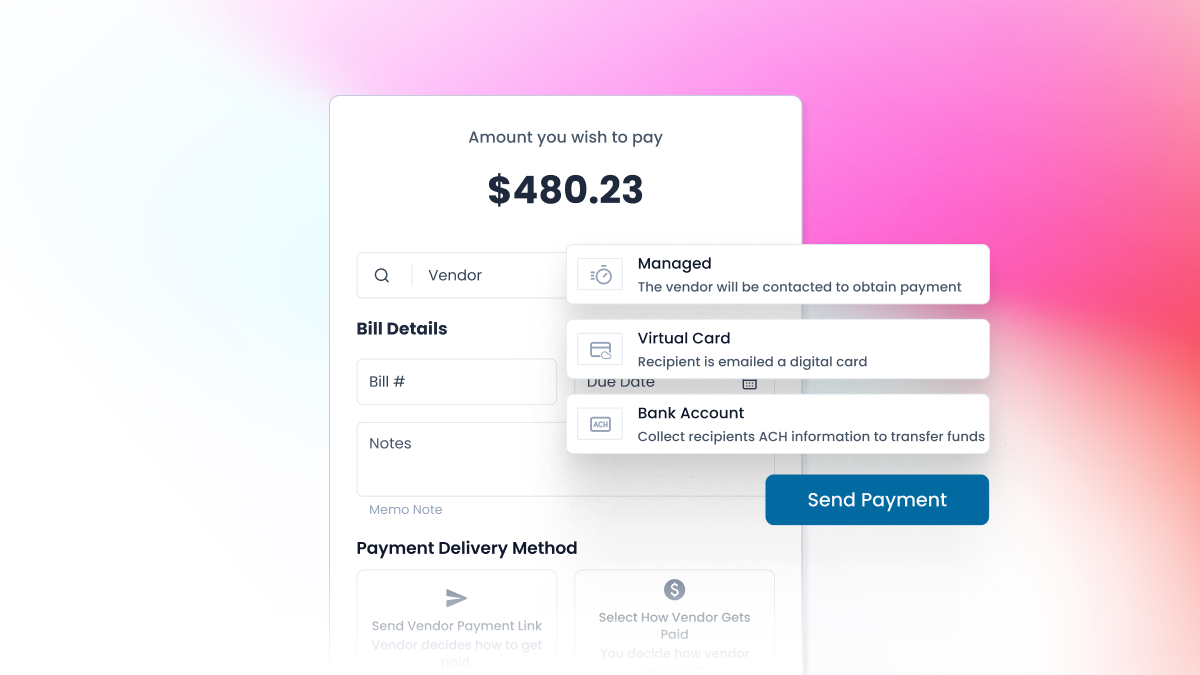
Vendor Payment Links flip the model. Instead of your merchants chasing vendors for details, each vendor receives a single, secure link that handles data collection and disbursement in one interaction.

Step 1: A merchant approves a bill inside your platform, triggering a payment link to the vendor.

Step 2: The vendor receives a branded email with a secure payment link. Branding is configurable at the merchant or platform level; Payabli remains invisible.

Step 3: The vendor opens the link and selects a preferred payment method on a clean, hosted page – no account to create and no back-and-forth.

Step 4: Funds are disbursed automatically. The vendor’s payment preference is tokenized and stored, so future payouts happen without another link.

That final step is where the value compounds. Every link interaction builds a tokenized payment profile for the vendor: the first payment requires the link, and every payment after that is fully automated using stored credentials.

What can be configured

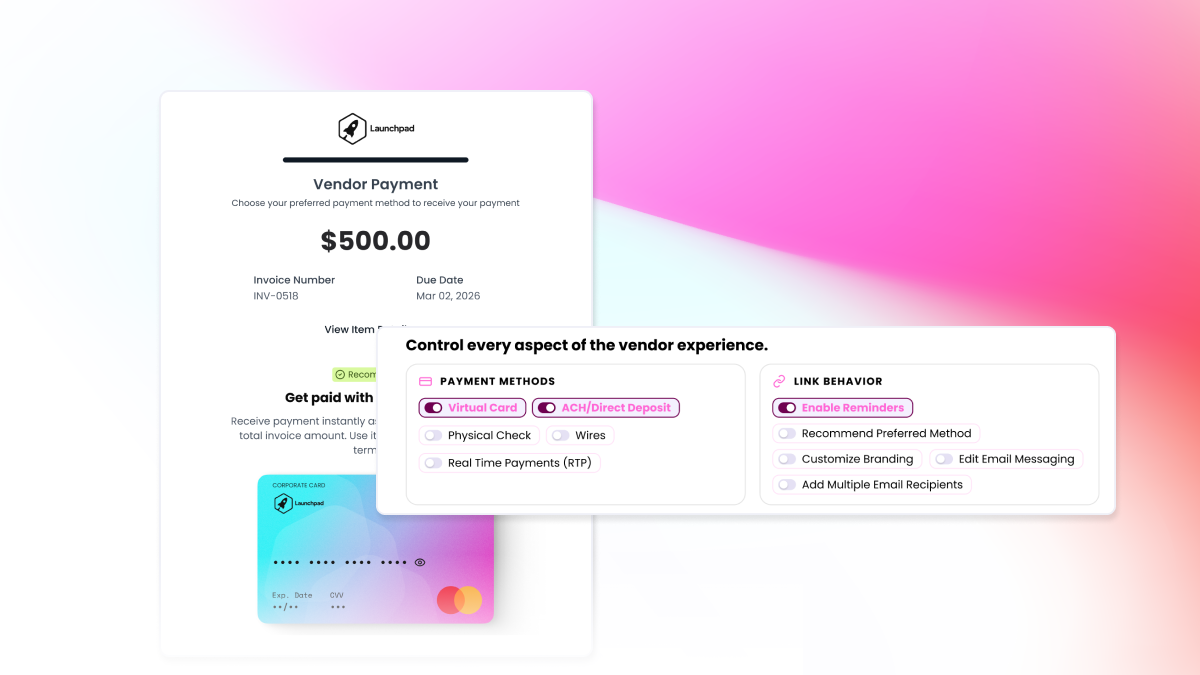
Vendor Payment Links give platforms and merchants granular control over the vendor experience, including which payment rails are offered and how each link behaves.

Payment methods are configurable per vendor or per link. Platforms can offer any combination of virtual cards, ACH/direct deposit, physical checks, wire transfers, and real-time payments (RTP), and can set a recommended default – useful for steering vendors toward virtual cards, where high interchange revenue flows back to your platform.

Link behavior is equally flexible. Merchants can enable automatic reminders for incomplete links, customize the branded email, add multiple recipients per vendor, and tailor the payment page to match their business’s look and feel.

Why this matters for platform economics

Every payment stuck in a manual chase is a payment that doesn’t move through your rails, and every payment that doesn’t move through your rails is revenue your platform is missing out on.

Vendor Payment Links remove the bottleneck entirely. When enrollment is self-service, more payments move through your rails, and more volume becomes revenue – through interchange sharing on virtual cards, markup on ACH, RTP, wire, and check fees, or simply stronger merchant retention because your payables product works end to end.

The option to recommend a preferred method also gives platforms a subtle but powerful lever. Defaulting to virtual cards, for example, steers volume toward the rail with the strongest revenue share without forcing the vendor’s hand. They still choose; you simply make the highest-value option the easiest to select.

The operational impact

Beyond revenue, Vendor Payment Links remove the operational drag of manually collecting and managing vendor payment details.

Fewer manual touchpoints. Rather than reaching out to each vendor and waiting for a reply, AP teams let vendors self-select their payment method through a secure link. Outreach happens once, automatically.

Higher data quality. When vendors enter their own verified details, merchants no longer key in bank information by hand, which means fewer failed payouts.

Healthier vendor relationships. Vendors who get paid quickly keep delivering without disruption. The link experience removes payment friction, so a slow payout never strains the relationship or stalls the service your merchants are counting on.

Vendor enablement that scales. Traditional enablement requires teams to call each vendor individually. That works for smaller portfolios but breaks down across hundreds or thousands of payments. Vendor Payment Links let vendors enroll themselves, with no outreach required.

Stored credentials remove repeat friction. After the first interaction, the vendor’s payment method is securely tokenized on their record, and future payouts reference it automatically. Platforms and merchants can set a default method per vendor so payouts flow without manual intervention.

Where Vendor Payment Links fit in the payables stack

Vendor Payment Links aren’t a standalone product – they’re the self-service collection layer that optimizes the rest of your embedded payables strategy. They give merchants and vendors a frictionless way to exchange payment details without phone calls, manual data entry, or a custom UI, so your platform can scale payouts without scaling manual effort.

Combined with Payabli’s broader Pay Out capabilities – bill management, approval workflows, AI-powered vendor enrichment, ghost cards for recurring vendor spend, and configurable funding models – Vendor Payment Links close the last-mile gap between “bill approved” and “vendor paid.”

Ready to eliminate the vendor payment chase? See how Vendor Payment Links fit into your embedded payables strategy at payabli.com/demo

Hosted vs. Embedded vs. API: Which Payments Model Fits Your SaaS Platform?

When it comes to embedded payments, one size never fits all. Every vertical SaaS platform has different technical capabilities, operational resources, growth timelines, and revenue goals. That’s why Payabli built our partnership approach around a single commitment: meeting you exactly where you are and growing with you from there.

Whether you’re launching your first payment feature or operating a full-stack payments business, Payabli gives you three paths to embedded payments – and the freedom to mix and match across all of them.

Embedded Payments Infrastructure Built for Where You Are – and Where You’re Going

Payabli’s embedded payments infrastructure is designed around how vertical SaaS platforms actually grow – not how a rigid vendor wants you to buy. You choose how you start, how deep you go, and how fast you move. And no matter which path you’re on, Payabli’s white-label solutions keep your brand front and center, so payments always feel native to your product.

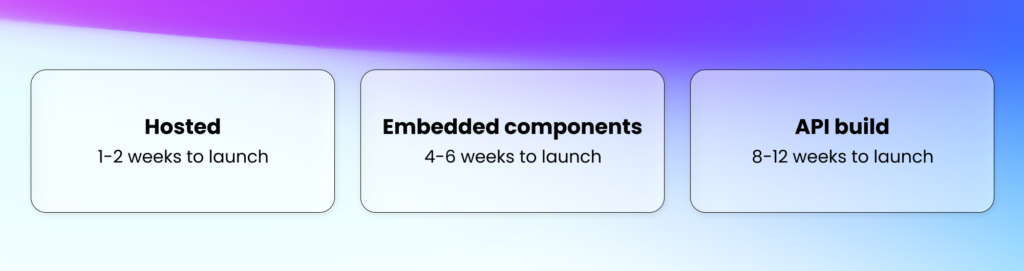
1. Hosted Solution: Launch in 1-2 Weeks with Minimal Lift

The goal: Go live fast with zero dev work and immediate revenue.

This is the fastest path to embedded payments – little to no engineering sprint required. With Payabli’s hosted solution, your customers click “pay,” land on a hosted payment page, and return to your platform. Simple, proven, live this month.

With Payabli, you can go live using:

  • Pre-built, hosted payment and onboarding forms that require minimal developer effort
  • White-label experience that keeps your brand front and center
  • Payabli-managed operations, including underwriting, onboarding, risk, and support – including end-to-end merchant support, so your team stays focused on your core product, not payment tickets
  • Start making money on payments immediately

You don’t need a payments team or a deep technical build. Plug in, go live, and start generating revenue while validating product-market fit.

Built for: Early-stage SaaS platforms, lean engineering teams, or any platform that wants to prove the payments opportunity before committing to deeper integration.

2. Embedded Components: Go Deeper & Gain Independence in 4-6 Weeks

The goal: Payments that live inside your platform – faster than a full custom build. Begin to take on more operational ownership at your own pace.

Once you’ve validated demand and built confidence in operating payments, embeddable components enable you to embed Payabli’s capabilities more deeply into your platform – making payments feel truly native to your product.

What this enables:

  • Payment widget, reporting, and boarding – easily enabled via no-code or low-code embedded components
  • Looks and behaves like you built it from scratch
  • Mix managed and self-service operations, handling some functions yourself while Payabli supports others
  • Tailor workflows around your industry’s specific needs
  • Enable more advanced features like custom pricing models, enhanced reporting, or additional payment methods

You get the native feel of a custom build at a fraction of the time and effort – a sweet spot between speed and sophistication.

Built for: Scaling SaaS platforms ready to differentiate their payments experience and develop operational muscle.

3. API Build: Full Control in 8-12 Weeks

The goal: Build the exact payment experience you want, with complete control over every detail.

For platforms ready to operate like a sophisticated payments business, Payabli’s API-first infrastructure gives you everything you need to run a full-stack payments operation. Every touchpoint, exactly as you designed it. 

What’s included:

  • Set and manage your own underwriting criteria
  • Operate your own risk program with granular controls
  • Build fully custom onboarding and servicing workflows
  • Own pricing, economics, and merchant lifecycle management
  • Automate end-to-end operations with deep technical integrations
  • Deliver a fully white-labeled payments experience from start to finish

You’re not just offering payments – you’re running a PayFac-level operation that drives significant value for your platform and your customers.

Built for: Mature SaaS platforms with dedicated payments teams treating payments as a strategic revenue driver.

The Real Differentiator: Mix, Match, and Scale

What makes Payabli unique isn’t any prescribed sequence – it’s that you can move fluidly between them, mix capabilities across them, and shift your approach as your business evolves. No rigid tiers. No outgrowing your provider.

With Payabli, you can:

  • Move at whatever pace makes sense for your platform
  • Mix and match capabilities – start with hosted, layer in embedded components, graduate to API when you’re ready
  • Shift operational responsibilities to your team or back to Payabli as your needs change
  • Choose your customer support model – let Payabli handle merchant support communications end-to-end while you own the merchant communication directly, or operate like a PayFac with Payabli behind the scenes while you own the merchant relationship directly
  • Scale without ever needing to re-platform

As Aaron Vela, Payabli’s Account Executive, puts it: “We align with you on service, operations, and technology all along the way. Whether you want to start small and scale gradually, or move quickly with advanced capabilities, our platform and team are designed to meet you exactly where you are.”

That flexibility isn’t a feature – it’s the foundation.

Why This Matters for Vertical SaaS: The Payments Platform You’ll Never Outgrow

Most payment infrastructure providers force a choice: oversimplified tools that cap your potential, or complex enterprise platforms that demand massive upfront resources. With With Payabli, you don’t have to choose – and more importantly, you never have to choose again.

There’s no ceiling on what you can build. No exit ramp that forces a costly re-platform when you scale. No tier upgrade that holds your next feature hostage. You launch at whatever stage makes sense for your business today, and the infrastructure grows with you.

You can:

  • Launch quickly without sacrificing future sophistication
  • Prove the payments opportunity before committing significant resources
  • Scale your investment in payments alongside your platform’s growth
  • Maintain full optionality to shift your approach as your business evolves
  • Never outgrow your provider – Payabli grows with you from day one

What the Vertical SaaS Journey Often Looks Like

Every SaaS platform is different, but here’s a common progression to revenue generation:

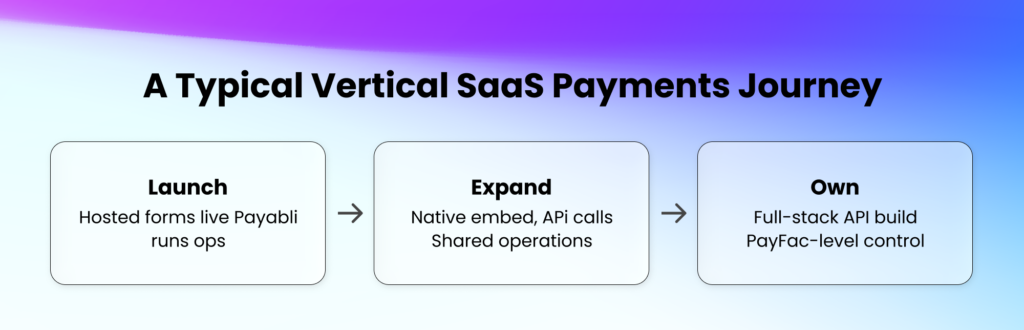
Months 1–6: Go live with hosted onboarding and payment forms. Payabli manages underwriting, support, and risk. You prove that customers want embedded payments and early revenue starts flowing.

Months 6–12: Integrate via API for deeper customization. Embed more workflows natively. Take on select operational tasks. Adopt new tender types, pricing models, or reporting tools.

Months 12+: Own risk, underwriting, and pricing end-to-end. Build tailored experiences for different merchant segments. Scale with fully automated workflows. Operate a full-stack payments business powered by Payabli’s APIs.

The pace and path are always yours to define. When the infrastructure doesn’t hold you back, there’s no limit to how fast you can grow:

“With Payabli’s simple APIs and Pay Out capabilities, we launched a payment solution for our end clients in record time, enabling us to facilitate millions of dollars in payments each month. Bringing an Accounts Payable product online has transformed our business — expanding into new markets, evolving into a fintech leader, and achieving more payment volume this year than all of last year combined.” – Aditya Kaddu, CEO and Founder at EdStruments

Ready to Start?

You don’t need a fully formed payments strategy to begin working with Payabli. You just need to take the first step. Whether you want to launch fast, go deep, or take full control (or start somewhere in between) – Payabli has the infrastructure, partnership, and flexibility to meet you there.

Schedule a demo and let’s talk about where you are today, and where you want to go on your embedded payments journey.

Embedded Payables for SaaS Platforms: A Guide

embedded payables

Key takeaways

  • Embedded payables let vertical SaaS platforms run automated vendor payouts inside their product, turning every outbound payment into a revenue stream for the platform and a faster, fully branded payout for the software customer.
  • B2B ACH (electronic bank-to-bank payments) volume grew nearly 10% in 2025, with close to 8.1 billion B2B payments as businesses continue moving away from paper checks. That volume is the wave that embedded payables ride.
  • A single API that covers payment acceptance, accounts payable, and payment operations keeps margin, data, and reconciliation under one roof, so adding accounts payable later does not mean onboarding a second vendor or rebuilding your reporting layer.
  • Owning the outbound side gives the platform a complete view of money flowing through the software customer’s business — in and out — in one place.

Embedded payables let vertical SaaS platforms earn on the money their software customers send out, not just the money they collect. Vendor and subcontractor payouts still run through bank portals, AP tools, and paper checks that the platform never sees. This guide covers how the model works, what platforms earn on each rail, and what to evaluate in a partner.

What are embedded payables for a SaaS platform?

Embedded payables are vendor disbursements that run inside your SaaS product instead of outside it. The software customer approves a bill, the system pays the vendor through the rail the vendor prefers, and the platform earns on the transaction. The per-transaction margin, the vendor data, and the workflow all stay with the platform instead of routing to a third-party tool.

This is the half of embedded B2B payments that most vertical SaaS platforms have not yet captured. Acceptance (Pay In) was the obvious first move because software customers were already collecting money. Payouts are where the software customer’s weekly workflow actually lives, which is exactly why owning them changes the platform’s relationship with its customer.

Where embedded payables show up in a vertical SaaS workflow

The pattern is the same across need-to-pay verticals, just with different vendors at the end of the line. A property management platform pays HOA service vendors and association contractors. A construction platform pays subcontractors and material suppliers on weekly draw schedules. A utility billing or field service platform pays the technicians and crews completing the work order. In every case, the payout sits one click away from the workflow the software customer is already using, and the mechanics behind that one click are what turn it into platform revenue.

How do automated vendor payouts work for SaaS?

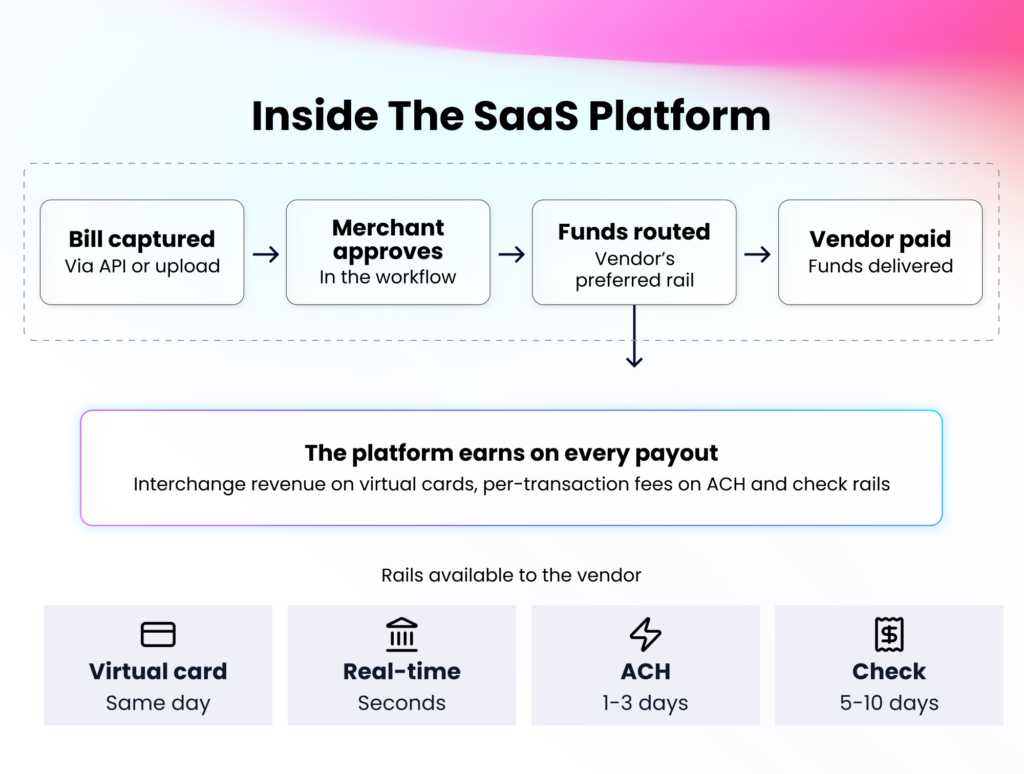
A bill enters the system, the software customer approves it, the payment routes through the vendor’s preferred method, and the data posts back to your platform with full remittance details. One API handles the money movement, webhooks fire at each status change, and the activity flows into the same reporting as your acceptance side.

Embedded payables flow for SaaS platforms: bill, approval, vendor payout across virtual card, ACH, real-time, and check rails, with platform revenue on every transaction.

How does money move from your platform to a vendor or subcontractor?

Funds debited from the software customer’s bank account move through whichever rail the vendor accepts (virtual card, ACH, check, RTP, and wire transfers), and settle to the vendor through the partner’s custodial account. ACH (Automated Clearing House) is the bank-to-bank network most vendor payments still ride on. The software customer sees the same status the platform sees, in near real time, without leaving your product.

What payment methods can vendors actually receive?

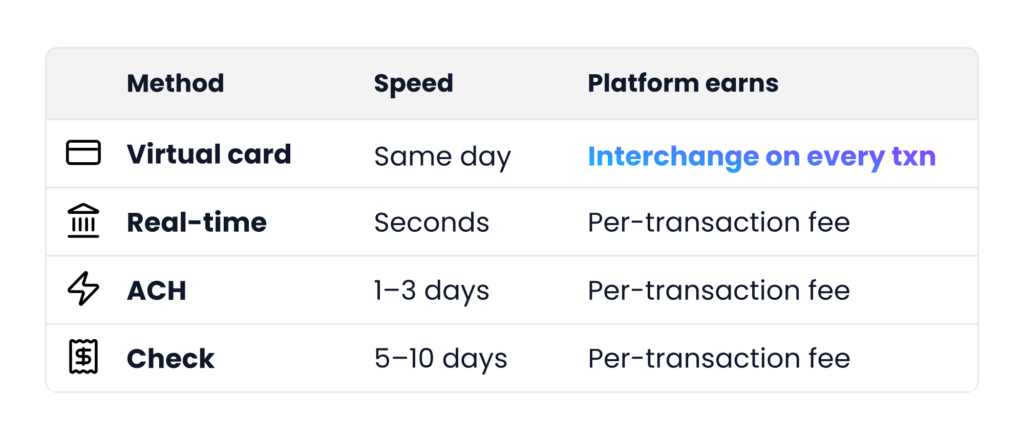
Vendors can be paid through five rails, each with a different speed and platform revenue:

endor payout rails
Alt text: Table comparing vendor payout rails for SaaS platforms across speed and platform revenue: paper check, ACH, virtual card, and real-time payments.

The shift toward digital rails is well underway. According to Nacha, B2B check usage fell from 81% in 2004 to 26% in 2024.

Virtual cards are digital card numbers issued for a single payment or vendor, and every transaction earns the platform interchange, a small percentage of the payment amount. For recurring vendors, Ghost Cards extend that earning model across the full year.

Who handles vendor enrollment and onboarding?

The embedded payments infrastructure partner runs vendor enablement through the product. Onboarding new payees is a configured workflow inside your software, not a manual process for your software customers or a support ticket for your team. Software customers focus on approving payments, not chasing banking details.

For situations where self-service makes more sense, Vendor Payment Links remove the enrollment step entirely. Your software customers send a secure link, the vendor enters their payment details, and funds are disbursed automatically. Collection and disbursement happen in one flow, with no portal to maintain and no enrollment to chase.

What are the benefits of embedded payables for SaaS platforms?

Four benefits drive the case for embedded payables: outbound revenue, stronger software customer retention, transaction data the platform owns, and a vendor experience under your brand.

1. Direct revenue on outbound volume

Every vendor payment earns the platform something. Virtual cards return interchange. ACH, checks, and instant payments return per-transaction fees. For most B2B software customers, outbound volume rivals inbound, which doubles the addressable revenue per customer.

2. Higher net revenue retention (NRR)

Approving bills, managing vendors, and reconciling payments are weekly tasks. When they run inside the software, the platform stops being a tool and becomes a workflow, which is what protects NRR.

3. Transaction data the platform owns

Every payout records which vendor was paid, when, on what terms, and through which rail. That dataset is what unlocks future products like cash flow forecasting, vendor scoring, and working capital.

4. A branded vendor touchpoint

Vendors get paid through the rail they prefer and see the platform’s brand on the remittance. The software customer looks more professional to their own vendors, and the platform’s brand reaches beyond its direct customer base.

What should you look for in an embedded payables solution?

The right embedded payables partner protects your margin, your brand, and your software customer relationship. Three questions cut to whether one fits.

Does it handle vendor enrollment without adding work to your team?

A strong partner runs vendor enablement inside the product, so onboarding new payees is a configured workflow rather than a manual lift for your software customers or a ticket queue for your support team. Enrollment is also where virtual card adoption is won or lost, because every vendor who never gets enrolled is a vendor who keeps getting paid by check, which is the lowest-margin rail on the stack.

Does it support the rails your vendors actually want?

Virtual cards earn the most, but vendors will still ask for ACH and checks. A solution that supports all three lets your platform earn across the full rail mix instead of forcing every vendor onto one method. Real-time payments and wire transfers are the next rail to evaluate, because instant settlement is becoming table stakes in verticals like construction and field service, and the platforms that support it earn on a transaction tier their competitors cannot match.

Does it cover payment acceptance and accounts payable on one stack?

If acceptance is already live, the accounts payable layer should plug into the same API, the same reporting, and the same reconciliation. Splitting them across two vendors fragments software customer pricing, doubles the engineering surface your team has to maintain, and leaves no single partner accountable when margin or reconciliation issues come up. The unified stack is also what makes future products like cash flow forecasting and working capital monetization possible, because both sides of the software customer’s money flow are sitting in one dataset under your control.

How to add embedded payables to your SaaS platform

The integration choice shapes how fast you ship and how much engineering you spend doing it. The right path depends on engineering bandwidth, brand control needs, and how fast you want to start earning on outbound volume.

What integration options can you choose from?

Embedded payables ship through multiple integration paths, ranging from fully custom API builds to prebuilt, ready-to-launch options. Each varies in time to launch, level of UX control, and the engineering investment required. Your provider can walk you through the options that fit your team’s capacity and timeline.

Sunbound launched embedded payments with a single developer and one project manager in under two months and now processes over $1 billion in annual payment volume. For a deeper look at how to sequence the integration, see embedded payments best practices.

How do you pick the right path?

The answer is to pick the path that gets you to live software customers fastest, then upgrade later. Revenue on outbound volume only starts compounding once real payments are flowing, and waiting for a more complex build means months of forgone interchange. Most platforms that start lean ship significantly faster than the ones that try to build everything upfront.

What does your team focus on during rollout?

The provider handles compliance, sponsor banking, and risk monitoring. Your team focuses on the product decisions: who can approve payments, how funds are sourced, what the vendor experience should look like, and how reporting surfaces inside your existing dashboards. Most rollouts run on a weekly cadence with the partner during the build phase, then taper to monthly check-ins once the integration is live and software customers are flowing through.

How Payabli turns vendor payouts into a revenue stream for SaaS

Payabli offers payment infrastructure and monetization for vertical SaaS platforms. Our Pay In / Pay Out / Pay Ops framework unifies payment acceptance, accounts payable, and payment operations under a single API, so platforms capture both sides of their software customers’ money flow without managing multiple vendors or rebuilding their reporting layer.

Virtual cards, ACH, checks, real-time payments, and wire transfers are embedded alongside acceptance flows on the same integration. Vendor enablement, invoice intake, and configurable approval workflows are built in, so software customers see a polished, fully branded product from day one.

Vertical SaaS platforms in property management, construction, utilities, education, and government use Payabli to turn vendor payouts into platform revenue.

If you are mapping where embedded payables fit on your roadmap, book a demo to see what your platform’s payout volume could earn.

IVR Payments for Vertical SaaS: A Pay-by-Phone Guide 

IVR phone payments

Key takeaways:

  • Without IVR payments, vertical SaaS platforms miss a major revenue channel. Payment-related calls can account for roughly half of inbound call volume in many businesses. Adding IVR captures those transactions, cuts merchant costs, and deepens platform stickiness.
  • IVR payments let customers pay by phone through an automated system using their keypad or voice prompts, with no live agent required and 24/7 availability.
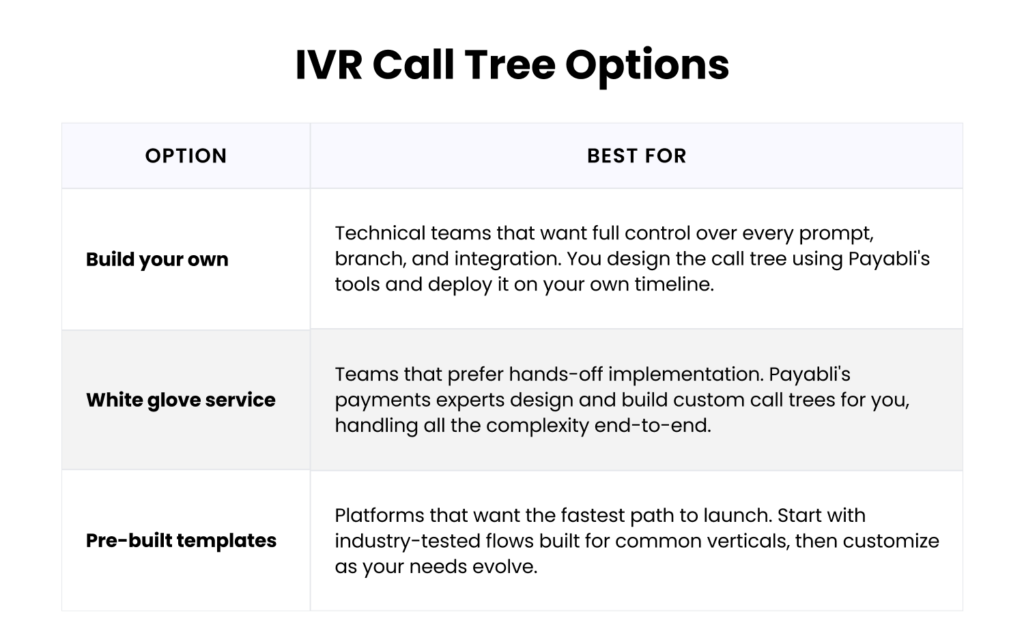
  • Call trees are the branching logic that shape each caller’s experience. With Payabli, platforms can build their own, use white-glove design services, or launch from pre-built industry templates.
  • Adding IVR alongside digital channels creates omnichannel payment coverage, which correlates with stronger merchant retention.

Most vertical SaaS platforms building embedded payments focus exclusively on digital channels like web, mobile, and payment links. But here’s what they’re missing: in many businesses, payment-related calls account for around 50% of inbound call center volume.

This represents a massive opportunity. Adding IVR payments lets you capture transaction volume competitors miss, reduce merchant operational costs, and create deeper platform integration that drives retention.

But what exactly are IVR payments? How do call trees guide the customer experience? And why do they create such powerful switching barriers for SaaS platforms chasing embedded payments revenue

In this article, we explain what IVR payments are, how call trees guide the customer experience, and the strategic benefits for your platform.

What are IVR payments?

Interactive Voice Response (IVR) payments let customers make secure credit card and ACH payments over the phone using an automated system, with no live agent required. Customers call a secure phone number, follow voice prompts, or use their keypad to enter payment information, and receive instant confirmation.

Think of it as a virtual terminal that customers operate themselves through their phone, available 24/7/365. Because the caller enters card data directly via DTMF tones, no agent ever sees or hears the details, which helps platforms reduce their PCI DSS compliance scope.

The flow is simple:

  1. Customer calls the merchant’s payment line.
  2. The automated system prompts for payment details (amount, account number, card info).
  3. Customer enters information via keypad or voice prompt.
  4. Payment processes in real time.
  5. Customer receives instant confirmation.

The entire interaction runs through your SaaS platform’s payment infrastructure, with IVR calling your existing APIs to validate accounts and retrieve balances, and uses the same Payabli APIs, reporting dashboard, and compliance standards as your other payment channels.

How do IVR call trees work for vertical SaaS? 

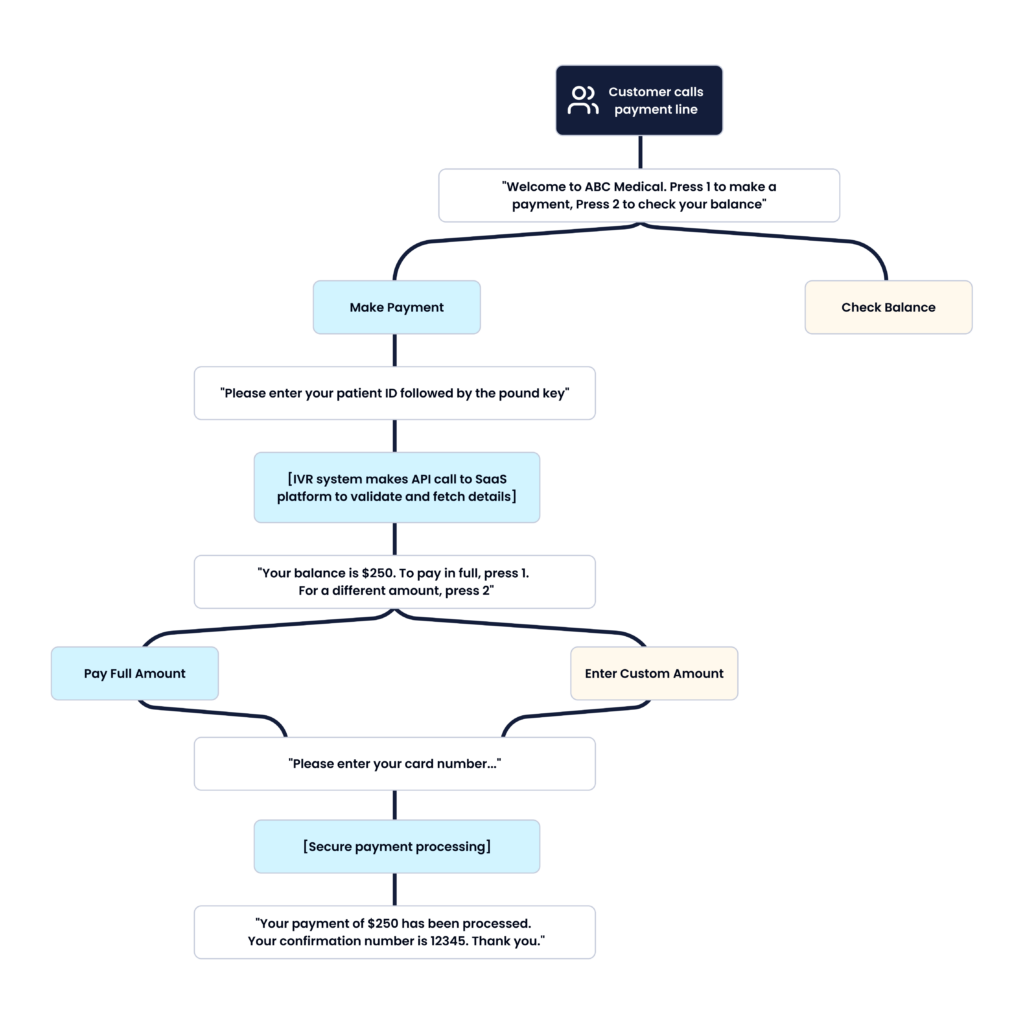
A call tree is the branching logic that guides customers through the IVR payment experience. It’s like a flowchart for phone interactions where each prompt leads to different paths based on what the customer selects.

IVR Call Tree Options

Call trees can be simple (straight to payment) or complex (account lookup, payment options, balance inquiries). The good news? With Payabli, you have options:

IVR call tree comparison for vertical SaaS: build your own, white glove service, or pre-built Payabli templates for pay-by-phone payments.

Whichever path fits, most platforms go live in weeks, not months. And for teams that want to skip code entirely, Payabli Creator handles it. 

Example IVR call tree for a medical practice

The beauty of IVR call trees is their flexibility. They adapt to your merchants’ specific workflows, terminology, and customer needs. Here’s an example: 

Why do IVR payments matter for vertical SaaS? 

Adding IVR to your embedded payments offering is not just about giving merchants another channel. It drives measurable impact across revenue, retention, and operational efficiency. 

1. Create a new revenue stream

IVR transactions generate higher margins than standard payment processing. You set the service fees (typically per transaction fee, monthly platform fee per phone number, or both) and capture that revenue directly.

These fees are easy to justify with immediate merchant ROI:

  • Eliminate staff costs for manually processing phone payments
  • Reduce support calls by 20-30%
  • Provide 24/7 payment acceptance without adding headcount
  • Accelerate collections and improve cash flow

2. Deploy quickly without engineering burden

IVR integrates through the same Payabli API as your other payment channels. No separate phone system builds, no phone provider registrations, and no ongoing maintenance teams. Payabli provides a complete, production-ready solution so you can focus on your core product.

3. Create switching barriers

Merchants using multiple payment channels through your platform are exponentially stickier. When you’ve automated their phone payments and integrated with their workflows through your software, switching costs skyrocket. Companies with strong omnichannel customer engagement strategies retain 89% of their customers on average, compared to 33% for companies with weak engagement.

4. Unlock high-value vertical use cases

Payabli’s configurable IVR integration enables powerful automation across need-to-pay verticals:

  • Streamline invoice collection: Law firms let clients pay retainers and outstanding invoices immediately without waiting for mailed checks.
  • On-time payments: Homeowners and renters can pay HOA dues or rent by phone from anywhere, making it easier to submit payment before the due date and avoid late fees.
  • After-hours revenue: Field services can capture payment immediately when jobs finish outside business hours.
  • Self-service payments: Healthcare practices and service businesses let customers pay invoices on their schedule without waiting on hold.
  • 24/7 availability: Emergency services for urgent situations are available anytime without requiring staff.

Why vertical SaaS platforms choose Payabli for IVR payments 

In competitive vertical SaaS markets, success means understanding your merchants’ complete operational reality. IVR payments are not legacy technology. They are incremental revenue, reduced churn, and platform differentiation rolled into one capability.

The vertical SaaS platforms dominating embedded payments are not the ones with the flashiest checkout. They are the ones comprehensively solving how money moves 24/7 across every channel. Payabli’s unified payment infrastructure covers payment acceptance, accounts payable, and payment operations, giving you everything you need to be that platform.

Want to add IVR payments to your platform? Book a demo and we’ll walk you through it. 

Risk as UX: Turning Risk Management Into Better Merchant Experiences

Every vertical SaaS company faces the same challenge: balancing growth with trust. As you embed payments directly into your platform, how you manage risk and fraud detection isn’t just a compliance concern – it’s a strategic choice that shapes your user experience.

When risk management becomes part of your embedded payments experience – not a barrier to it – everything accelerates. Onboarding moves faster. Merchants activate sooner. Platforms build lasting trust.

At Payabli, we believe risk is not a cost center – it’s an intelligence layer that fuels confident growth.

Our Pay Ops technology turns that intelligence into a competitive advantage – making risk visible, configurable, and actionable across the entire embedded payments journey, from onboarding to payment acceptance.

From Rules to Models: The Evolution of Risk Management

Most payment fraud detection systems start with static, rules-based monitoring – velocity checks, blocklists, or simple IP/geographic flags. Useful, but blunt. Modern risk management strategies require more intelligence.

Our Pay Ops solutions take that foundation and layers in machine learning–driven risk scoring, contextual policy orchestration, and agentic automation to transform risk from a reactive process into a proactive experience layer.

This proactive approach starts the moment a merchant within your platform signs up. By embedding intelligent risk evaluation into onboarding, SaaS platforms can verify, segment, and activate merchants confidently – minimizing fraud while maximizing flow.

Beyond Transactions: Risk Management Strategies Across the Full Merchant Lifecycle

True risk management extends far beyond authorization. Payabli embeds intelligence into every stage to facilitate continuous protection for platforms that feels seamless:

Onboarding & Underwriting: Dynamically verify business data and flag risk factors in real time. Adaptive pathways fast-track trusted merchants while escalating suspicious cases for review.

Transaction Monitoring: ML-powered scoring synthesizes velocity, geo-location, and behavioral signals into explainable risk scores that dynamically approve, hold, or block.

Payout Controls: Volume-based rules monitor ACH exposure. If payouts exceed thresholds, the system holds funds or triggers review – protecting platforms without disrupting cash flow.

Continuous Merchant Intelligence: Continuous monitoring tracks chargebacks, refunds, and exposure trends. When patterns shift, automated triggers adjust rules or prompt re-underwriting.

Together, these capabilities transform your SaaS platform into a full-lifecycle risk system – one that turns risk management into a competitive advantage by aligning it directly with user experience. 

Rules Engine, Reimagined

At Payabli, we’ve built a powerful orchestration engine that allows multiple outcomes – alert, hold, block – for every transaction. Instead of rigid “yes/no” logic, our risk model dynamically adapts to behavior, generating explainable transaction records for every decision.

That same flexibility applies during the merchant onboarding process. Risk signals inform adaptive pathways: fast-tracking trusted merchants for quick approval while automatically escalating suspicious cases for review. 

The result? Smarter protection that feels invisible. This is “Risk as UX” in action, providing protection that works quietly behind the scenes.

Customizable Risk & Onboarding Policies

Every vertical SaaS platform operates differently. Payabli lets SaaS platforms define risk and onboarding policies at the organization or merchant level – tightening controls for new or high-risk accounts while allowing flexibility for established, trusted merchants.

This contextual control transforms what’s often seen as friction into a feature. Merchants feel seen and understood, while SaaS platforms maintain the guardrails that keep ecosystems healthy. Risk and experience move in sync.

Make Smarter Decisions with Risk Scores: Context You Can Act On

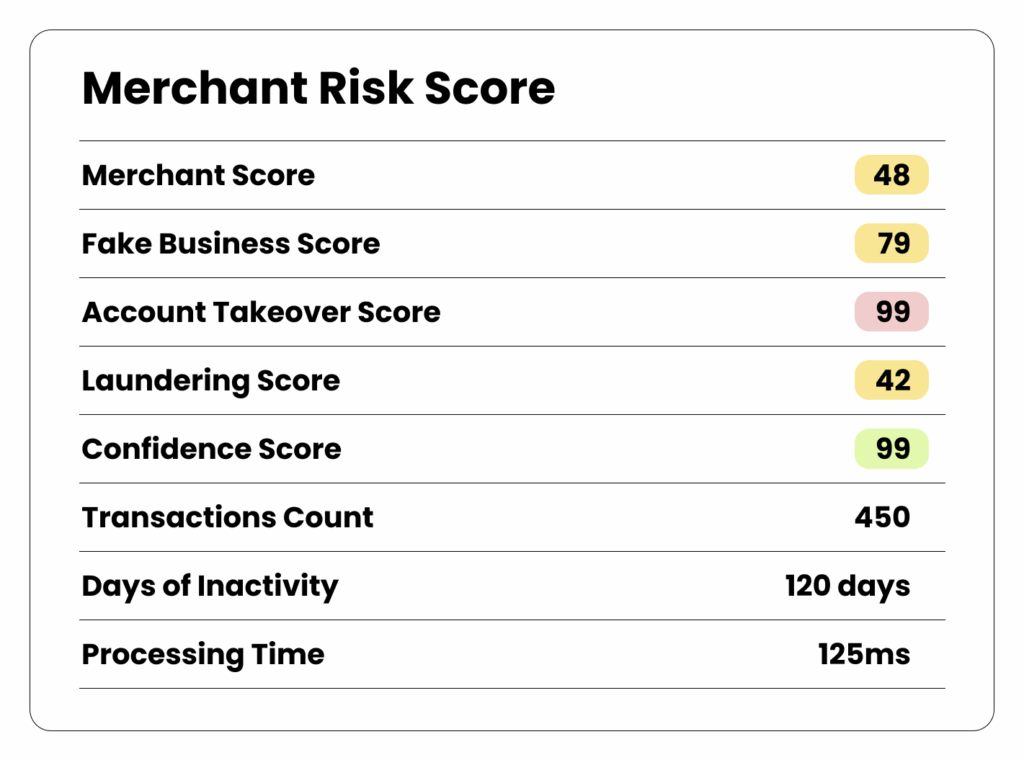
At the heart of our Payment Operations platform (Pay Ops) is our Risk Scoring Model, an advanced payment fraud detection engine that generates merchant scores and per-transaction scores to quantify potential fraud or loss.

This risk scoring approach is built from multiple layers of intelligence:

  • Transaction patterns (velocity, frequency, amount anomalies)
  • Merchant-level history (chargebacks, refunds, exposure trends)
  • Device and location signals (geo mismatch, IP diversity)
  • Behavioral and vertical data unique to each merchant’s industry

The result is an explainable, transparent score – not a black box. SaaS platforms can view sub-scores for AML risk, transaction anomalies, and fraud probability, with clear reasoning behind each outcome.

Transparency here is UX. When merchants understand why they’re being verified or approved, it builds confidence and reduces drop-off – turning compliance moments into trust moments.

Today, Payabli’s teams are shadow-scoring all transactions internally – a step toward offering these insights directly to SaaS platforms managing their own exposure and onboarding workflows.

AI-Powered Policy Creation and Triage

Managing risk across hundreds of merchants can overwhelm even the best teams – but when risk intelligence is automated, it becomes part of the experience rather than an interruption.

Payabli’s AI-driven agents continuously monitor and triage fraud alerts in real time. When potential card-testing events occur, these agents:

  • Cluster related alerts
  • Detect patterns (multiple BINs, IP variations, timing spikes)
  • Surface summarized context directly in Slack
  • Recommend actions like “hold,” “review,” or “safe to ignore”

This turns a flood of alerts into one intelligent conversation – letting human reviewers focus on what matters most. In practice, that means fewer interruptions, faster decisions, and a more seamless merchant experience from onboarding to payment acceptance.

Building the Next Layer: Risk Management as a Product

In many ways, Payabli has built its own version of Stripe Radar – but purpose-built for vertical SaaS platforms. Because our Pay Ops infrastructure is modular, platforms can decide how deeply to integrate the risk layer:

  • Base: Internal risk monitoring and fraud alerts
  • Advanced: Per-transaction risk scores and custom rule policies
  • Enterprise: Co-managed risk operations and AI-driven triage

Over time, these capabilities don’t just reduce losses – they unlock new revenue. Vertical SaaS platforms can monetize advanced merchant monitoring, loss liability protection, or transaction scoring, using Pay Ops as the engine behind it all.

Why It Matters for Vertical SaaS Platforms

Owning the full payments experience means owning the risk that comes with it – but also the trust it creates. When risk management is designed as part of the user experience, SaaS platforms can:

  • Onboard merchants faster with confidence
  • Reduce fraud losses without adding friction
  • Protect merchants through explainable, real-time risk data
  • Automate reviews to keep workflows smooth
  • Build trust through transparency and control
  • Monetize operational intelligence as a premium service

This is the future of risk management – invisible infrastructure that quietly powers exceptional experiences.

Let’s Build Your Risk Management Strategy Together

The next generation of vertical SaaS platforms will win not just by managing risk – but by embedding it into the user experience. Payabli helps you transform compliance into confidence and risk operations into growth levers. If you’re building the future of embedded payments, we’d love to help. Schedule a demo to start shaping your risk management strategy today.

Ghost Cards: Turn Vendor Payouts Into Your SaaS Platform’s Highest-Margin Revenue Stream

For Vertical SaaS Platforms powering embedded payments, Ghost Cards are emerging as a powerful solution to an often-overlooked challenge – the Pay Out side of the equation. While many platforms obsess over Pay In optimization—perfecting card acceptance, reducing friction, and maximizing conversion—vendor payouts frequently remain manual, fragmented, and inefficient. Ghost Cards streamline this process, unlocking automation, control, and scalability on the Pay Out side that matches the sophistication of Pay In.

But as platforms scale, this oversight becomes costly.

Fragmented payout processes create friction that frustrates customers and erodes trust:

  • Critical payments missed or delayed due to manual vendor setup errors – One data entry mistake means a contractor doesn’t get paid on time, jeopardizing your customer’s relationship with their supplier.
  • Card-on-file vendors won’t accept ACH or checks – Some vendors only accept card payments, forcing your customers to maintain multiple payment systems or lose access to preferred suppliers.
  • Payment rail mismatch sends checks or ACH to card-enabled vendors – Every mismatch between vendor preferences and your default rails creates friction, delays, and support overhead that drains resources.

These aren’t edge cases – they’re everyday realities that create support tickets, damage customer satisfaction, and leave revenue on the table.

What if you could eliminate these headaches while turning payouts into your platform’s highest-margin revenue stream?

That’s what Ghost Cards make possible.

What Are Ghost Cards?

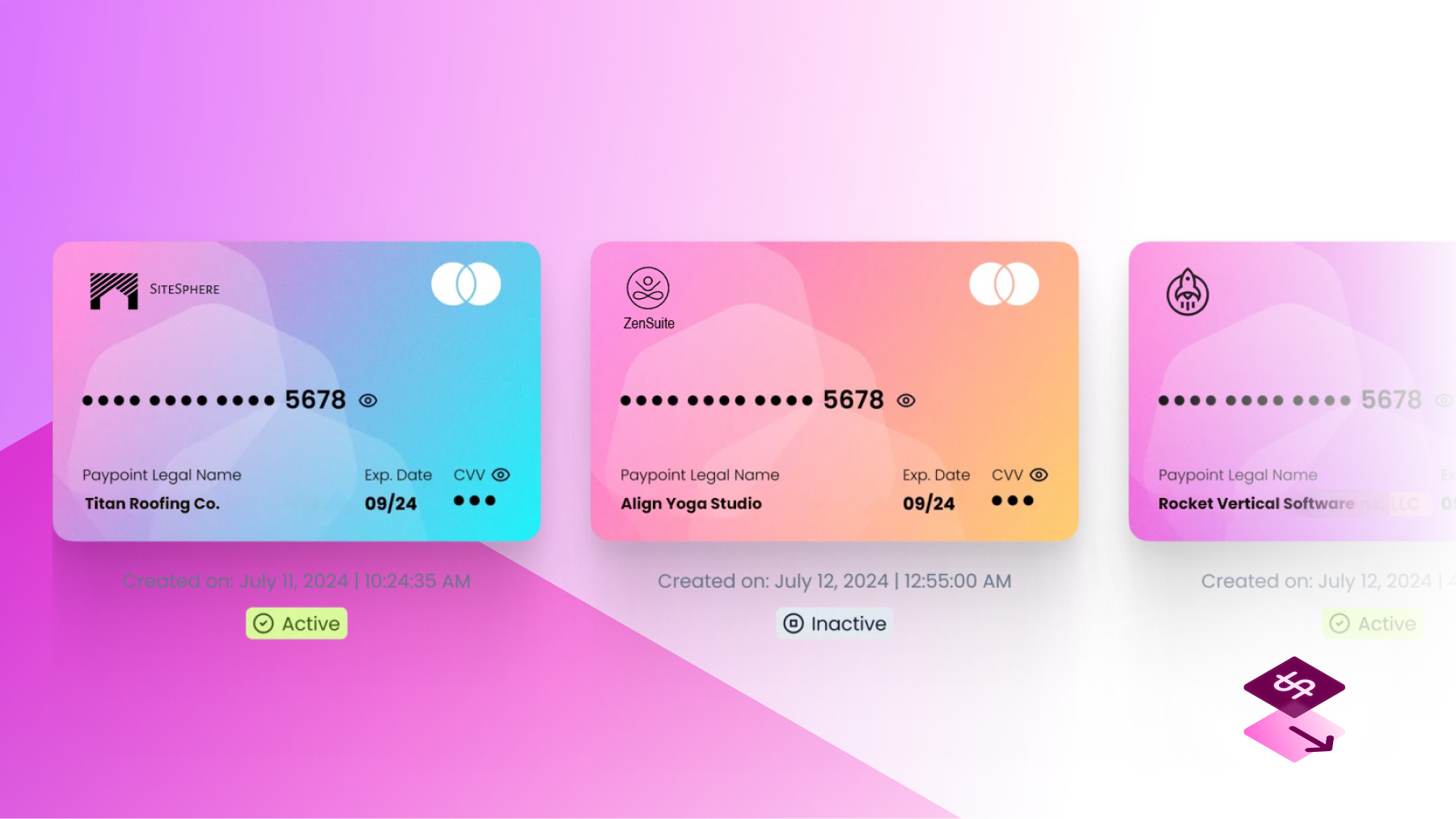
A Ghost Card is a multi-use virtual card issued to a vendor for ongoing payments. Unlike single-use virtual debit cards, Ghost Cards can be tied to specific vendor relationships – making them ideal for recurring invoices, supplier contracts, and repeat service providers.

They function like any traditional credit or debit card – only faster, safer, and fully digital.

In short: Ghost Cards let your platform issue one card per vendor, automating recurring payments while maintaining full control.

Why Ghost Cards Are a Game-Changer

Ghost Cards don’t just simplify how vendors get paid – they monetize the entire payout flow.

Because they operate on card rails, Ghost Cards generate significantly higher interchange revenue than ACH or check payments – often outperforming even your Pay In monetization.

But the advantages go beyond revenue:

  • Recurring & Multi-Use – One card per vendor makes paying repeat suppliers simple, automated, and efficient so that a critical payment (like a utility bill) is never missed.
  • Configurable Controls – Set spend limits, restrict merchant categories, and control expirations.
  • Instant Funding – Credit or good-funds models eliminate ACH delays.
  • White-Labeled – Brand every transaction with your platform’s logo.
  • Unified Reporting – Full visibility and reconciliation from your dashboard.

With Ghost Cards, platforms don’t just process payments – they control the entire payout experience.

Ghost Cards vs. Virtual Debit Cards

CategoryVirtual Cards (Single-Use)Ghost Cards (Multi-Use)
UsageOne-off vendor paymentsRecurring vendor relationships
ControlBasic (single transaction)Advanced (limits, MCC, expirations)
Vendor ExperienceOne card per paymentOne card for ongoing payments
ReconciliationHarder to match to invoicesEasier, tied to vendor account

Ghost Cards extend the capabilities of traditional single-use virtual cards – enabling automation, better visibility, and ongoing profitability.

Who Benefits Most from Ghost Cards

Ghost Cards are ideal for Vertical SaaS platforms serving industries that manage recurring vendor relationships and frequent supplier payments.

Use Cases:

  • HOA & Property Management – Pay recurring contractors like landscapers and maintenance crews.
  • Healthcare – Streamline payments to repeat suppliers for medical equipment and consumables.
  • Education – Issue recurring payments to transportation, IT, and facility vendors.
  • Field Services & Construction – Manage ongoing payments to subcontractors, materials suppliers, and rental companies.
  • And Many More – Any vertical with recurring vendor relationships benefits from Ghost Cards’ flexibility and control.

By simplifying these recurring payouts, Ghost Cards improve vendor satisfaction while driving consistent platform revenue.

Turn Recurring Payouts Into Recurring Profits

Ghost Cards give SaaS platforms a double advantage:

  • They empower businesses with faster, more secure vendor payments.
  • They unlock recurring, high-margin revenue from every payout – with significantly higher interchange revenue than ACH or check payments. 

Instead of handing off payouts to traditional banks or third-party processors, your platform becomes the hub for every transaction – earning more revenue while delivering a better vendor experience.

With Ghost Cards, payouts aren’t just a back-office process – they’re a growth engine.

Start Monetizing Vendor Payments Today

Ready to own your payout experience and maximize your revenue potential? Book a demo or talk to our team about Ghost Cards and start turning payouts into profit.

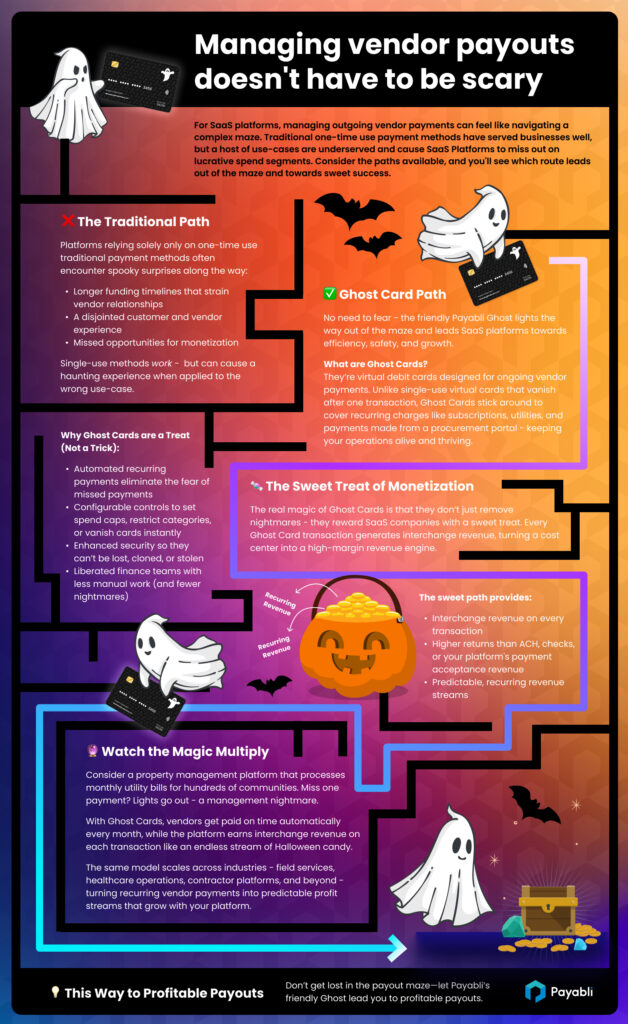
Escape the Haunted Maze of Vendor Payouts and Find the Sweet Path to Profitability with Payabli Ghost Cards

Managing vendor payouts is one of the most overlooked opportunities for SaaS platforms to drive profitability. The right payout strategy can transform operations, improve vendor relationships, and unlock new revenue streams – but only if you’re leveraging the full range of modern payment options available.

At Payabli, we offer comprehensive payout solutions to match your vertical SaaS platform’s unique needs – from traditional Virtual Card, ACH, check, and wire transfers for one-time payments, to our innovative Ghost Cards for recurring vendor payments.

Ghost Cards are multi-use, virtual debit cards specifically designed to automate ongoing vendor expenses while generating interchange revenue with every transaction. For SaaS platforms managing embedded payments, vendor disbursements, or supplier payouts, Ghost Cards turn what was once a cost center into a profitable revenue engine.

We created this fun, Halloween-themed infographic to help you navigate the payout maze. Every vertical SaaS platform faces the same choice: which payment method fits which use case? Traditional methods have their place, but for recurring vendor payments, Ghost Cards are the clear path to automation, enhanced controls, and meaningful monetization.

Download the infographic here.

Vendor Payouts: The Untapped Revenue Driver for SaaS

Vendor payouts aren’t a cost to manage – they’re a revenue opportunity to capture. By owning and monetizing payouts alongside payments, vertical SaaS companies can unlock new margins, deepen platform stickiness, and build durable competitive advantages.

Vendor payouts for SaaS platforms aren’t just an operational cost; they’re an untapped revenue opportunity. By owning and monetizing payouts alongside payments, vertical SaaS companies can unlock new margins, deepen platform stickiness, and build durable competitive advantages.

Most SaaS leaders obsess over how money flows in, optimizing checkout, reducing friction, and capturing every basis point of margin. But here’s the question few ask: are you leaving money on the table every time your platform sends money out to vendors?

When vendor payouts are treated as a back-office afterthought, outsourced through third parties and forgotten, a revenue stream quietly walks out the door. Every payout your platform processes is a transaction, and every transaction is a chance to capture margin, strengthen vendor relationships, and create a deeper competitive moat.

The SaaS platforms that recognize the power of embedded vendor payouts aren’t just cutting costs; they’re capturing new revenue streams, improving retention, and transforming how value flows through their ecosystems.

The Missed Opportunity Sitting in Plain Sight

Think about your vertical SaaS platform for a moment. You’ve built the central nervous system of an ecosystem – connecting buyers with sellers, customers with service providers, businesses with contractors. Money flows in when customers pay. But it also flows out when vendors get paid.

Most vertical SaaS companies have nailed the “Pay In” side – they’ve integrated payment processing, optimized checkout experiences, and captured the associated economics. But when it comes to “Pay Out“, the story is very different.  Most embedded payment providers don’t offer robust payout capabilities, if any at all – and most SaaS platforms haven’t even thought to ask for them.

This oversight in your payments strategy can come with significant costs: 

  • Missed revenue: Every payout is a transaction that could carry margin – often with higher returns than ACH, checks, or your platform’s payment acceptance revenue
  • Critical payments missed/delayed: Without reliable payout infrastructure, essential vendor payments can fail – meaning contractors don’t show up and suppliers cut off services. For your customers, unreliable payouts threaten operational continuity and their ability to keep the lights on.
  • Weakened user experience: Your customers expect seamless, modern payment experiences. Why shouldn’t your vendors? Disjointed payout processes create friction, reduce satisfaction, and weaken platform stickiness.
  • Loss of control: Managed payables limit flexibility in how and when payments are made, stripping SaaS platforms of valuable control in tailoring workflows to their verticals.

The bottom line? Every vendor payment is an opportunity to earn revenue, strengthen your platform, and deliver a better customer experience.

How Vendor Payments Actually Generate Revenue

Here’s what most SaaS leaders don’t realize: vendor payments aren’t just about moving money from Point A to Point B. They’re about how you move it – and each method carries its own revenue opportunity:

  1. Virtual CardsThe highest revenue generator.
    • Vendors are paid via a single-use, digital credit card number. SaaS platforms earn interchange revenue on these transactions, which can be significant. Virtual cards also deliver faster settlement and added security.
  2. ACH TransfersA balance of speed and cost.
    • ACH is often preferred for recurring vendor relationships. While margins are lower than virtual cards, SaaS platforms can still monetize ACH through per-transaction fees or premium options like same-day ACH.
  3. ChecksLegacy, but still relevant.
    •  Though less efficient, some vendors prefer checks. SaaS platforms can capture margin through check-issuance fees while meeting vendors where they are.

By offering all three methods – and capturing economics from each – you transform vendor payments from a cost center into a profit center. You generate new revenue from every dollar flowing out while giving vendors the flexibility, speed, and choice that builds loyalty.

Why Payabli Is Different

Most payment providers focus on one side of the transaction: Pay In or Pay Out. Even those that claim to do both typically treat payouts as an afterthought – just wiring funds, sending checks, or pushing an online payment – forcing SaaS platforms to give away both the economics and the experience.

Payabli was purpose-built to solve this. We unify Pay In, Pay Out, and Pay Ops under a single infrastructure stack, giving SaaS platforms full ownership of the transaction lifecycle:

  • Pay In:  Accept payments seamlessly across cards, ACH, and alternative methods with optimized conversion and modern checkout experiences.
  • Pay Out: Automated, streamlined disbursements to vendors and suppliers via virtual cards, ACH, and checks.
  • Pay Ops: The back-office intelligence that ties it all together, from reconciliation to reporting to compliance.

This unified approach doesn’t just simplify operations. It fundamentally changes your platform’s economics by letting you capture—and keep—margin on both sides of every transaction.

The SaaS Platforms That Will Win Tomorrow Are Monetizing Vendor Payments Today

The future of SaaS isn’t about building better workflow tools. It’s about becoming essential financial infrastructure. The platforms winning tomorrow won’t just help their users work—they’ll control how money moves through their entire ecosystem.

Vendor payments are how you make that shift.

When you own payouts, you’re not just adding a feature. You’re fundamentally changing your relationship with customers. You become the platform they can’t leave – because leaving means rebuilding their entire financial operation. That’s not stickiness. That’s gravity.

The question isn’t whether to own this opportunity. It’s whether you’ll act before your competitors do.

Ready To Turn Payouts Into Profit?

With Payabli, SaaS platforms finally have the infrastructure to monetize both sides of the transaction journey – turning what was once back-office plumbing into a powerful engine for growth. Book a demo today to learn how Payabli can help you capture the vendor payment opportunity before your competitors do.

Pay by SMS: The Easiest Way for Vertical SaaS Platforms to Boost Payments Revenue

In today’s competitive vertical SaaS landscape, platforms need more than just great features to win and keep customers — they need revenue-generating capabilities that create measurable impact. Pay by SMS is one of the fastest, most effective ways to do just that.

With Pay by SMS, merchants can send secure payment links directly to their customers’ phones via text message. Customers tap the link, review their invoice, and pay instantly — no logins, no apps, no unnecessary steps.

And for SaaS platforms, every fast, seamless payment means more processed volume — and more revenue.

Why Pay by SMS Is a Game-Changer for SaaS Platforms

1. Accelerate Payment Volume
When merchants get paid faster and more often, your platform processes more transactions. More transactions mean more revenue opportunities from payment processing.

2. Differentiate Your Platform
Pay by SMS adds a high-impact, mobile-first payment option that many embedded payment providers don’t offer. It’s an instant value-add for merchants who want to meet their customers where they are — on their phones.

3. Boost Merchant Retention
Merchants stick with solutions that help them get paid faster. Offering Pay by SMS gives them a reason to process payments through your platform instead of exploring alternative payment processors.

4. Simple, Flexible Deployment
Pay by SMS can be enabled quickly through Payabli’s API or embedded directly into your existing invoicing flow for minimal development effort and maximum revenue impact.

How Pay by SMS Works

  1. Send Payment Link – Merchants generate and send a secure payment link for an invoice via API or your platform’s UI.
  2. Customer Opt-In – If customers are opted in, they receive the SMS instantly. If not, Payabli automatically sends an email prompting them to enroll.
  3. Receive & Pay – Customers tap the link, review the invoice, and pay in seconds.

Value for Merchants, Revenue for You

When your merchants thrive, your platform grows. By connecting merchants and customers through Pay by SMS, you’re giving them a faster, simpler way to complete transactions — and creating more opportunities for your platform to process payments.

Benefits for your merchants:

  • Get paid faster by sending invoices directly to a customer’s phone.
  • Avoid additional logins or apps and pay instantly with a text.
  • Enhance customer experience with a fast, seamless, and secure checkout.
  • Save time by automating payment requests and opt-in workflows.

Benefits for your SaaS platform:

  • Increase payment volume to generate more processing revenue.
  • Differentiate your platform with a high-impact payment option other embedded payment solution providers may not offer.
  • Boost merchant retention by delivering tools that directly improve cash flow.
  • Deploy with ease through Payabli’s developer-friendly API or by embedding into your existing invoicing flow.

Why Partner with Payabli for Pay by SMS

Payabli is built for embedded payments, making it simple for vertical SaaS platforms to bring Pay by SMS to market quickly and securely. Our API-first architecture allows seamless integration into your existing workflows, while our compliance-first approach ensures every transaction is fully protected. The result is a frictionless deployment that delivers immediate impact.

When you partner with Payabli, you’re not just enabling another way to pay — you’re unlocking a powerful revenue engine. Value-added features like Pay by SMS helps merchants collect payments faster, driving higher transaction volume, increased processing revenue, and stronger loyalty to your platform. With Payabli, you get a partner dedicated to helping your platform grow through seamless, revenue-driving payments.

Ready to see Pay by SMS in action?

Let’s talk about bringing Pay by SMS to your SaaS platform and unlocking new revenue streams.

Bring Digital Wallets to Your SaaS Platform – Without the Hassle

Apple Pay and Google Pay are table stakes. But embedding them into your vertical SaaS stack? That’s where Payabli gives you the edge.

Online checkouts are evolving, and fast. Your SaaS platform’s customers and their end users expect the ability to pay with popular digital wallets like Apple Pay and Google Pay. The question is not whether your platform should support digital wallets. It is about how quickly and easily you can do this, without putting extra work on your team or delaying your roadmap.

Most providers make digital wallet integrations harder than they need to be. Payabli doesn’t.

The Invisible Work of Wallets: Why Most Solutions Fall Short

Bringing Apple Pay and Google Pay to your SaaS platform usually comes with a heavy list of technical requirements:

  • Complex key and certificate management
  • Manual merchant onboarding
  • Integration of encryption libraries
  • Custom API work and PCI-level configurations

It’s not just a checklist—it’s an obstacle course.

While others give you the tools and walk away, Payabli handles the entire digital wallet stack on your behalf. As a registered Payment Service Provider (PSP) for Apple Pay and Google Pay, we handle the hard work for you so you don’t need to build, manage, or maintain it yourself.

Think of Payabli as your digital wallet infrastructure-as-a-service—built for scale, speed, and simplicity.

Digital Wallets, the Payabli Way: A New Standard of Simplicity

Payabli is redefining what it means to support Apple Pay and Google Pay for browser-based, card-not-present transactions. Here’s how:

One Step, Platform-Wide Enablement

Activate wallets across all merchants at once, with new merchants automatically onboarded. No extra work required.

Fully Abstracted, Fully Managed

With our low-code digital wallet solution, we handle key management, encryption, tokenization, and certificate handling. This means you or your developer teams don’t have to manage burdensome configurations, libraries, or compliance tasks.

Secure & Compliant by Default

Every wallet transaction is PCI Level 1 compliant, encrypted, and tokenized out of the box. No security shortcuts, no risk of falling out of scope.

Fastest Way to Start Accepting Digital Wallets

Start accepting wallet payments in under one week with Hosted Payment Pages – no code required. Want a more integrated experience? Our low-code Express Checkout UI with embedded components gets you live in as little as two weeks.

Built-In Advantage: What PSP Status Means for You

Most solutions require the SaaS to own and operate the technical plumbing for Apple Pay and Google Pay. This includes acting as the Merchant of Record, registering for digital wallet programs, and managing cryptographic keys—none of which are fast or easy.

Because Payabli is a registered PSP of Apple Pay and Google Pay, we handle this for you.
No waiting on approvals. No merchant-specific configurations. No friction.

Your team stays focused on building products. We take care of the rest.

Get Started Today – Deliver the Checkouts Your Merchants Expect

Enabling digital wallets shouldn’t feel like a build-your-own adventure. With Payabli, you can deliver the modern, embedded payment experience your merchants want—fast, securely, and without any technical overhead.

Contact our team today to get started — or explore our developer docs to see how easy integration can be.