
Key takeaways
- Payabli splits embedded payments into three motions on one unified API: Pay In (money in), Pay Out (money out), and Pay Ops (the operations that run both), so a vertical SaaS platform can run its whole payments business without stitching together separate acceptance, payout, and risk vendors.
- Pay In is the acceptance layer: cards, ACH, check, cash, and wallets, one-time or recurring, with PayFac-as-a-service onboarding and multi-party payments for offline and online sales.
- Pay Out is the issuance layer: automated accounts payable to vendors and contractors, instant payouts by same-day ACH, RTP, and wire, check issuance, and virtual cards that turn payouts into interchange revenue.
- Pay Ops is the control layer: onboarding and KYB, underwriting, risk and dispute management, reconciliation, and analytics, so the platform can monetize both sides of the flow and keep it compliant.
For vertical SaaS platforms, payments are now a primary driver of revenue, enterprise value, and product stickiness. But building a real payments business is still harder than it should be. Acceptance comes from one provider, payouts from another, compliance from a third, and manual work fills the gaps. Launches slip from weeks to months, operational overhead grows, and revenue you could be earning never shows up. Payabli takes a different approach, organized around three payment motions we call the three payment pillars.
How do Pay In, Pay Out, and Pay Ops work together?
Before diving into each pillar, here’s the high-level framework that sits at the center of Payabli’s platform:
- Pay In: How money flows into your platform
- Pay Out: How money moves out of your platform
- Pay Ops: Everything needed to power, manage, reconcile, and optimize those flows
Every payment challenge faced by vertical SaaS businesses lives somewhere inside these three motions. Yet until now, almost no provider has been designed to solve all three together. Instead, most platforms piece together a patchwork of acceptance tools, payout vendors, risk engines, and spreadsheets, creating fragile stacks that might function, but rarely scale.
Payabli’s 3 P’s unify the entire payments lifecycle into one modern, API-first infrastructure built exclusively for vertical SaaS. This transforms payments into a strategic growth engine.
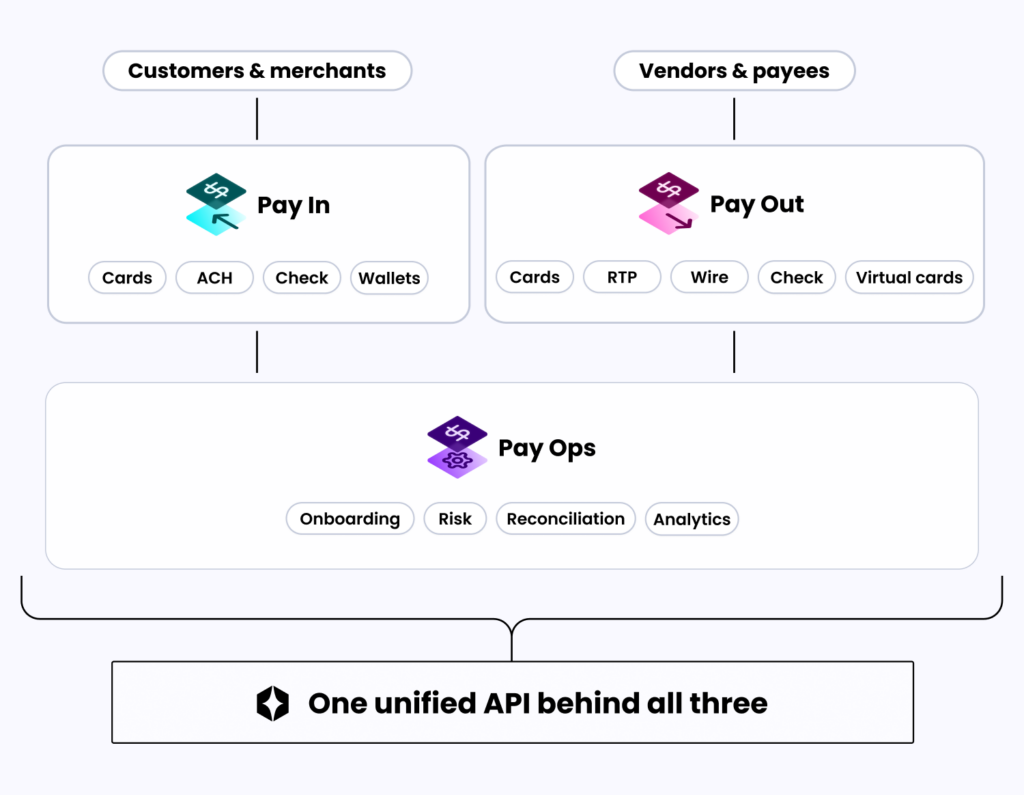
Now that the high-level framework is clear, let’s break down each Payabli Pillar in more detail.
Pay In: Payment Acceptance Layer
Pay In represents everything that happens when money comes into your platform. It is the payment acceptance layer, the foundation of any payments operation.
Most traditional providers focus on credit card processing. Payabli’s Pay In infrastructure goes much deeper, addressing the complex, multi-merchant, multi-stakeholder realities of vertical SaaS.
Pay In empowers platforms with:
- Card, ACH, check, cash, digital wallet, and alternative payment acceptance
- One-time and recurring transactions
- Bulk merchant onboarding and scalable Payfac-as-a-Service
- Split funding, marketplace routing, and multi-party payments
- A unified API for online, offline, and mobile acceptance
Where solutions like Stripe Connect offer horizontal flexibility, Payabli’s Pay In is purpose-built for vertical SaaS complexity, especially industries with hybrid or offline components such as property management, healthcare, and field services.
Pay Out: Automated & Monetizable Accounts Payables
If Pay In is about how money enters your ecosystem, Pay Out is how money flows out to vendors, suppliers, contractors, property owners, or any other payees.
This is where Payabli stands apart in the embedded payments landscape. Most embedded payment providers were built for acceptance, not issuance. As a result, SaaS platforms patch together multiple systems just to pay vendors, property owners, suppliers, or contractors.
Payabli changes that with a fully integrated Pay Out engine capable of powering modern, automated AP (accounts payable) workflows right inside your platform.
Pay Out enables:
- Automated accounts payable workflows for vendors, suppliers, or contractors
- Intelligent vendor enrollment and enrichment
- Instant payouts including same-day ACH, RTP, and wire transfers. Check issuance also available.
- Virtual cards and ghost cards for high monetization through interchange and fees
- Configurable approval flows and disbursement controls
For verticals where payouts are constant and complex (property management, field services, healthcare), the ability to automate, orchestrate, and monetize outbound payments is transformative.
Pay Ops: The Payment Operations Behind Every Dollar Moved
Building a payments business isn’t just about moving money. It’s about safely, compliantly, and intelligently managing that movement at scale.
That’s where Pay Ops comes in, the control center that ties Pay In and Pay Out together.
Pay Ops includes:
- Merchant onboarding & KYC/KYB
- Automated underwriting & risk scoring
- Risk management, fraud monitoring & dispute management
- Reconciliation and settlement reporting
- Compliance workflows & financial controls
- Intelligent analytics tools and visibility across the entire lifecycle
With Pay Ops, everything from onboarding to reconciliation runs smoothly, predictably, and automatically. Payabli eliminates the need for multiple point solutions (risk tools, onboarding vendors, payout systems, and reconciliation platforms) by making them native to the infrastructure.
For SaaS platforms, this means faster onboarding, fewer support tickets, better visibility, and a dramatically more scalable payments business.
Why Payabli’s Payment Pillars Give Vertical SaaS a Strategic Advantage
- A Unified Stack Means Fewer Vendors and Faster Launches
Most platforms stitch together a gateway, a Payfac, an AP system, a risk engine, and an onboarding vendor, juggling 3–5 providers just to move money in and out. Payabli replaces all of it with a single, fully integrated system built to work end-to-end. That means less complexity, faster go-to-market, and far less operational overhead, all from one API.
- Deeper Product Stickiness
When payments are embedded across a platform’s core workflows, they become part of what makes the product indispensable. Every flow that runs natively through Payabli is one more reason merchants stay, and one more layer of value competitors can’t easily pull apart.
- Monetization on Both Sides of the Payment Flow
Platforms can now monetize:
- Inbound transactions via processing margin
- Outbound payments via virtual card interchange; service fee revenue through other payout methods
- Operationalized services through value-added tools
- Built for the Nuances of Vertical SaaS
While horizontal platforms struggle to adapt to niche industries, Payabli embraces complexity:
- Multi-stakeholder payments: one transaction split among several parties at once
- Offline-to-online workflows: for industries with hybrid and in-person components like property management, healthcare, and field services
- Recurring billing: one-time and subscription transactions
- Online check deposit: meeting verticals where paper still moves real money
- Payout-heavy, need-to-pay verticals: automated, monetizable AP for the industries that disburse constantly
The result is an infrastructure tailor-made for the needs of vertical SaaS founders and product teams.
Pay In, Pay Out, Pay Ops. One Infrastructure.
Vertical SaaS is entering its next era, one where it powers financial ecosystems. Payabli’s embedded payment infrastructure helps you get there.
By aligning around the three payment pillars (Pay In, Pay Out, and Pay Ops), vertical SaaS platforms can replace fragmented systems with a unified payments architecture that powers growth, reduces friction, and unlocks new revenue.
Want to see the three pillars on one API? Book a demo.