
Key takeaways
- Exempt debit runs 80 to 170 bps while regulated debit is capped at 21 cents plus 5 bps, and the gap between them widens as tickets grow.
- Downgrades are the cost that never surfaces. No errors, and the transaction settles. Interchange detail reporting is the only place it shows.
- Visa retired Level 2 interchange in April 2026. Commercial volume that relied on Level 2 data now needs to meet Product 3 requirements or fall to standard rates.
- Sending enhanced data and qualifying on enhanced data are different outcomes.
Most software platforms treat interchange as something that happens to them. The rate is set centrally, and no one in your contract chain can bargain it down.
The networks that set those rates also publish the conditions for qualifying for lower ones, and whether a transaction meets them depends on what you submit. For anyone earning revenue on embedded payments, qualification is one of the few things left that moves your own margin.
What interchange is and who keeps it
Interchange is paid to the bank that issued the cardholder’s card. The network sets the rate and keeps none of it. Your payment provider adds its markup above it.
Three charges stack on every card transaction:
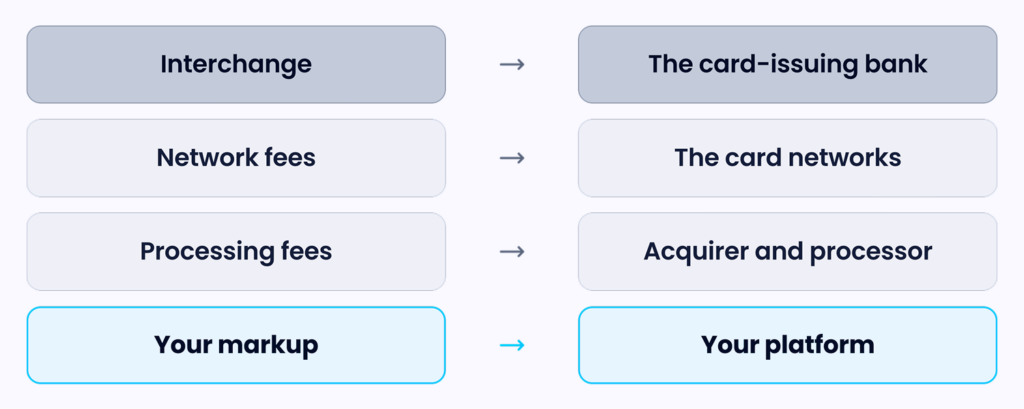
Interchange plus dues, fees, and assessments is the wholesale cost of the transaction before anyone’s markup. The industry calls it interchange passthrough.
Under interchange-plus pricing, you see all three separately. Under flat-rate pricing, they arrive as one number, so a regulated debit transaction and a rewards credit card cost you the same, and the bundle is priced to protect the provider at the expensive end.
That difference decides whether any of this is available to you.
What determines your rate
Some of what drives your rate is fixed by your merchants. The rest is set by how your platform submits the transaction:
- Set by your merchants and their customers: card network and card type, card program (consumer, rewards, business, corporate, purchasing), merchant category code, and transaction size.
- Set by how your platform submits the transaction: card-present or card-not-present capture, address and ZIP verification, enhanced data on commercial cards, enrollment in preferred-rate programs, and authorization hygiene.
The first list comes with your merchants. The second is work you can schedule.
Regulation II caps what banks holding $10 billion or more receive on debit at 21 cents plus 5 basis points of the transaction. Certain prepaid and government-program cards are exempt too, even when a covered bank issued them. Because the cap is mostly a flat 21 cents, the difference between covered and exempt debit widens as tickets grow. Which bank issued the card is not your decision, and it still moves your cost.
Ticket size works the same way. Part of interchange is a flat per-transaction charge, which weighs heaviest on small tickets. A platform billing monthly memberships and one billing milestone draws start from different cost bases before anyone touches configuration.
Downgrades: The quietest margin leak
A downgrade happens when a transaction fails to meet the criteria for the rate it was eligible for, so the network applies a higher non-qualified rate.
No ZIP or address verification at checkout. Settling outside the required window. Missing or malformed fields on commercial cards. Keyed entry where a card could have been dipped or tapped.
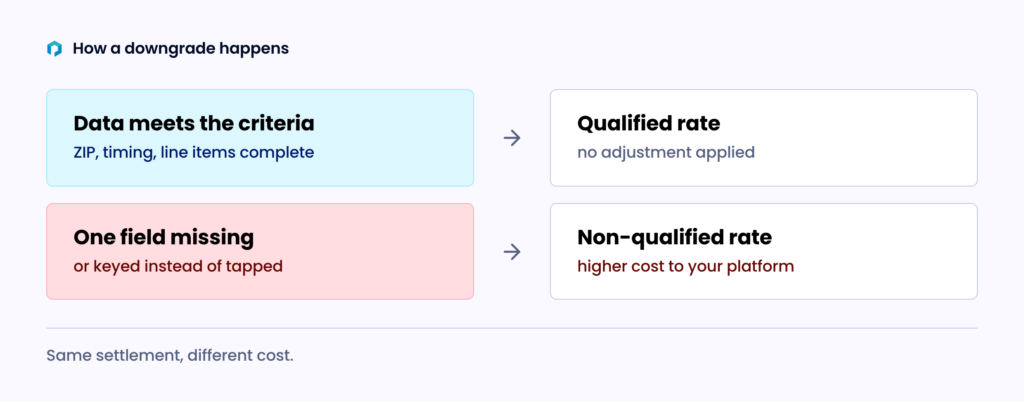
A downgraded transaction settles normally, with no error and nothing in your logs to mark it. You find them by reading interchange detail reports, which is why most platforms never find them.
What changed in 2026
If you read anything on interchange optimization written before this year, part of it is now wrong.
Visa replaced its Level 2 and Level 3 interchange programs with the Commercial Enhanced Data Program and a new interchange category called Product 3. CEDP launched in April 2025, replaced Level 3 interchange in October 2025, and fully retired Level 2 interchange in April 2026. The old route to reduced commercial rates no longer exists. Product 3 is the only one, and it asks for more than Level 2 ever did.
1. The data bar is higher
Visa no longer accepts generic or placeholder values. Fields must be complete and specific, and transactions carrying blanks or filler text are disqualified. Systems that auto-populated dummy values to reach Level 2 no longer work.
2. Merchants get graded
Every merchant starts unverified, paying baseline rates. Visa then reviews a 30-day window of processing and checks data quality. Clear 90% of transactions and the merchant becomes verified, staying verified until quality drops below that line. Verified merchants get the difference back as a rebate, which Visa has up to 45 days to issue.
3. Participation carries a fee
Transactions submitted with enhanced data carry a five basis point participation fee. Small against the savings on commercial volume, so enriching every transaction is not automatically correct.
Mastercard’s data rate programs run under their own rules, so this is network-specific.
For your platform, this is a data quality problem, and the quality has to come from your invoicing and line-item records. Most vertical SaaS platforms already hold structured invoice data. Whether those fields survive the trip to the network in a form Visa accepts is a separate question.
Regulation II and the settlement
The debit cap behind those exempt and covered rates is in litigation. A federal court in North Dakota found in August 2025 that the Federal Reserve had exceeded its authority in adopting Regulation II and vacated the rule, then stayed its own order to keep debit interchange from becoming an unregulated market while the Fed appealed. The Fed filed its reply brief in the Eighth Circuit in March 2026. The cap stands while the case runs.
Judge Brian Cogan granted preliminary approval to the Visa and Mastercard settlement in June 2026. As proposed, it would trim credit rates by ten basis points against varying rates for five years and cap standard consumer credit at 1.25% for eight years. Honor-all-cards would end, letting your merchants decline some higher-cost premium and commercial credit cards, and broader surcharge and discount rights would come with it. Approval is preliminary, large merchants objected at the April hearing, and the National Association of Convenience Stores has said it will appeal if final approval comes. Nothing here is worth planning around yet.
Where optimization happens
Each of these five levers belongs to a different team:
1. Verification data at checkout
Collecting ZIP and address on card-not-present transactions removes a large category of downgrades. Capturing the fields and passing them through takes product and integration work.
2. Card-present capture where it applies
If your merchants take payment in the field or at a counter, dipping or tapping qualifies for lower rates than keying the card in. Tap to Pay on iPhone makes this available without hardware.
3. Rail choice on large recurring payments
NACHA reported 35.2 billion ACH payments worth $93 trillion in 2025, averaging roughly $2,640 per payment. Interchange carries a percentage component alongside the fixed one, so card cost climbs with the ticket while a per-item bank transfer fee does not. Subcontractor draws and supplier invoices are scheduled, predictable, and well above any card average.
Card usually pays you better, so this lever is about keeping volume rather than lowering cost. A merchant paying six figures in supplier invoices will find a cheaper way to move that money, and a wire they arrange themselves never touches your platform.
4. Enhanced data on commercial cards
The largest saving on an individual B2B transaction, though how much it moves your book depends on how much Visa commercial volume you actually carry. CEDP governs it now, and it does not cover Amex, which runs its own Level 2 program you have to enroll in.
Most relevant for B2B verticals. Healthcare platforms see insurer virtual cards.
5. Preferred-rate programs
The networks run programs that carry lower interchange for qualifying merchants, and Visa has emerging market programs that fit property management, rent, utilities, and field service. Eligibility is not automatic and nobody at the network will tell you which of your merchants qualify.
Why this beats negotiating your provider fee
US merchants paid $1.57 in fees on every $100 accepted during 2024, counting issuers and processors together. For a typical embedded payments platform, interchange passthrough is several times larger than what you pay your provider, so a modest percentage improvement there returns more margin than a large percentage cut to provider fees.
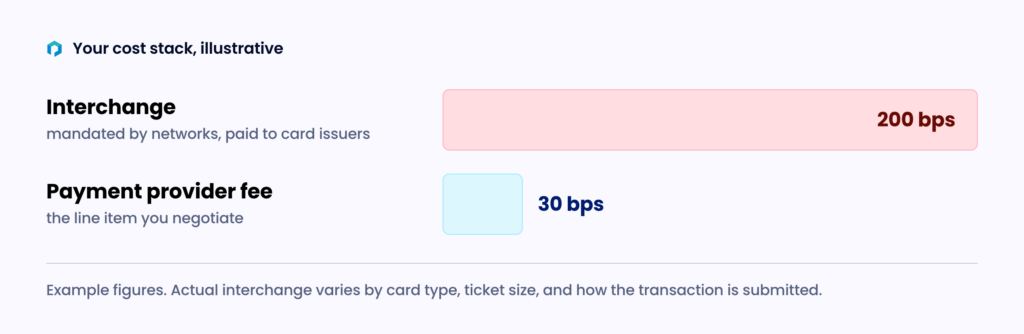
The provider fee also has a floor, because support and reliability cost money to deliver.
Authorization counts have the same problem. Payabli’s documentation notes that authorization fees apply per attempted transaction, and a decline is still an authorization attempt that triggers an auth fee. Where a charge does get retried, the merchant records one payment and your cost line logs two attempts. A platform modeling revenue off settled volume alone is working from a number that understates what it was billed for.
Questions to ask your payments provider
Whether you are evaluating providers or auditing the one you have:
1. Can you show me interchange details, transaction by transaction?
2. What share of my transactions have opportunity for more cost optimization?
3. What share of my commercial transactions is clearing CEDP validation, and which of my merchants are verified?
4. Which of my merchants are enrolled in preferred-rate programs, and who confirms eligibility?
5. How will we manage interchange through a volume migration?
The third question separates real capability from a feature checkbox. A provider can pass data on every commercial transaction and still have none of it clear validation.
How Payabli approaches this
Payabli runs Pay In, Pay Out, and Pay Ops on one unified API, with pricing tools built to give a platform visibility into wholesale costs and set margin by customer segment.
A flat-rate or pure revenue share reseller cannot tell you which merchants are drifting from debit toward rewards. With the wholesale cost visible, you can price a debit-heavy merchant differently from a rewards-heavy one.
Interchange-plus, tiered, and flat are supported natively, so debit-optimized dues, commercial-card data capture, and service-fee tuition each run the structure their economics call for.
Payabli publishes a walkthrough of its monthly merchant statements with worked figures. A statement in that format reports processed volume by card brand, separates the percentage discount fee from the per-authorization fee, and shows authorization counts alongside settled activity. In the published example, 29 authorizations generated $8.70 in fees against $14,332.64 of volume broken out by card brand.
Payabli pairs the platform with guidance on interchange optimization, pricing, and residual reviews, which is the difference between seeing a margin problem and fixing it.
Platforms on Payabli can also ask Amigo Insights about live payments data directly, including effective rate by merchant, card mix, and downgrade patterns, without building a dashboard or waiting on an analyst. If you know what you want to pull, a prompt is enough. If you don’t, Partner Development supplies a prompt list to copy from. Take the data into your own analytics tools, or ask Amigo to chart it, then work with Partner Development on where your numbers should go next.

Frequently asked questions
1. What is the difference between interchange and our processing rate?
Interchange is the wholesale cost paid to the card issuer. Your processing rate is interchange plus network dues, fees, and assessments plus your provider’s markup. Only the last part is negotiable.
2. How would we know if we are being downgraded today?
Ask for interchange detail reporting and look at the distribution of interchange categories. A blended average can look reasonable while hiding a meaningful share of non-qualified transactions.
3. Does optimization matter if our platform is mostly consumer-facing?
The work is different rather than smaller. Verification data and card-present capture help every platform, and most consumer-facing verticals carry some commercial card volume through insurer payments, employer-paid transactions, and corporate accounts.
4. If we steer volume to ACH, what happens to our cost?
Payabli charges a fixed amount per ACH transaction, usually around $0.30, so your cost does not move with the ticket. Percentage pricing with a cap is something you might offer your merchants, not something you pay. Returns and chargebacks are charged per occurrence, so a book with weak account validation keeps less of the savings. Actual rates depend on your agreement.