
Key takeaways
- Merchant onboarding verifies a business and clears it to accept payments. Underwriting is the risk decision inside it: whether to approve the merchant, and on what terms. Run both well, and they become one mostly automated process, where low-risk merchants go live in minutes, only real exceptions reach a human, and the platform grows volume without approving risk it can’t see.
- Slow approval is a revenue problem. A merchant stuck waiting for days often never processes them at all, and the cost to acquire them is already spent.
- Underwriting answers four things: is the business real (KYB), can it cover its own liabilities (credit and financial), will it defraud you or rack up disputes (fraud), and is it even a permitted type of business?
- Board your own merchants, and you own their risk. Your sponsor bank holds you accountable for every approval, so build versus buy comes down to how much liability you want on your balance sheet.
- Payments can lift revenue per customer 2x to 5x, but only for merchants who actually make it through onboarding. The platforms that win hand the underwriting, compliance, and sponsor-bank relationship to infrastructure and keep their own team on product.
Payments only start earning once a merchant is live, so everything between a signed customer and their first transaction runs through onboarding, with underwriting as the risk decision inside it. For a vertical SaaS platform, this is the least visible part of the payments business and the one that determines whether the rest of it performs: handled well, merchants activate in days and processing volume ramps; handled poorly, qualified businesses stall out mid-application while riskier ones get through and surface as losses later. What follows is how the process works end-to-end and where the liability lands.
How does merchant onboarding work for a platform?
Onboarding moves a business from application to live processing through a fixed sequence, and every stage exists to answer one question before money moves: Is this merchant who they claim to be, and can the platform absorb the risk of processing for them?

The merchant application and data collection
The application collects the legal business name, tax ID, business address, ownership, expected processing volume, and how the business takes payments. It is also where the Merchant Category Code (MCC) is derived from the business description, which shapes pricing and risk treatment later, as the boarding overview explains. Incomplete or mismatched data here is the most common source of delay: a missing website or a legal name that does not match the tax ID routes an otherwise clean application into manual review. Prefilling known merchant data and validating fields on entry keep that from happening.
KYC and KYB verification
Know Your Customer (KYC) confirms the identity of the individuals behind the business; Know Your Business (KYB) confirms the entity itself, its registration, beneficial owners, and standing. Both are regulatory requirements, not internal preferences. Beneficial-ownership collection follows FinCEN customer due diligence rules, and every applicant is screened against the OFAC sanctions list and Mastercard’s MATCH list of previously terminated merchants. A business on MATCH cannot be boarded until the underlying issue is resolved.
Underwriting and risk review
Underwriting is the judgment layer: from everything collected, it estimates how likely a merchant is to generate a loss, weighing the business model, financial footing, and dispute exposure against the platform’s risk appetite. Applications with clean, low-risk data clear automatically; the rest go to closer review. The aim is not to inspect every file by hand but to pay attention only where the data warrants it.
Approval, boarding, and going live
Once approved, the merchant is boarded: the account is provisioned with the processor and sponsor bank, and live transactions can begin. Platforms decide how much of this to own, from a fully API-driven integration they control end to end, to a prefilled hosted application, to a white-labeled link, which the three boarding methods compared lay out. Backend activation typically finishes within one business day of approval.
What does merchant underwriting actually assess?
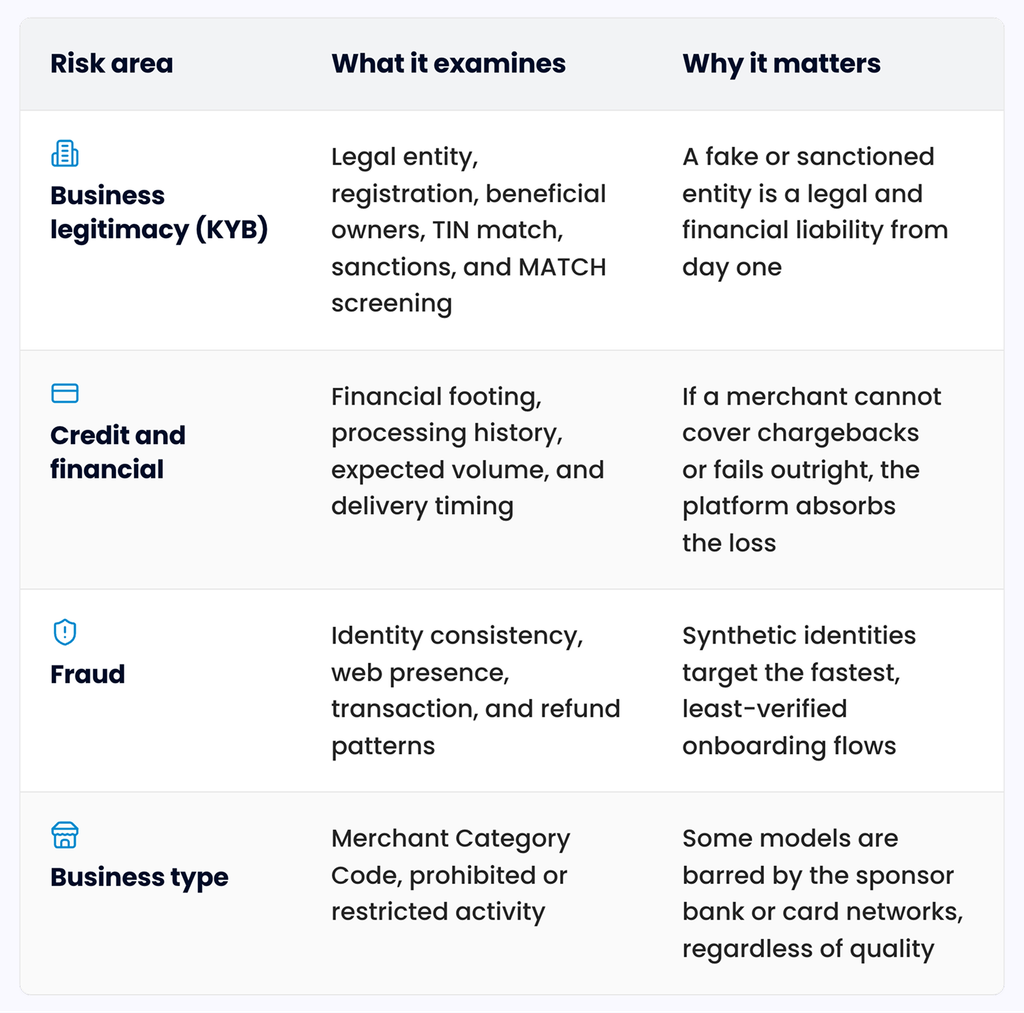
Underwriting is not one check but four separate questions, each with its own evidence and its own failure mode.
Credit, financial, and fraud risk
A merchant that collects payment upfront and delivers later, on deposits, custom work, or subscriptions, carries chargeback exposure that the platform ultimately backstops, so if that business fails with orders unfulfilled, the disputes are settled against the platform. Fraud sits alongside credit risk rather than beneath it, because the same fast, low-friction onboarding that legitimate merchants prefer is exactly what synthetic-identity attempts are built to exploit.
Prohibited and high-risk business types
Some businesses are declined on category alone; others clear with conditions. The most common condition is a reserve, which holds back a share of settlements against future chargebacks or losses. Reserves are also the term that affects a merchant’s cash flow the most, so calibrating them to real risk is what lets a platform approve a business it would otherwise turn away.
The decision: approve, decline, or approve with limits and reserves
Underwriting rarely resolves to a clean approval or decline. A conditional approval, with volume caps, a reserve, or delayed settlement, is often what lets a platform board a borderline merchant without taking on more exposure than it can carry, and the decision and its reasoning should be documented, because the sponsor bank can and does ask to see them.
How to onboard merchants fast without adding risk
Speed and safety are usually framed as a tradeoff, but the platforms that onboard fastest tend to be the ones carrying the least uncontrolled risk, precisely because they have separated the merchants that warrant scrutiny from the ones that plainly do not.
Why slow onboarding costs you revenue
Every merchant you acquire represents a spend that earns nothing until they start processing, so a business stuck in a multi-day approval queue is not a neutral delay but a stranded cost that compounds when the merchant loses momentum, and a share of them never comes back. The loss is larger than a single application because it also includes the years of transaction volume that merchants would have run through the platform.
Automating low-risk approvals and escalating the rest
The workable model verifies identity and business data automatically, scores risk with a combination of machine-learning models and explicit rules, clears clean applications on the spot, and routes only genuine exceptions to a human reviewer. Configurable risk orchestration inside a payment operations layer is built to run exactly that split, letting a platform set its own thresholds so the queue reaching an analyst stays small and genuinely ambiguous, and human judgment is spent only where it changes the outcome.
What underwriting risk does your platform actually own?
This part is easy to underestimate, because embedding payments reads as a product decision right up until underwriting turns it into a question of who absorbs the loss when a merchant goes bad.
What you own versus your provider
PayFac-as-a-service infrastructure lets you skip the hard part of accepting payments: card-network registration, the sponsor-bank relationship, the compliance and underwriting stack, and the cost of building all of it. What it does not remove is portfolio risk. Because you decide which merchants come onto your platform, you keep a stake in how they behave, from defaults and chargebacks to fraud and businesses that are not what they claimed. How much of that lands on you rather than your provider comes down to your agreement, through reserves and loss-sharing terms, and how much of the merchant decision you take on, since the more you steer underwriting and approvals, the more you own the outcome. The provider owns the infrastructure; you own the risk profile of the merchants you bring on.
Sponsor bank and card network requirements
Underneath any payments program sit a sponsor bank and the card networks, whose rules govern the whole chain: KYC and KYB standards, AML monitoring, PCI DSS obligations, NACHA rules for ACH, and ongoing merchant monitoring. Your provider holds that relationship and carries the direct obligation, but the rules still shape your book, because a portfolio that runs hot on fraud or chargebacks invites tighter terms, added scrutiny, or the removal of merchants you onboarded. Underwriting is how you keep that portfolio inside those limits as it grows.
Build vs. buy: Should your SaaS platform underwrite merchants in-house?
For most vertical SaaS platforms, the answer is no, and the reasoning is concrete:
What building it in-house requires
Running your own underwriting means registering as a payment facilitator, which brings card-network registration, a sponsor-bank relationship, and roughly 12 to 18 months of setup before the first dollar is processed. It also means operating the machinery underneath it on an ongoing basis: a compliance function, risk staff, monitoring systems, annual PCI Level 1 audits, and the reserve and dispute handling that comes with holding merchant funds. None of that advances your core product, which is the real cost. The PayFac-as-a-Service guide breaks down the full path and what it takes.
What infrastructure carries for you
The contrast is clearest when you put the two paths side by side, across the factors that actually decide the outcome: how long it takes to go live, who holds the compliance and liability, and where your engineering time goes.
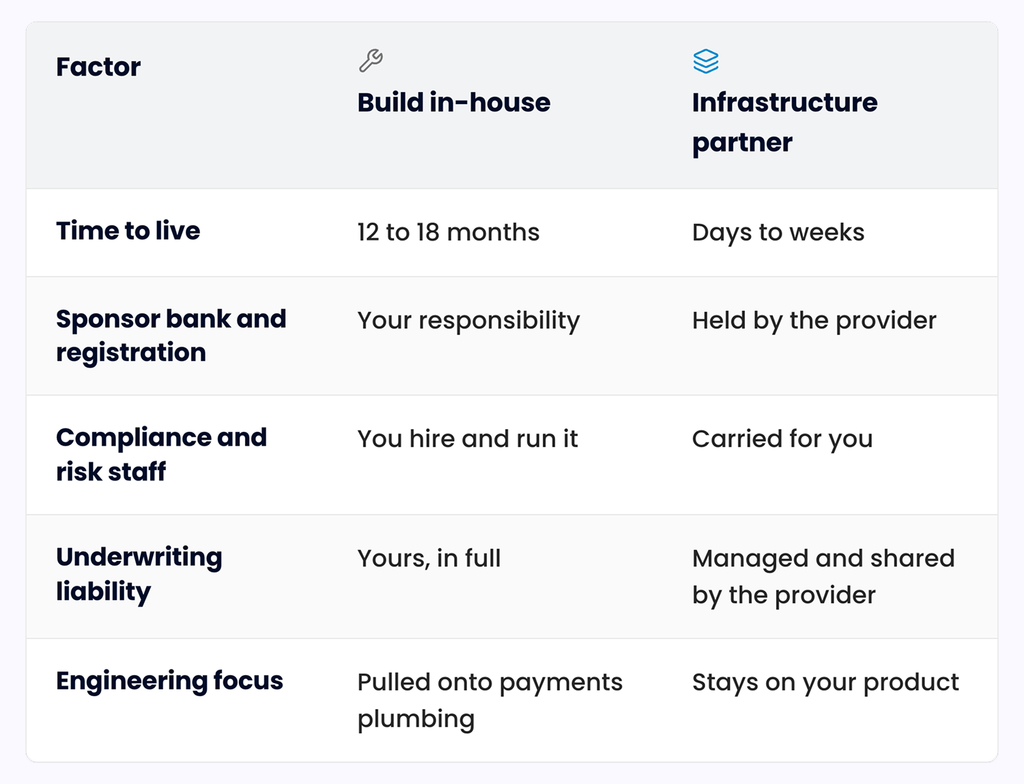
Using an infrastructure partner is how most vertical SaaS platforms get facilitator economics without taking on the registration and compliance load themselves.
Embed merchant onboarding and underwriting with Payabli
Payabli provides embedded onboarding and configurable underwriting through a single unified API that also covers Pay In, Pay Out, and Pay Ops. Merchants board through a full API-driven flow, a prefilled hosted application, or no-code Creator components, while KYC and KYB, sanctions and MATCH screening, PCI, NACHA, and AML obligations sit inside the platform, and risk orchestration runs against thresholds you set. Builder Prime grew payment volume by 1,000 percent after embedding payments with Payabli.

Merchant onboarding and underwriting FAQ
1. What is the difference between merchant onboarding and underwriting?
Onboarding is the full process of moving a merchant from application to live processing. Underwriting is the risk assessment within it that decides whether to approve the merchant and on what terms.
2. How long should merchant onboarding take?
Low-risk merchants can be approved in minutes when verification and risk scoring are automated, while applications that require additional documentation or manual review typically take a few days. Backend activation after approval generally completes within one business day.
3. What information do merchants need to provide to get approved?
Merchants submit the legal business name and tax ID, business address, ownership and beneficial-owner details, a clear description of the business, expected processing volume, and bank account information, and the accuracy and consistency of that data is what determines whether an application clears automatically or drops into manual review.
4. Can merchant underwriting be fully automated?
Low-risk approvals can be fully automated, but higher-risk and ambiguous applications still benefit from human judgment, so the strongest setup clears the straightforward decisions automatically and routes genuine exceptions to a reviewer, which is faster and safer than relying entirely on either approach.