Author: Marielle Mekkaoui

Beyond Embedded Payments: How Vertical SaaS Platforms Expand Their Fintech Stack with Purpose

Payments used to be the differentiator. Today, they are table stakes. 

Over 60% of vertical SaaS platforms have already embedded payments, according to a survey by EY-Parthenon, and adoption continues to climb. Embedded payments work because they’re intuitive, sticky, and powerful. When executed well, payments can increase revenue per user up to 5x

More than 80% of the embedded-finance market remains untapped. There are massive opportunities with payouts, working capital, insurance, spend management, and embedded marketing automation. These offerings are natural extensions of how a vertical SaaS platform can solve customer problems in high-complexity, need-to-pay verticals like healthcare, field services, property management, hoa and retail. 

The real question for founders isn’t whether to embed payments—it’s how to move beyond them without losing momentum.  As Ershad Jamil, former Chief Growth Officer at Service Titan, noted in his recent article,Moving Beyond Payments: When & How to Expand Your Fintech Stack, a lot of companies launch payments successfully—and then stop there.  How do you evolve your vertical SaaS platform from including payments as a feature into a purpose-built embedded ecosystem?

Payabli recently hosted a discussion with leaders across the embedded fintech landscape to dig into how founders can think beyond payments while staying focused on their core product and customer? 

The Biggest Misconception: We can add more embedded fintech later

Many founders and vertical SaaS platform leaders underestimate how early they should be thinking about a multiproduct strategy.  According to Ershad Jamil, “If you’re selling $50–100K ACV, you should be multiproduct from day one.”

During his time at ServiceTitan, Ershad’s team  launched nine fintech-adjacent products, which collectively grew to represent roughly one-third of total revenue. They didn’t wait for payments to reach saturation to begin exploring new products, instead, they watched customer adoption on payments as a guide and leading indicator. 

A practical rule of thumb:

  • If 5–10% of customers have adopted payments, you are building momentum.
  • That’s enough signal to start building—or partnering on—the next offering.
  • You can leverage your existing payments team to fast-track the next embedded product offering.

Founders often wait for “perfect adoption” before moving forward. In reality, momentum compounds faster when platforms layer products early, leveraging existing customer trust, data, and GTM motion.

Evaluating embedded fintech: Table stakes or Value add?

When it comes to deciding which embedded fintech products to add next to your platform, many founders struggle with deciphering what’s mandatory vs. what is monetizable. In this quickly evolving landscape customer expectations are also changing rapidly, so something that was a game-changer two years ago may be table-stakes today.  

Table stakes are defined by your vertical, your customer’s daily workflows, and what competitors already provide. Two years ago, embedded payments, basic reporting and reconciliation, and some form of cash-flow visibility felt like “nice to have” features, and today they are expected. 

“Accounting is extremely complementary to payments. Customers don’t want to leave their platform to understand their money.”

Raj Bhaskar, CEO, Tight

Accounting is a good example. As Raj Bhaskar, CEO of Tight, noted, “why hand over your customers to QuickBooks in the last mile?”  Customers are reluctant to move payments onto a platform unless it also helps them understand where the money went. Handing them off to QuickBooks breaks the experience—and increasingly feels outdated.

On the flip side, value added products unlock measurable business outcomes like faster cash flow, business growth, or reduced operational burden. That’s where categories like working capital and marketing automation come into play as accelerants. While there is an abundance of SMB focused marketing automation tools, embedding marketing into your platform brings greater convenience, data integration and visibility of actual marketing spend that wasn’t possible before. 

Table Stakes Embedded ProductsValue Add Embedded Products
Accounting
Marketing Automation
Financing and Working Capital
Spend Management
Insurance

As you evaluate additional fintech offerings, keep in mind that AI is not a stand alone offering. Integrated AI capabilities and automations are becoming the expectation for how your platform will work as a system of action.  As Raj says, “Why open a report and drill down into the data when you could open a chat and ask what is my month over month revenue increase and what should I do next?” AI will raise the bar across every embedded product:

  • Accounting that works in real time
  • Marketing that optimizes itself
  • Capital that’s proactive, not reactive

The question isn’t whether to add AI. It’s whether your product is intentionally designed to use it.

When evaluating if a new offering will strengthen your core platform or differentiate it, keep these questions in mind:

  • What job are customers still leaving your platform to complete?
  • What critical business decision are you forcing customers to make outside your platform today?
  • What manual workarounds signal unmet demand inside your product?
  • Does this offering increase customer dependency?
  • Does this offering directly compound payments volume or retention?
  • If you don’t offer this, who will your customer turn to?

Evaluating embedded fintech: Follow customer pull or competitor push?

Should roadmaps be driven by what customers ask for—or by what competitors force you to react to? Consensus among embedded fintech leaders leans strongly toward customer pull, with an important caveat. 

Customers will tell you their pain points: Cash-flow gaps, time spent reconciling books or difficulty growing revenue.  At times you need to respond to those direct pain points and at other times you need to listen to the signals. Your customers won’t always tell you what’s possible. It’s your team’s role to ask, what can we do differently?

“Customers didn’t ask us for embedded financing—but it became one of the most powerful products we launched.”

Ershad Jamil, Former CGO, ServiceTitan

At ServiceTitan, embedded financing succeeded precisely because customers didn’t ask for it. The team understood the business, the workflows, and the opportunity to solve the pain customers had simply learned to tolerate.

The real unlock is marrying together these elements to inform your embedded fintech roadmap:

  • Direct signals: Surveys, feedback, usage data
  • Indirect signals: Offhand comments, workarounds, hack
  • Internal conviction: Knowledge about what technology can now make possible

Keep in mind listening blindly to customers could lead to incrementalism. And, ignoring customers will lead to irrelevance. The balance is where innovation lives. As Ershad says, “Be careful to listen, not march directly – and miss innovation.”

Product Consideration: Three Offerings that Compound Payments

While there are dozens of potential fintech offerings to consider adding to your multi-product approach, three categories stand out as compelling “next steps” beyond payments.

Start thinking about not only what product to offer, but what product meets the needs of various customer segments. And, just like payments, each additional product should have its own TAM, P&L, and adoption goal. 

Accounting 

“Accounting is extremely complimentary to payments”, says Raj Bhaskar – CEO, Tight.  It extends payments, it doesn’t replace them. 

Embedded accounting provides automated reconciliation and real-time reporting. It reduces labor, increases retention, and drives higher payment volumes (hundreds of thousands of ACV). With embedded accounting, you can connect all money in and money out in one platform.

“No business owner started a company because they love managing the books. Accounting should work for you—not the other way around.”
Raj Bhaskar, CEO, Tight

If customers are doing accounting on your platform, you’ll have great retention.  

Working Capital

Mike Barbosa – CEO, OatFi, frames access to capital as a core element of your business in this way: 

  • Growth capital is the protein and nutrients.  It’s what you need to invest in long-term to grow and build strength.
  • Working capital is the blood and air. It’s what’s necessary to smooth out the cash flow and thrive organically.

If your platform already helps customers manage supplier or business customer payables or receivables, embedded working capital can:

  • Smooth cash flow – extend payables outstanding
  • Strengthen payments usage
  • Drive 20–40%+ revenue uplift, even up to 100%

If your customers have a working capital problem and can only access it through your payments tool, it will provide a significant uplift.  You can market working capital the same way as payments.  It fits seamlessly. It’s not just another product—it supercharges the ones you already have.

Marketing

At first glance, marketing may feel adjacent to fintech. In practice, it’s a force multiplier.  Marketing belongs in the fintech roadmap because growth compounds everything else.

Platforms offering marketing tools often see 20–30% adoption in year one and $1–2K ACV uplift. Their customers will replace software spend and reduce costs with agencies.  SMBs with embedded marketing could be growing double-digits and increasing payments yield.

Embedded marketing automation:

  • Helps customers grow
  • Makes customers stickier
  • Increases payment volume as a second-order effect

“Embedded marketing is a force multiplier. Businesses that grow stay on the platform—and transact more.”
Teddy Liu, Co-Founder, Pocketflows

GTM Strategy: Build or Partner?

The right question isn’t can you build—it’s should you. Keep your goal of speed to value in mind.

Additionally, rebuilding products like accounting or marketing would require massive investments in infrastructure. 

As Raj states emphatically, “What is the last thing you would ever want to do?  Would you want to build QuickBooks again?  I’ve never heard of a business owner raving about QuickBooks, even though it’s the market leader.”  

Teddy notes that to build marketing automation in-house, “ you would have to build connectivity, mail deliverability, compliance and more – would you really want to rebuild all that infrastructure? Is that core to your platform?” 

Instead, consider leveraging partners to embed your new offerings. Evaluate these partners based on:

  • Level of internal effort required
  • Proven customer references in your vertical
  • Ability to support you through launch, iteration, and scale

4 Steps for Moving Beyond Payments in the Next 30 Days

If you’re early in this journey, start here:

  1. Define what’s table stakes vs. value-add for your platform
  2. Talk to customers about what tools they’re actually using—or what workflows they are hacking together
  3. Map customer spend to understand share-of-wallet opportunities
  4. Pick one next move that compounds payments
Payment Security Testing That Scales With Engineering Teams

How Payabli approaches fintech security to support SaaS platforms embedding payments at scale.

Written by Emilio Sepulveda

When you’re building embedded payments for vertical SaaS platforms moving millions of dollars, security testing isn’t optional. It’s the basis of trust between your platform, your customers, and the people using it every day. That’s why, when I joined Payabli a few months ago, I was immediately impressed with how seriously security testing is taken here.

Payabli’s dedication to continuous security testing, talking about issues openly, and just the general seriousness about security is a huge deal. It’s absolutely vital in the payments world, and it’s a major win for a team this size.

What also became clear is how heavy a constant stream of security findings can feel for a small, fast-moving engineering team. Even when testing is working as intended, the volume and timing of findings can turn useful signals into noise – landing outside of sprint planning, breaking focus, and arriving without the context needed to move quickly.

The challenge is not security testing itself – it’s how that testing fits into day to day engineering work.

When continuous testing creates friction

Continuous security testing is powerful, but without structure it can create unintended friction for engineering teams:

  • Findings arrive with little predictability
  • Engineers are pulled into constant alert triage
  • Remediation work lands outside of planned sprints
  • High-impact findings compete with low-value noise

Over time, this makes it harder to focus on the work that actually reduces risk. And for SaaS platforms embedding payments, this friction doesn’t stay internal. It shows up as delayed launches, last-minute fixes, and surprise issues at the worst possible time.

The challenge isn’t security testing itself – it’s how that testing integrates with how products are built.

How we’re maturing our fintech security testing

We continue to run continuous security testing at Payabli, but we’ve changed how it shows up for engineering – and, in turn, for our SaaS partners.

Instead of testing everything all the time without context, we focus security testing on what teams are actively building. Assets, endpoints, and APIs are clearly defined and owned, and testing is mapped directly to that inventory. This ensures findings arrive with context, accountability, and clear remediation paths.

Security testing is planned around engineering sprint cycles. Teams know what is being tested, when it’s happening, and why it matters. Expectations are set in advance, and findings are reviewed together with shared understanding of impact and priority.

This approach keeps security testing continuous while making it predictable. Engineers can plan fixes, absorb findings, and reduce risk without disrupting existing workflows. For SaaS platforms leveraging Payabli’s embedded payments infrastructure, that predictability translates directly into fewer surprises and a more resilient platform.

Why this alignment matters

Effective fintech security programs ensure SaaS platforms can scale payments confidently, without compliance friction or unexpected risk. When security testing aligns with how engineers plan and build, everything works better:

  • Remediation can be scheduled instead of rushed
  • High confidence findings stand out clearly
  • Alert fatigue is reduced
  • Security feels like support, not interruption

Most importantly, risk is addressed earlier – while features are being built, not weeks before launch. That means fewer last-minute issues, smoother audits, and greater confidence as platforms scale.

The outcome

Security testing that scales isn’t about running more scans or generating more findings. It’s about focusing on impact instead of volume.

By reducing noise and aligning timing and context, security testing becomes something engineering teams rely on – not something they work around. Engineers stay focused, risk is reduced earlier, and Payabli can scale security in a way that strengthens engineering velocity rather than slowing it down.

For the SaaS platforms we partner with, this means working with an embedded payments provider whose security program is mature, transparent, and built to scale alongside your growth.

How Embedded Payments Helped Sunbound Scale to $1B With Payabli

Modernizing Senior Living Finance: Sunbound’s Vision

Founded by Manny Corminsky and Stuart Mason who had each witnessed the challenges of senior living firsthand, Sunbound emerged with a clear mission: to modernize the financial operations of an industry stuck in the past. With roots in Utica, New York, where Corminsky’s family helped found an assisted living nursing home, Corminsky saw both sides of the senior living experience – the operational pain points facilities faced with making payments and the frustrations families encountered during the transition process.

Sunbound’s platform automates revenue processes across both private pay and insurance claims, improving profitability and cash flow speed while creating a seamless payment experience for families. Their ability to scale depended heavily on having reliable, flexible, and user-friendly payment integration that matched the complexity of senior living. Today, Sunbound serves regional and national senior living operators across the full continuum of care.

The Challenge: What Happens When Your Payments Infrastructure Can’t Scale With You?

Senior living facilities face unique payment complexities: over 50% of families still pay by check, financial processes are heavily paper-based, and operators navigate a complex mix of private pay, Medicare, and Medicaid on thin margins. Adding further complexity, a majority of payments come from third parties (relatives, friends, or trusts), creating friction around accessibility and security.

When Sunbound launched embedded payments in June 2023, they integrated to Stripe combined with JP Morgan’s ACH collections. But their initial payment integration wasn’t designed for the volume, variability, or user needs of the senior living market.

Within just three to four months, critical payment challenges emerged:

Rigid Transaction Thresholds: Despite providing detailed projections and advance notice, Stripe consistently failed to adjust processing limits proactively. Sunbound experienced some months where 20-30% of transactions were blocked, forcing emergency escalations to get final batches approved.

Customer Interface Barriers: Approximately 50% of Sunbound users couldn’t adopt Stripe’s OAuth-style login – particularly third-party payers without online banking access. This forced Sunbound to maintain a separate manual ACH process through a separate processor.

Operational Drain: With payments fragmented across two systems, Corminsky and his co-founders spent upwards of 50% of their time on payment reconciliation and crisis management.

Additional Pain Points: 5-7 day settlement times created cash flow strains, and the manual ACH process introduced compliance risks around sensitive banking information.

By Fall 2023, just months after launch, Sunbound knew they needed a new embedded payments solution that could scale with them. Payments were too core to their business to continue struggling.

The Payabli Solution: Embedded Payment Infrastructure  and True Partnership

Recognizing the need for more flexible and reliable embedded payment solutions, Sunbound turned to Payabli for their unified API, modular payment components, and powerful documentation. What stood out most wasn’t just Payabli’s robust payment infrastructure – it was the partnership mentality.

“We were impressed by co-founders Jo, Will, and the Payabli team,” Cominsky shared. “They didn’t just sell us a platform. They became advisors, guiding us through onboarding, compliance, and scaling best practices.”

Together, Sunbound and Payabli designed an embedded payments experience that integrated seamlessly into Sunbound’s platform. Key improvements included:

  • Flexible ACH and card payments on a single API designed for both families and operators.
  • Accelerated payout times that improved cash flow reliability.
  • Proactive monitoring and flexible adjustments to navigate transaction limits with minimal disruption.
  • Simplified compliance and KYC processes recognized by operators for its ease and reliability.

Implementation with Payabli was quick and seamless, with Sunbound processing payments in under two months.

“The Payabli team was quick to hop on calls, troubleshoot issues, and help us think through every detail,” said Cominsky. “They offer a true partnership invested in our growth.”

The Impact: From Crisis Management to Peace of Mind

Since partnering with Payabli for embedded payment solutions, Sunbound has grown from a five-person startup processing hundreds of thousands monthly to a 35-person company processing over $1 billion annually in payments and claims.

“We haven’t had a single issue with payment limits or scaling since switching to Payabli,” said Cominsky. “Payabli gives us peace of mind and allows us to focus on what makes us unique, while Payabli handles the payment side they specialize in.”

The results:

  • Zero payment disruptions during rapid growth phases.
  • 50% reduction in operational workload for reconciliation and manual payment management.
  • Faster customer onboarding and improved family satisfaction.
  • Seamless compliance experience through Payabli’s guided KYC processes and implementation support.

Today, Sunbound’s customers benefit from streamlined payment experiences that improve cash flow and operational efficiency. Families can pay seamlessly regardless of tech comfort level, operators have complete transparency, and Sunbound has reclaimed valuable time to focus on innovation rather than payment crisis management.

Looking Ahead: Scaling Financial Solutions for Senior Care

Sunbound’s vision extends beyond revenue processes – they’re building the complete financial operating system for senior living. Next on the roadmap: payout API and account payables functionality to manage vendor payments, subcontractor disbursements, and other money-out operations that are just as critical to operators’ cash flow.

Payabli’s platform breadth makes this expansion seamless. “What’s really nice is when we move into accounts payable, we can already just turn on the AP module with them,” Cominsky explained. “Payabli built such a robust platform that enables us to easily add on value-added services to double or triple our growth rate without needing a new vendor or partner.”

By leveraging Payabli’s payout API, Sunbound will close the loop on senior living financial operations – from collecting payments to disbursing funds – all within a single, unified platform.

A Partnership Built on Trust and Support

Payabli has proven to be more than payments infrastructure for Sunbound – they’re a trusted partner that provides the support and peace of mind essential to every stage of their growth journey. Their embedded payments technology is the foundation that allows Sunbound to eliminate operational bottlenecks and enable billion-dollar payment volumes without friction.

Whether onboarding new clients, managing complex payment mixes, or troubleshooting unique customer scenarios, Sunbound’s team knows they can rely on Payabli’s proactive partnership and customer-centric approach. In an industry where trust and reliability are paramount, that partnership is the ultimate differentiator.

Building Your Payments Team: A Hiring Guide for Vertical SaaS Platforms

Embedded payments have evolved from a “nice-to-have” revenue booster to one of the fastest-growing opportunities in vertical SaaS – often contributing 30-50% of total company revenue within just a few years of launch. But here’s what separates the platforms generating millions in payment revenue from those struggling to gain traction: how they approach the build.

The most successful platforms treat payments as a core product, not just a feature. They recognize that delivering a seamless payment experience requires the same level of strategic investment, technical sophistication, and operational rigor as their primary software offering. And as payment volume scales – from processing a few million to hundreds of millions annually – the need for dedicated payments expertise becomes unavoidable.

So how do you know when it’s time to bring on your first Head of Payments? And what should you look for when you do?

This article addresses these critical questions and outlines how to build an effective payments team for your vertical SaaS platform, starting with your first hire: a Head of Payments or Payments Lead. We’ll cover the capabilities that matter most for this foundational role, then explore when and how to add specialized positions as your payments program matures.

The Biggest Mistake Vertical SaaS Teams Make When Hiring for Payments

Many vertical SaaS platforms start payments hiring with an impossible wish list for their first payments leader – whether titled Head of Payments, Director of Payments, or Payments Lead. They are searching for a “payments unicorn” – someone who knows everything from risk and underwriting to product, go-to-market, and compliance. That bar isn’t realistic, and it’s not necessary. 

The better question is: what do we need most right now? Before writing the job description, identify the single capability that matters most at your current stage – hiring for payment adoption and go-to-market, customer management, operations, or product. Listing every payment responsibility dilutes strategic focus and scares away strong candidates when they don’t hit every checkbox. 

Start with leadership focused on your core needs. As payments volume grows, you’ll likely add specialized roles like payments sales reps, merchant support, or a payments product marketer – but those come later, after you’ve proven the model with your Head of Payments or Payments Lead.

What to Look For In Your First Payments Hire: Your Hiring Evaluation Guide

As you evaluate candidates for your Head of Payments or Payments Lead, here are the critical capabilities that separate strong payments leaders from poor fits:

Cross-Functional Influence: Payments leaders rarely have large teams. They work across finance, product, technology, and sales without direct authority. Look for examples of aligning teams, securing product bandwidth, or enabling sales to position payments correctly – all without direct reports.

Partnership Management: Your processor relationship directly impacts success. Merchant onboarding is typically the biggest hurdle to activation. Strong candidates understand processors as true partners, maintain direct communication channels, and collaborate on complex merchant situations rather than managing them as vendors.

Merchant Relationship Building: The best payments leaders develop personal relationships that go beyond what large processors offer. Look for experience building direct merchant relationships, providing personal support, and showing up at industry conferences or maintaining direct support channels.

Data-Driven Decision Making: Strong candidates use data to identify friction, improve workflows, and drive adoption. They should talk about outcomes with specific numbers and demonstrate how they’ve taken customer feedback and turned it into actionable improvements.

What Strong Candidates Look Like (vs. Red Flags)

Strong payments leaders demonstrate:

  • Excitement about successes backed by specific numbers
  • Clear explanations of complex concepts across audiences  
  • Deep merchant understanding and what drives adoption
  • Examples of productive processor partnerships

Watch out for:

  • Speaking in generalities without owning outcomes
  • Overusing jargon instead of clear explanations
  • No concrete metrics around adoption, retention, or boarding
  • Treating payments as isolated from the broader product

How to Set Your Payments Leader Up For Success

Hiring the right person is only half the equation. Your payments leader needs:

Company-Wide Buy-In: When sales, customer success, and product support payments as a priority, payment adoption improves immediately. Without this, your payments leader can’t get the bandwidth they need.

Honest Expectations: Be transparent about where you are in your payments journey. Are you ready to commit resources, or still exploring? It’s only fair for candidates to understand your real stage and constraints.

Strong Processor Partnership: Clunky boarding processes or poor communication will sabotage even the best hire. Your payments leader needs a responsive, collaborative embedded payments partner.

Leadership Chemistry: This relationship becomes the backbone of how quickly you can scale. Find someone you work well with.

When to Scale Your Payments Team

Once your Head of Payments has established your payments foundation and proven the model, you’ll likely need additional support. Here’s when to consider new payment hires:

  • Payments Sales Rep: When adoption becomes a bottleneck and your leader spends a majority of time on sales calls rather than strategy.
  • Payments Support Rep: When onboarding volume and support tickets pull focus from strategic work (Note: Some embedded payments partners like Payabli offer dedicated merchant support options, eliminating this headcount need).
  • Product Marketer: When you need dedicated resources for sales enablement and customer education materials

The sequence matters less than the trigger: hire when a specific function becomes a clear bottleneck to growth. When building a payments team, most companies start with leadership, add sales support next, then layer in specialized roles as volume scales.

Ready to Hire a Payments Leader? Next Steps

Before you start interviewing, answer these questions honestly:

  1. What’s our most critical need right now? Go-to-market, operations, product, or partnership management?
  2. Where are we in our payments journey? Early exploration, ready to scale, or looking to differentiate?
  3. What resources can we commit? Sales bandwidth, product development capacity, budget, and executive attention?
  4. What does success look like? Define concrete milestones – monthly, quarterly, and annually.
  5. How will we support this person? Company buy-in, processor partnership, and realistic expectations?

Once you can answer these clearly, you’re ready to write a focused job description that prioritizes what actually matters, interview payments candidates against the capabilities that drive success, and build a team that will transform your embedded payments program into a lucrative competitive advantage.

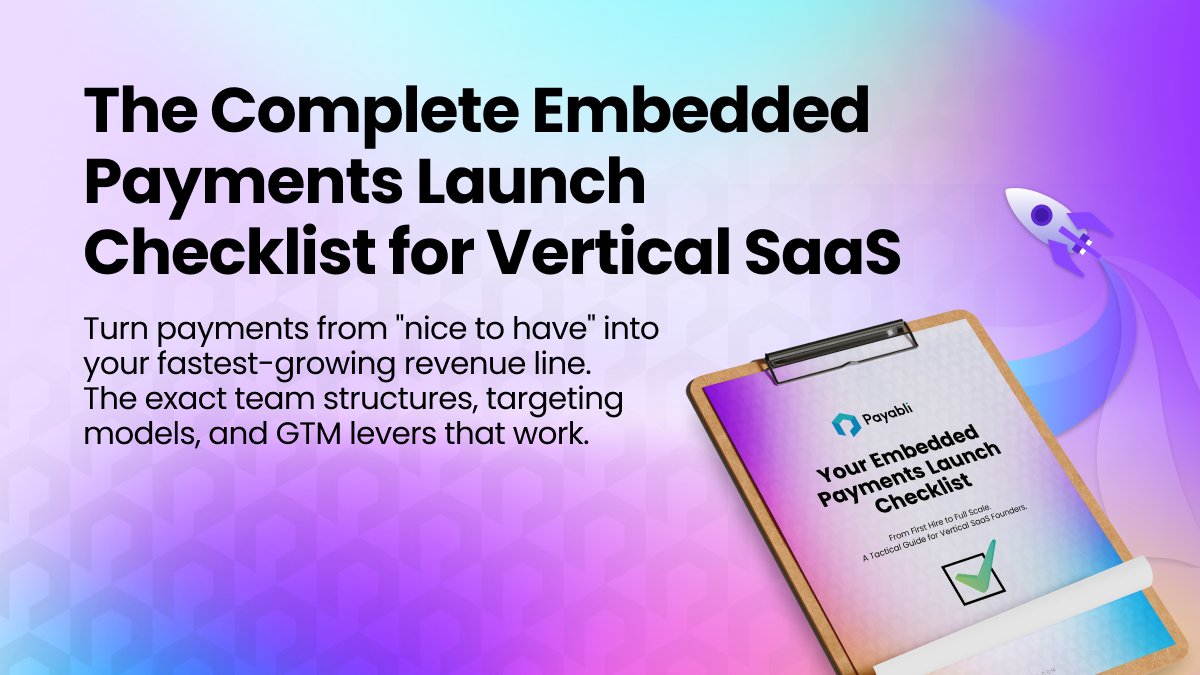
Ready to go deeper? Download our complete Embedded Payments Launch Checklist for a comprehensive guide to everything you need for a successful payments launch within your vertical SaaS platform.

Stop Searching, Start Building: Payabli’s Enhanced Documentation Architecture

Written by: Casey Smith, Docs @ Payabli

Finding the right doc shouldn’t feel like a scavenger hunt. That’s why we launched some big changes to how Payabli’s docs are organized. We completely reimagined the navigation and content organization to make it easier for our readers to find what they need and get on with their day.

Here’s what’s changing, why it matters, and what’s coming next.

What’s changed

Navigation that matches how you actually work

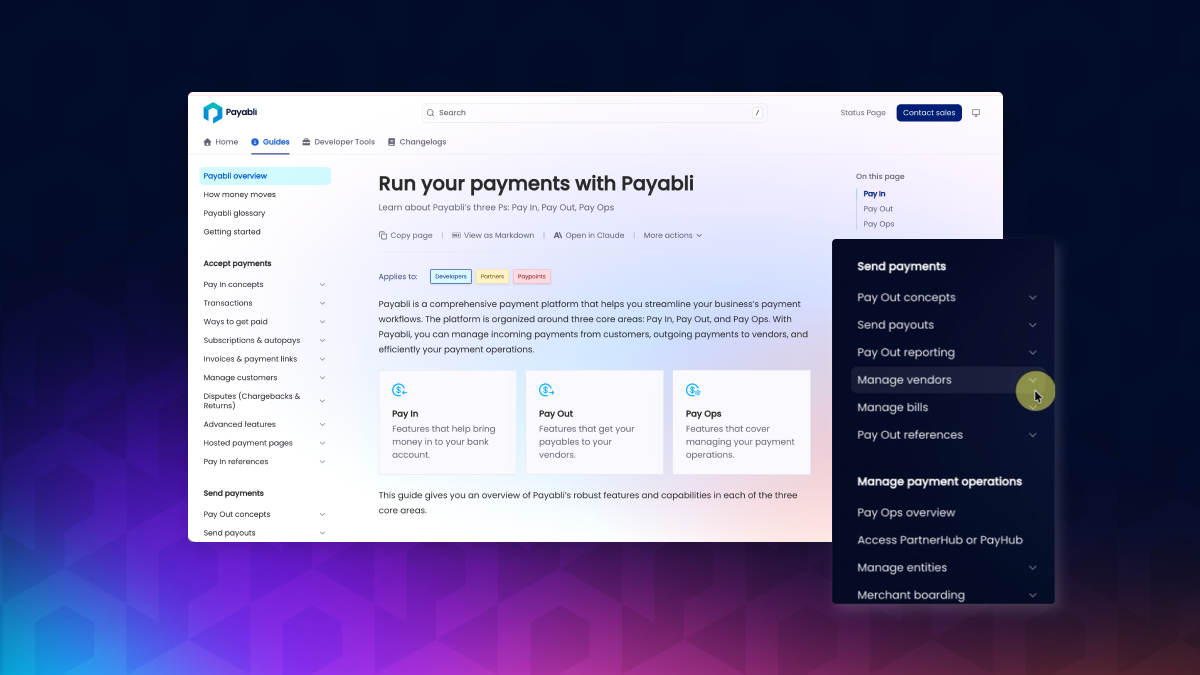
Before: Four separate sections (Home, Learning, Developers, Product docs) that forced you to guess where content lived. API guides in one place, UI guides somewhere else, concepts scattered across a “Learning” section you probably didn’t know we had.

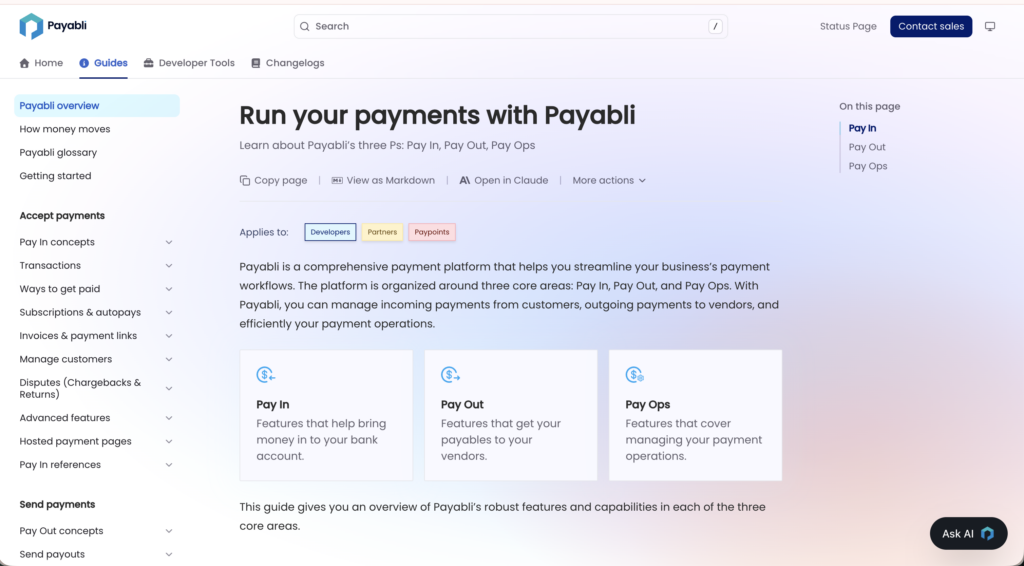
Now: Three clean tabs organized by what you’re trying to do:

Changelogs: Version history and updates

Guides: Concepts, procedures, and troubleshooting for everyone

Developer Tools: API reference, SDKs, and testing resources

No more hunting across multiple sections. No more “is this in Developer docs or UI docs, or is it Learning?”

Shallower navigation, less hunting

We flattened the navigation hierarchy. Some things that took 5-6 clicks now take 2-3. Others went from 5 to 3. But the real difference is you’re not jumping all over the screen anymore.

For example, getting to the V2 Transaction Endpoints used to look like this:

Product tab (top nav) → Developers → API Reference → 

scroll down → Pay In Endpoints → V2 Transaction Endpoints

Now it’s:
Developer Tools → Pay In Endpoints → V2 Transaction Endpoints

Three clicks instead of five, and they’re all in the same navigation area. Less clicking, less hunting, less confusion.

Old way:

Animated GIF

New way:

Animated GIF

Reference materials where you need them

Some of the biggest complaints we heard were “I can’t find the test cards” and “where are the error codes?”

So, we moved all reference materials (like our test cards, API schemas, error codes, status definitions) out of a separate “References” section and put them next to the guides where you’d actually need them.

You can find all references for a product area at the end of the section navigation. They have names like “Pay In references” so you can find them fast.

Animated GIF

One source of truth

We eliminated over 20 duplicate pages.

Before, searching for “boarding overview” returned a few similar-looking guides (one for API, one for UI, one in “Learning”). You’d have to guess which one was the one you needed, or you’d have to click through all of them.

Now, we strive for one authoritative overview page per topic. When you search, you’ll know you found the right answer. We still have separate docs for UI and API tasks, clearly labeled so you know exactly what you’ve found.

URLs that tell you what you’re getting

Page URLs are more descriptive now. Instead of vague slugs, you’ll see exactly what a page covers before you click:

  • /pay-in-ach-cycle-overview (not just /ach-process)
  • /pay-ops-boarding-field-explorer (not just /boarding-fields)

If you’re bookmarking pages or sharing links with your team, this makes everything more predictable.

Better starting points

Each major section now has a comprehensive overview page that explains what’s possible, links to relevant content, and helps you get oriented quickly. No more landing on a page and wondering “okay, now what?”

What didn’t change

Developer Tools stayed put. All the SDKs, API references, and testing resources are still in one place under the Developer Tools tab. If you know exactly which endpoint or SDK you need, you can go straight there (with fewer clicks).

Search works the same way. The search bar is still in the same spot and searches the same content. We didn’t change how search works, the changes just make the results more useful with less duplicated content.

Why we restructured it

Our old structure was organized around our product divisions (Pay In, Pay Out, Pay Ops) and audience (developers vs non-technical users). That made sense internally, but it didn’t match how you actually think about your work. You don’t think “I need to do a Pay In operation.” You think “I need to process a payment” or “I need to refund a customer.”

We’re also scaling fast. Payabli is building a lot of cool stuff this year, and we needed an information architecture that could keep up, one where new content has an obvious home and gaps are easy to spot and fix.

So we reorganized the entire navigation and information architecture around tasks and user intent instead of product categories. The result is documentation that works the way you work.

What’s coming in 2026

The Payabli Docs team has some big plans for 2026! Here’s a sneak peek of what this reorganization made room for.

Recipes and cookbooks

We’re going to be creating practical recipes and cookbooks for workflows throughout the year. Keep an eye out for easy-to-read recipes for workflows like:

  • Handling failed payments with retry logic
  • Setting up a new vendor and paying them with a virtual card
  • Implementing split funding across paypoints

You can think of these as the simple “just show me how to do it” guides for when you want to move fast.

Then, when we’ve got recipes published, we’ll start combining them into opinionated cookbooks to help guide you through implementing and using Payabli.

Filling the gaps faster

The new structure makes it obvious where we’re missing content. That means we can fill those gaps faster instead of discovering them six months later when someone asks “wait, is this documented?”

What you need to know

Your bookmarks still work. We implemented permanent redirects so all old URLs will continue to work.

We’re listening. If you have suggestions, let us know. We’re monitoring how you use the docs and making adjustments based on what we learn.

The numbers

We touched 837 files and removed over 51,000 lines of redundant content to make this happen.

Whether you’re integrating our API for the first time, learning to run a transaction in the Payabli Portal, or looking up a specific endpoint, you should be able to find what you need in fewer clicks with less confusion.

The new docs are live at docs.payabli.com. Try searching for something you use regularly—test cards, boarding fields, refunds—and see the difference. Questions or feedback? Email us at docs@payabli.com

Today’s “Impossible” Is Tomorrow’s Baseline: Engineering the Next Generation of Embedded Payments

Within weeks of joining Payabli, several observations became abundantly clear: I joined an extremely innovative company, I worked alongside a world-class team, and I knew close to nothing about embedded payments. 

Today, 18 months later, we are transitioning as a company from startup to scale-up. We are now post-Series B, process more than $6 billion in annual payments volume, doubled our team size to well over 100 people, and now partner with many leading SaaS platforms servicing over 60,000 merchants across industries such as healthcare, field services, government, and property management. In 2025 alone, we hit 400% year-over-year growth, while maintaining a focus on reliability while we also innovate.

I feel privileged to be part of this extraordinary journey and rapid growth. I’ve also learned there is no faster education in payments than scaling infrastructure to onboard tens of thousands of merchants and reliably process billions in annual volume.

Every Generation Finds the Previous One’s Friction Intolerable

To begin understanding embedded payments, how the ecosystem operates, and where we are heading, I find it helps to trace the industry back to its origins.

The first payment on record was a barley ration issued to a temple worker in ancient Uruk around 3100 BCE, inscribed on a clay tablet in proto-cuneiform script. 

Five thousand years of innovation followed. Coins replaced barley. Paper currency replaced coins. Banks emerged to hold deposits and extend credit. Checks let merchants settle without carrying cash. Each step forward took centuries.

Then came the 1950s. Computing, telecommunications, and consumer finance converged, accelerating what had evolved gradually for millennia.

  • 1950 – Diners Club launched the first universal credit card, extending trust at scale to strangers via “buy now, pay later.”
  • 1958 – Bank of America introduced BankAmericard (the precursor to Visa), pioneering revolving credit lines for consumers.
  • 1967 – The first ATM in London made banks accessible 24/7, diminishing the need for human tellers.
  • 1970 – CHIPS enabled digital transfers of billions, digitizing institutional money long before consumers.
  • 1997 – SMS purchased a Coke in Finland, turning phones into nascent wallets.
  • 1998 – PayPal launched peer-to-peer transfers, simplifying cashless sharing.
  • 2010 – 10,000 BTC bought two pizzas – a curiosity worth hundreds of millions today, igniting decentralized finance.
  • 2014 – Apple Pay mainstreamed contactless payments, turning “tap to pay” from novelty to norm.
  • 2020 – The COVID pandemic compressed a decade of digital adoption into months; cash became a liability, and adaptable payment stacks determined survival.
  • 2024 – AI agents began autonomous purchases – booking flights, ordering supplies, and handling B2B deals. Legacy APIs, built for human clicks, now faced millisecond agentic commerce as an urgent engineering reality.

The pattern is hard to miss: every generation finds the previous one’s friction intolerable and invents something new. What once required clay tablets now happens in milliseconds. What once required bank branches now happens on your phone. Before each of these milestones, the very thought seemed impossible. 

This is precisely what I love about Payabli; we are building the next generation of payments infrastructure that currently seems impossible, but will one day be written about.

Why Payments Architecture Cannot Be an Afterthought

Embedded payment infrastructure demands a different mindset than most software. In a typical application, a bug means a bad user experience. At Payabli, the stakes are higher. A single misstep in our systems can cascade into real-world consequences: an HVAC contractor unable to meet payroll, leaving technicians unpaid; a delayed utility disbursement plunging thousands of homes into darkness; a property management firm stalled on rent collections, threatening eviction timelines and tenant stability. These aren’t hypothetical edge cases, they are the lived realities of the merchants and communities who depend on us.

This unforgiving reality profoundly shapes every decision we make: how we architect systems with layered redundancy and fault tolerance, how we test with obsessive rigor across each service, how we deploy using zero-downtime strategies, and how we respond to incidents with urgency and ownership when the inevitable occurs. 

Payabli’s architecture reflects this discipline in its design as a single, unified platform – seamlessly integrating Pay In (payment acceptance), Pay Out (disbursements and payables), and Pay Ops (onboarding, risk management, billing, reconciliation, and reporting). While fragmented providers introduce brittle integrations and mounting risk as scale increases, our cohesive, developer-first API eliminates those weak points entirely, enabling software platforms to embed complete lifecycle control with both confidence and resilience.

The truth I’ve learned about payments engineering is that reliability and security are the product. A beautiful interface means nothing if the charge fails. A clever feature means nothing if settlement is delayed. Merchants don’t notice when payments work, they notice when they don’t. Our job is to be invisible.

People Matter More Than Architecture

Here’s something I didn’t learn in a computer science course: the best infrastructure is built by teams that truly enjoy working together.

I am grateful to work on such an incredible team. These are some of the most genuine, curious, intelligent, and hard working people I have ever met. We are largely distributed around the world, from New York City, to Casablanca, Dubai, and even Montevideo – yet this has not inhibited us in the slightest from building world class products together. 

We trust each other to ship fast, flag problems early, and pick up the phone at odd hours without a second thought. This is largely a tribute to our leadership and those who built a foundation for us to build upon.

The Future: Humans and AI in Harmony

For centuries, humans were the bottleneck in payments – swiping cards, approving transfers, reconciling invoices. Every transaction relied upon human action.

That landscape is rapidly changing. Today, AI agents are executing autonomous purchases in production: booking travel, replenishing inventory, and settling B2B invoices; all in milliseconds, without checkout pages or human clicks. Legacy APIs, designed for deliberate human interaction, are now being stress-tested by relentless, agentic commerce.

While this is fascinating, full autonomy is not our destination. In high-stakes domains like healthcare, government, and property management, human intuition, oversight, and accountability will always be irreplaceable. The leaders in embedded payments will embrace both realities: empowering humans with seamless, intuitive tools while engineering robust infrastructure for the rise of AI agents.

With our Series B momentum, we’re building agentic AI applications with a problem-first approach, accelerating capabilities that solve real payment challenges, including:

  • Amigo: Our embeddable AI agent that guides onboarding, resolves support queries, and surfaces real-time analytics.
  • MCP Servers: Secure bridges that connect external AI assistants to live payments infrastructure and documentation.
  • Proprietary fraud models: Machine learning systems honed on deep, industry-specific data for tailored risk detection.

The winning platforms will not remove humans from the loop, they will make them superhuman. We are not awaiting the agentic future at Payabli; we are building it.

Embedded Payments Launch Checklist

Discover the exact tactics top vertical SaaS leaders use to turn payments into their fastest-growing revenue stream. This checklist breaks down the white-labeled experiences, team structures, merchant targeting models, and GTM levers proven to drive adoption—and equips your platform with a fully built, ready-to-deploy payments playbook.

How ExactEstate Saved Clients Up to $1M Annually in Payment Fees with Unified Property Management Payments

Building Better Property Management: ExactEstate’s Mission

Founded in 2018 by Matt Hoskins, ExactEstate was born from a clear vision: create a property management software that prioritizes ease of use above all else. With a family background in affordable housing and property management, Hoskins witnessed firsthand the challenges posed by legacy systems that were difficult to use and inefficient.

ExactEstate’s philosophy centers around what Hoskins calls the “three-click rule” – ensuring that any user can accomplish their task in three clicks or less. What truly sets ExactEstate apart is their approach to affordable housing. While most competitors treat the segment as an afterthought, ExactEstate was built from the ground up with dedicated solutions for affordable housing compliance, including LIHTC, TRACS, and Section 8. Combined with robust capabilities for affordable, multifamily, HOA and single-family properties, ExactEstate offers comprehensive property management software solutions for diverse needs.

Today, ExactEstate serves property management companies managing thousands of units across all property types, helping them streamline operations from collections to compliance reporting.

The Challenge: Inefficient Payments Holding Back Growth

For property management companies, efficient and automated rent collection and payment processing are everything. Yet the industry has been plagued by inefficient property management payment solutions that create manual processes and significant financial burden.

Before partnering with Payabli, ExactEstate faced critical challenges:

Dual Processor Complexity: Managing separate processors for credit cards and ACH created friction everywhere – clients under the ExactEstate platform onboarded twice, developers maintained two APIs, and reconciliation became unnecessarily complex.

Manual Chargeback Nightmare: Without automated chargeback processing for property management, staff spent hours each month manually managing chargebacks.

Expensive PCI Compliance: ExactEstate’s use of direct APIs from multiple processors made PCI compliance both expensive and operationally burdensome, creating barriers to client acquisition.

Excessive Processing Fees: High processing fees were creating massive financial losses for merchants, with some large clients losing over 1 million dollars annually to payment processing fees alone.

The fragmented payment stack wasn’t just a technical inconvenience – it was directly impacting ExactEstate’s ability to deliver on their promise of efficiency and ease of use across all the property types they serve.

Why Payabli? The Right Partner at the Right Time

The breaking point came when manual chargeback processing became an unsustainable drain on operational resources. When their existing processor, Swipe4Free, couldn’t provide an automated solution, ExactEstate knew they needed property management payment solutions with a single, unified API for both credit cards and ACH.

After evaluating multiple payment providers, including Fiserv, ExactEstate chose Payabli for:

  • Single API integration for all payment types
  • Embedded payment components that enable seamless, automated rent collection
  • Superior documentation that accelerated implementation
  • Exceptional customer support that matched their own service standards

“The biggest thing that Payabli has done for us is offer the same type of customer support that we try to offer our clients,” Hoskins noted. “Everything was extremely responsive. Everybody wanted to work with us very happily.”

The Payabli Impact: Simple, Robust, and Scalable

Since partnering with Payabli for embedded property management payment solutions, ExactEstate has transformed their payment infrastructure and delivered significant value to customers across all property types.

Low Processing Fees: Payabli enabled ExactEstate to offer clients industry-low processing fees. “Because our payment processing rates are so low with Payabli, we’re able to keep that low for us, which keeps us getting more funds from the payment processing itself,” Hoskins explained.

Automated Chargebacks: Manual chargeback workflows that consumed hours of staff time each month were replaced by Payabli’s automated chargeback processing for property management.

Streamlined Onboarding: The dual-processor nightmare became a single task with rapid onboarding and underwriting.

Built-In PCI Compliance: Payabli’s embedded components provide PCI compliance without the labor and cost of achieving it independently.

Increased ACH Adoption: With Payabli’s seamless ACH processing, tenants are shifting from high-cost credit cards to cost-effective ACH payments, delivering savings for both property managers and tenants.

Seamless Payout Integration: Scalable payout capabilities for vendor payouts and mortgage processing. “We can do bulk payouts, cancel payouts if needed, and get exact statuses in real-time,” ExactEstate noted.

Looking Ahead: What’s Next for ExactEstate

The partnership between ExactEstate and Payabli continues to evolve with ambitious plans on the horizon. ExactEstate is deepening its integration of Payabli’s Pay Out capabilities throughout its accounts payable workflows, enabling property management companies to seamlessly manage vendor payments and subcontractor disbursements – all within the same unified platform that handles mortgage collection.

Additionally, with Payabli expanding into Canada, ExactEstate is positioned for international growth, enabling them to expand services to property management companies across North America with the same comprehensive payment infrastructure.

“Payment processing is one of the most important things inside of property management,” Hoskins explains. “As ExactEstate scales to support more clients, Payabli scales with us.”

A Partnership Built on Shared Values

Payabli has proven to be more than a payments infrastructure provider – they’re a trusted partner that shares ExactEstate’s commitment to customer success and ease of use. By eliminating payment processing complexity and delivering million-dollar savings, Payabli enables ExactEstate to focus on what they do best: helping property management companies operate efficiently.

Whether managing affordable housing communities with complex compliance requirements, HOAs with unique assessment structures, or multifamily properties with high transaction volumes, ExactEstate’s clients benefit from seamless property management payment solutions powered by Payabli.

Risk as UX: Turning Risk Management Into Better Merchant Experiences

Every vertical SaaS company faces the same challenge: balancing growth with trust. As you embed payments directly into your platform, how you manage risk and fraud detection isn’t just a compliance concern – it’s a strategic choice that shapes your user experience.

When risk management becomes part of your embedded payments experience – not a barrier to it – everything accelerates. Onboarding moves faster. Merchants activate sooner. Platforms build lasting trust.

At Payabli, we believe risk is not a cost center – it’s an intelligence layer that fuels confident growth.

Our Pay Ops technology turns that intelligence into a competitive advantage – making risk visible, configurable, and actionable across the entire embedded payments journey, from onboarding to payment acceptance.

From Rules to Models: The Evolution of Risk Management

Most payment fraud detection systems start with static, rules-based monitoring – velocity checks, blocklists, or simple IP/geographic flags. Useful, but blunt. Modern risk management strategies require more intelligence.

Our Pay Ops solutions take that foundation and layers in machine learning–driven risk scoring, contextual policy orchestration, and agentic automation to transform risk from a reactive process into a proactive experience layer.

This proactive approach starts the moment a merchant within your platform signs up. By embedding intelligent risk evaluation into onboarding, SaaS platforms can verify, segment, and activate merchants confidently – minimizing fraud while maximizing flow.

Beyond Transactions: Risk Management Strategies Across the Full Merchant Lifecycle

True risk management extends far beyond authorization. Payabli embeds intelligence into every stage to facilitate continuous protection for platforms that feels seamless:

Onboarding & Underwriting: Dynamically verify business data and flag risk factors in real time. Adaptive pathways fast-track trusted merchants while escalating suspicious cases for review.

Transaction Monitoring: ML-powered scoring synthesizes velocity, geo-location, and behavioral signals into explainable risk scores that dynamically approve, hold, or block.

Payout Controls: Volume-based rules monitor ACH exposure. If payouts exceed thresholds, the system holds funds or triggers review – protecting platforms without disrupting cash flow.

Continuous Merchant Intelligence: Continuous monitoring tracks chargebacks, refunds, and exposure trends. When patterns shift, automated triggers adjust rules or prompt re-underwriting.

Together, these capabilities transform your SaaS platform into a full-lifecycle risk system – one that turns risk management into a competitive advantage by aligning it directly with user experience. 

Rules Engine, Reimagined

At Payabli, we’ve built a powerful orchestration engine that allows multiple outcomes – alert, hold, block – for every transaction. Instead of rigid “yes/no” logic, our risk model dynamically adapts to behavior, generating explainable transaction records for every decision.

That same flexibility applies during the merchant onboarding process. Risk signals inform adaptive pathways: fast-tracking trusted merchants for quick approval while automatically escalating suspicious cases for review. 

The result? Smarter protection that feels invisible. This is “Risk as UX” in action, providing protection that works quietly behind the scenes.

Customizable Risk & Onboarding Policies

Every vertical SaaS platform operates differently. Payabli lets SaaS platforms define risk and onboarding policies at the organization or merchant level – tightening controls for new or high-risk accounts while allowing flexibility for established, trusted merchants.

This contextual control transforms what’s often seen as friction into a feature. Merchants feel seen and understood, while SaaS platforms maintain the guardrails that keep ecosystems healthy. Risk and experience move in sync.

Make Smarter Decisions with Risk Scores: Context You Can Act On

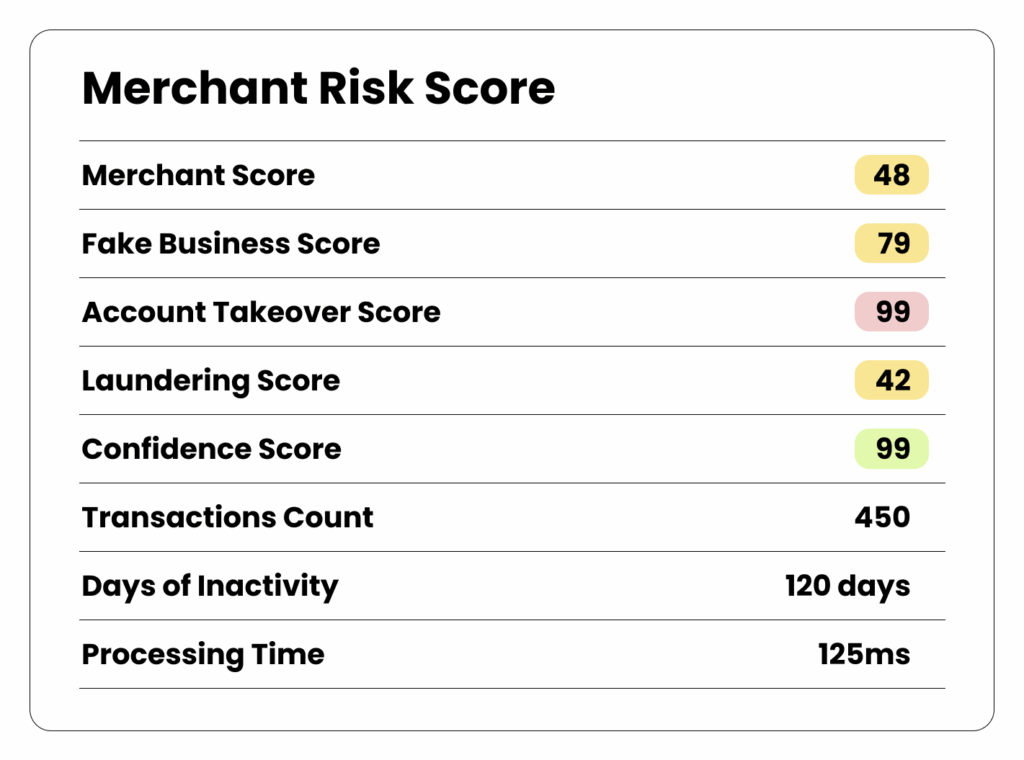
At the heart of our Payment Operations platform (Pay Ops) is our Risk Scoring Model, an advanced payment fraud detection engine that generates merchant scores and per-transaction scores to quantify potential fraud or loss.

This risk scoring approach is built from multiple layers of intelligence:

  • Transaction patterns (velocity, frequency, amount anomalies)
  • Merchant-level history (chargebacks, refunds, exposure trends)
  • Device and location signals (geo mismatch, IP diversity)
  • Behavioral and vertical data unique to each merchant’s industry

The result is an explainable, transparent score – not a black box. SaaS platforms can view sub-scores for AML risk, transaction anomalies, and fraud probability, with clear reasoning behind each outcome.

Transparency here is UX. When merchants understand why they’re being verified or approved, it builds confidence and reduces drop-off – turning compliance moments into trust moments.

Today, Payabli’s teams are shadow-scoring all transactions internally – a step toward offering these insights directly to SaaS platforms managing their own exposure and onboarding workflows.

AI-Powered Policy Creation and Triage

Managing risk across hundreds of merchants can overwhelm even the best teams – but when risk intelligence is automated, it becomes part of the experience rather than an interruption.

Payabli’s AI-driven agents continuously monitor and triage fraud alerts in real time. When potential card-testing events occur, these agents:

  • Cluster related alerts
  • Detect patterns (multiple BINs, IP variations, timing spikes)
  • Surface summarized context directly in Slack
  • Recommend actions like “hold,” “review,” or “safe to ignore”

This turns a flood of alerts into one intelligent conversation – letting human reviewers focus on what matters most. In practice, that means fewer interruptions, faster decisions, and a more seamless merchant experience from onboarding to payment acceptance.

Building the Next Layer: Risk Management as a Product

In many ways, Payabli has built its own version of Stripe Radar – but purpose-built for vertical SaaS platforms. Because our Pay Ops infrastructure is modular, platforms can decide how deeply to integrate the risk layer:

  • Base: Internal risk monitoring and fraud alerts
  • Advanced: Per-transaction risk scores and custom rule policies
  • Enterprise: Co-managed risk operations and AI-driven triage

Over time, these capabilities don’t just reduce losses – they unlock new revenue. Vertical SaaS platforms can monetize advanced merchant monitoring, loss liability protection, or transaction scoring, using Pay Ops as the engine behind it all.

Why It Matters for Vertical SaaS Platforms

Owning the full payments experience means owning the risk that comes with it – but also the trust it creates. When risk management is designed as part of the user experience, SaaS platforms can:

  • Onboard merchants faster with confidence
  • Reduce fraud losses without adding friction
  • Protect merchants through explainable, real-time risk data
  • Automate reviews to keep workflows smooth
  • Build trust through transparency and control
  • Monetize operational intelligence as a premium service

This is the future of risk management – invisible infrastructure that quietly powers exceptional experiences.

Let’s Build Your Risk Management Strategy Together

The next generation of vertical SaaS platforms will win not just by managing risk – but by embedding it into the user experience. Payabli helps you transform compliance into confidence and risk operations into growth levers. If you’re building the future of embedded payments, we’d love to help. Schedule a demo to start shaping your risk management strategy today.

Preparing for the Agentic FinTech Future: Payabli’s AI-Native Transformation

I’m Ankita, AI Product Lead at Payabli. I came into fintech from outside the industry, which means I ask a lot of “why do we do it that way?” questions. Here, I write about building AI systems that actually work—for our team, our customers, and the emerging world of agentic fintech.

When I joined Payabli six months ago, the company had already embraced AI with an impressive toolkit—ChatGPT, Claude, Cursor, Gemini, and more. Teams were actively using AI for writing, brainstorming, and research, signaling a strong foundation and a real appetite for innovation.

But I also saw an opportunity to go further. While people were using AI tools, they weren’t yet experiencing the transformative upside. Many workflows still relied on manual processes begging for automation, and teams wanted clearer direction on how AI could fundamentally reshape the way fintech work gets done.

Fast forward six months: we’ve built a suite of AI agents operating across the organization, contributing to more than 24 hours of manual work saved every week. We’ve consolidated our toolset to streamline learning, training, and sharing of best practices. And we’ve begun laying the groundwork for what we believe is the next frontier in the industry—agentic fintech, where autonomous systems handle operational complexity so humans can focus on strategy, relationships, and innovation.

This is how you evolve into a truly AI-native organization.

Start With a Clear Picture: Assessing Real AI Adoption

You can only fix what you can measure, so I started by getting a clear picture of Payabli’s AI usage.

Through surveys, conversations with team leads, and benchmarking with industry counterparts, I discovered that 75% of the company was using AI automations daily – a strong starting point. However, employees were working across various AI tools, and that fragmentation was holding us back. Training was inconsistent. And most importantly, teams were focused on surface-level use cases instead of the deep automation and integration work that would deliver real impact.

Automate the Pain Points First

My approach to demonstrate the latent value of AI was simple: identify the most time-consuming manual processes, automate them, and build a portfolio of proof points. Often people aren’t opposed to AI adoption – they just don’t even realize it can solve their specific problem.

I started with the low-hanging fruit – the repetitive, time-intensive tasks that were taking up hours of employee time and built tools to automate them:

  • Chargeback AI Agent: Handles routine email responses, collaborates with human analysts on complex chargeback cases, and tracks action items – reclaiming hours previously spent on manual work.
  • Engineering Ticket Monitoring: Automates the monitoring of support tickets to ensure high-quality descriptions that speed up engineering output.
  • Sales Lead Qualification Tool: Automatically evaluates new customer leads against our criteria and notifies the sales team directly in their email inbox

These AI automations became our proof points. Everyone could see the tangible impact – colleagues reclaiming hours each week, faster response times, higher quality outputs – all within their existing tools. More importantly, it shifted the conversation from “Can AI help?” to “What should we automate next?”

Build AI Literacy, Not Just AI Tools

As important as it was to build automations, it was equally critical to create shared understanding around how AI should be used across the company. You don’t become an AI-native organization by deploying tools alone – you get there by ensuring every employee knows how and when to use AI to accelerate their work.

To support that shift, I created comprehensive internal AI documentation that outlines how we use AI at Payabli, including:

  • Guidance on when to use different AI assistants — for research, analysis, content creation, or structured workflows.
  • Instructions on leveraging our integrated workspace tools, including web search, database search, and project management.
  • How to create specialized AI agents with custom instructions and knowledge bases
  • Examples and frameworks employees can follow to identify automation opportunities in their own workflows.

The goal was not just to share information, but to instill an automation-first mindset across the organization. Instead of stopping at low-hanging fruit, employees now have tools and frameworks that help them consider where AI can meaningfully speed up processes or improve quality.

AI literacy isn’t a one-time initiative – it’s a cultural shift. By documenting, training, and creating space for experimentation, we gave every employee the confidence and skills to ask a powerful question: “How can AI make this faster?”

That’s when the real transformation began.

Turning Internal AI Wins Into Customer-Facing Innovation

AI automation delivers incredible value for internal teams, but the real opportunity is when you can extend that value to customers and enhance your product. Coming into fintech with fresh eyes helped me identify where we could make the biggest impact using AI virtual assistants.

I scoped several AI-powered features currently in development for Payabli’s 2026 production release, including:

  • Analytics AI Agent – “Amigo,” Payabli’s embeddable chatbot, helps SaaS platforms quickly ask questions about transactions, identify trends, and find ways to improve their business.
  • Vendor Enablement AI Agent – Helps merchants pay vendors faster by using an AI voice agent to encourage vendor enablement and determine payment preferences.
  • Risk Scoring AI Agent – Machine learning models to score incoming transactions with an AI agent on top that conducts initial reviews and surfaces high-priority items for analyst investigation.

The key is identifying the highest-leverage areas for AI automations – not just adding it where it looks impressive. To effectively lead Payabli towards becoming an AI-native organization, I prioritize opportunities based on potential time savings, competitive differentiation, customer need, and strategic alignment.

Envisioning the Future of Agentic Commerce

Building for today isn’t enough – a big part of my role is anticipating where the industry is headed and positioning Payabli to lead that shift.

The agentic commerce wave is coming. AI agents will soon handle complex purchasing decisions autonomously – but there’s a problem: while e-commerce is racing to become AI agent-ready, the services industry isn’t getting as much attention. Service merchants lack the API infrastructure and tooling that would make them discoverable and transactable by AI agents.

That’s the gap we’re filling. We’re developing a strategy to ensure service-based businesses have what they need to participate in this shift – from merchant enablement toolkits to new payment token infrastructure designed for agent-driven transactions.

The AI-powered features we’re building now – risk scoring agents, vendor enablement voice agents, analytics capabilities – aren’t just standalone products. They’re building blocks for a future where payments infrastructure is intelligent by default and services are as accessible to AI agents as consumer products are today.

The possibilities ahead are endless, and we’re still early. Creating the mindset shift where every employee starts by asking “how can AI help?” has positioned Payabli to become a leader in AI-native payment infrastructure as the fintech industry continues to transform. There’s tremendous potential ahead for how we continue infusing AI into our product and organization – and we’re just scratching the surface.