
Key takeaways
- Payment orchestration is a single software layer above your payment providers that controls how each transaction is routed, retried, tokenized, and reported through one API. It recovers payments a single provider would have lost and cuts processing costs. For a vertical SaaS platform, embedding a layer that already does this usually beats building your own.
- Routing and retries recover transactions a single provider would have declined, and reroute around outages before anyone notices. The more you process, the more the recovery is worth.
- Payment orchestration pays off above a certain volume, not on day one. Below that, setup and upkeep cost more than the gains.
- The underrated win is reconciliation: one ledger across every provider instead of separate portals at month-end.
- Building an orchestration layer yourself takes months and serious engineering investment. Embedding payments infrastructure that already carries it takes days.
A homeowners association platform runs its April dues. One processor encounters a speed bump, part of the batch soft-declines, and nobody catches it until a property manager calls two days later asking where the money went. That’s what payment orchestration fixes, and it looks different when you’re a software company collecting invoices, cards, and ACH instead of a store chasing checkout conversion.
How does payment orchestration work?
Payment orchestration is a control layer between your platform and the providers that move money: processors, gateways, acquirers, and rails like card or ACH. Instead of your code talking to each one directly, it talks to the orchestration layer, and the layer decides where every transaction goes, what happens when one fails, and how it all gets reported back.
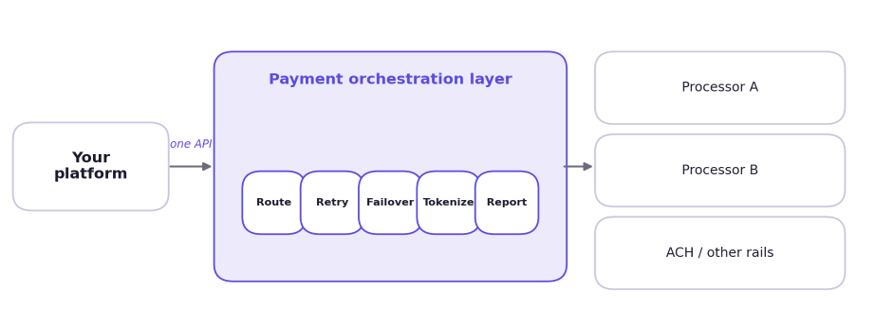
The orchestration layer (one API over many providers)
The value is having one integration instead of many. Every provider brings its own API, auth, webhook quirks, and settlement file format, so wiring up three directly leaves you with three integrations to maintain forever. An orchestration layer collapses those into one API, where your platform speaks a single language, and the layer translates for each provider underneath. Add one later, and your billing code doesn’t change.
Smart routing, retries, and failover
Routing rules send each transaction down the path most likely to clear at the lowest cost, whether that’s a card type to a specific acquirer, a region to a local rail, or riskier traffic to a stricter check. When a payment soft-declines, retry logic tries again through a different provider before anyone sees an error, and if a provider drops mid-day, failover reroutes traffic on its own. The merchant never learns that there was an outage. For recurring billing, that resilience is the difference between a renewal that lands and one that quietly turns into involuntary churn.
Tokenization and unified reporting
These two pieces are quieter but matter more over time. Tokenization stores a card once and reuses it safely, keeping sensitive data out of your systems and shrinking your PCI scope. When those tokens are portable instead of locked to one provider, you can move volume without asking customers to re-enter their cards. Unified reporting pulls every provider’s data into one ledger, so your finance team can work from a single view.
Why do platforms use payment orchestration?
SaaS platforms adopt payment orchestration for four reasons, and approval rates usually come first, since routing and retries claw back payments that would otherwise have failed. Cost follows because routing each transaction to the cheaper provider lowers your blended rate. Resilience comes next, since traffic that reroutes automatically keeps any one provider from taking down your payments. Reach rounds it out, letting you add a new payment method or regional rail with a configuration change your team ships in an afternoon. All four grow with volume, which is the part most guides skip, because the more you process, the more even a small gain is worth.
Payment orchestration vs. gateway vs. processor
These three terms often get used interchangeably, which is exactly why architecture conversations go sideways, but each one is a distinct layer:
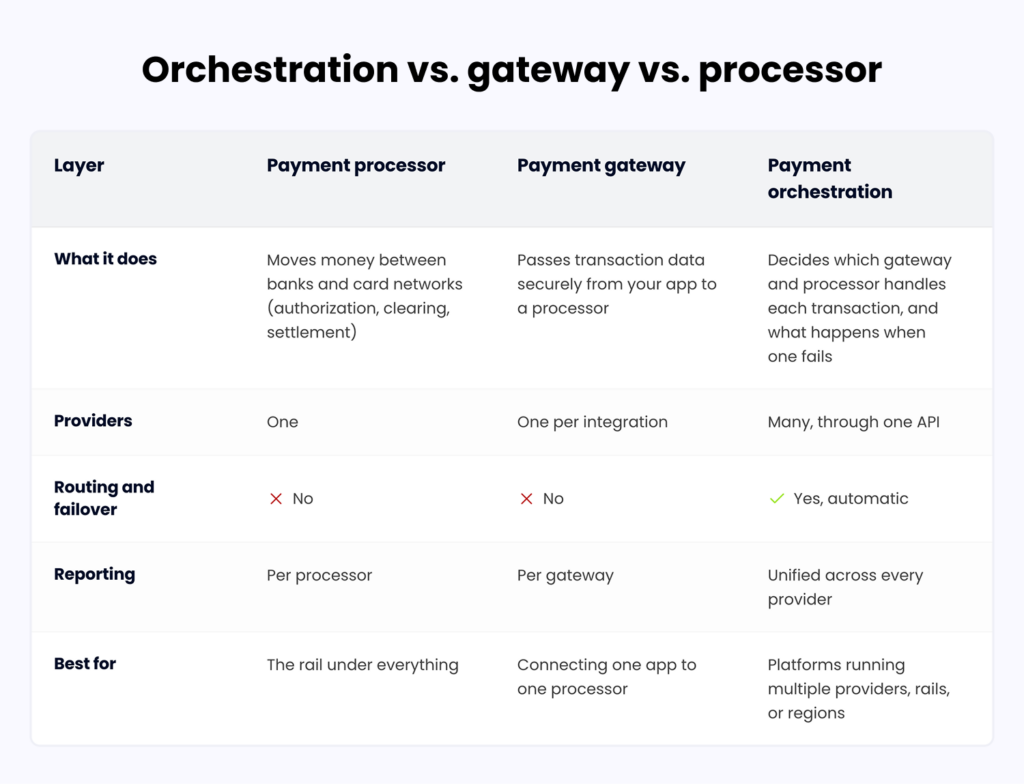
The processor moves the money, the gateway hands it a transaction, and orchestration decides which of the other two to use and how to respond when one fails, which puts it above the other two rather than in place of them.
Do SaaS platforms need payment orchestration?
Not every SaaS platform does, and almost none need it on day one, so the useful question is when it starts to earn its place rather than whether to adopt it eventually.
When orchestration earns its place
Orchestration pays off when a few conditions hit at once: you’re processing enough that a one-or two-point swing in approvals is real revenue, you’re running more than one provider (or about to), and your merchants sit across regions or rails no single provider serves well. Add flatlined approval rates, you can’t move without more headcount or a rebuilt integration, and the case is clear. When two or three of those are true together, the math works.
How to know you’re ready
The mistake most teams make is waiting for an outage or a fee hike to force the move, then rushing the integration at the worst possible moment. Approval rates dip during a hurried migration, reconciliation gets messy when transactions split across providers mid-month, and disputes lose their paper trail. If you’re nearing the volume where the gains are real, start early and treat it like any other payments rollout: run a second provider on a thin slice of traffic, watch the numbers, and expand once you trust them.
Should you build your own orchestration layer?
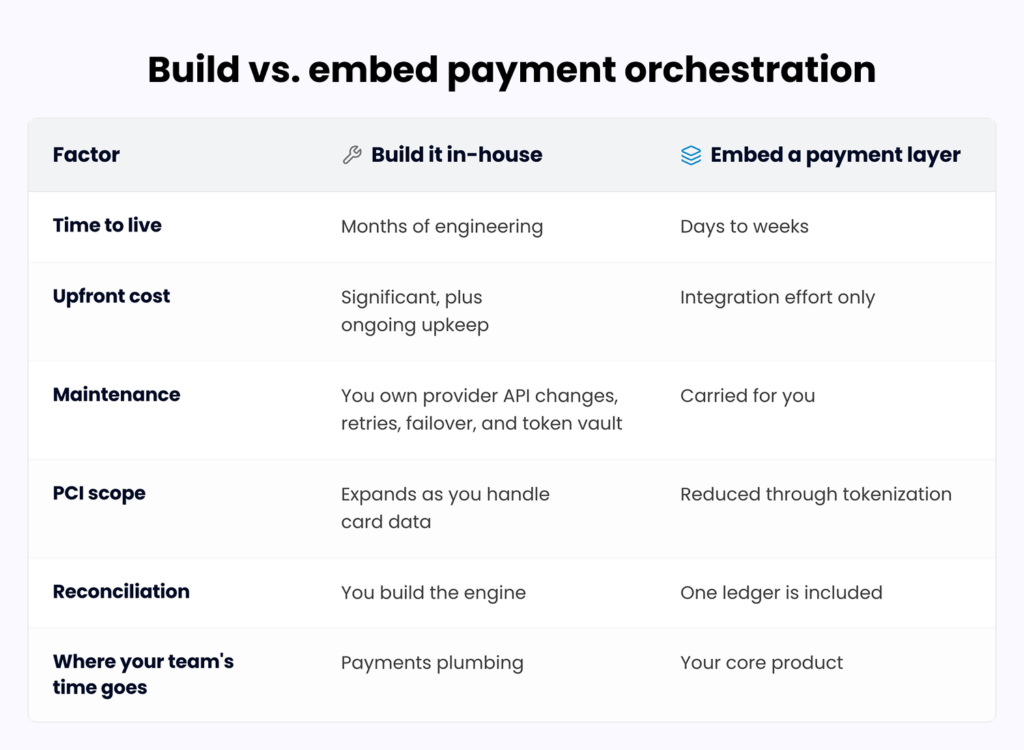
For a vertical SaaS platform, this is the real question, and it’s usually framed backward: the choice isn’t which orchestrator to bolt onto your processors, but whether you want to be in the orchestration business at all.
What building it in-house requires
Building it yourself means owning routing logic, retry and failover rules, a token vault, webhook handling for every provider, a reconciliation engine, and PCI obligations that grow as you handle more card data, then maintaining all of it while providers change their APIs underneath you. Standing up a real multi-processor infrastructure takes serious time and sustained engineering investment, and the upkeep ends up costing more than the initial build. For most platforms, that’s headcount and roadmap, not spent on the product customers actually bought.
What infrastructure carries for you
The alternative is to embed a payment layer that already carries these primitives, so routing, tokenization, failover, and unified reporting come standard. For software companies whose core product isn’t payments, that’s usually where the build-versus-buy math lands.
Get a single embedded payment layer with Payabli
Once the math points to orchestration, vertical SaaS platforms whose merchants get paid on recurring invoices, ACH, cards, and scheduled billing don’t need to become a payment orchestration company to deliver it. That’s the logic behind PayFac-as-a-Service: full payment economics without the registration and compliance burden of building your own.
Payabli puts all three sides of payments behind one unified API: Pay In for acceptance, Pay Out for the embedded B2B payments that pay vendors and suppliers, and Pay Ops for onboarding, risk, billing, and reporting. Tokenization, saved payment methods, query APIs, webhooks, unified reporting, and interchange optimization on commercial cards all come standard. You embed it with direct APIs or no-code components, go live in days rather than months, and monetize payments without owning the upkeep.

Payment orchestration FAQ
What’s the difference between payment orchestration and a payment gateway?
A gateway connects one transaction to one processor, while orchestration sits above one or more gateways, chooses which to use, retries through another path when one fails, and reports across all of them in one place. The gateway is a component, and orchestration is the control layer that manages those components.
Does payment orchestration improve authorization rates?
Usually, how much depends on your volume and current decline rate. When one processor declines a transaction for reasons unrelated to the card, orchestration retries it through another, and those recovered payments add up faster the more you process.
Is payment orchestration only for large enterprises?
No, but it doesn’t add value at every size, because the gains scale with volume: a platform processing tens of millions gains far more from a small approval improvement than a smaller one does. Below a certain scale, the operational lift can outweigh the return, which is why timing matters as much as the decision.
Do you need multiple processors to use payment orchestration?
Not strictly, since some platforms run orchestration over a single provider for centralized tokenization, cleaner reporting, and the option to add providers later without re-architecting. The routing and failover benefits arrive once you have more than one, but the single-layer wins of one API and one ledger apply from day one.