Category: Developer Relations

10x Impact: Inside Payabli’s Documentation Revolution

Six months into joining Payabli, I had already migrated us to a new documentation platform, integrated AI-powered chat, and started filling the gaps in our documentation. 24 months later, we’ve transformed from sparse, founder-run docs into hundreds of pages of content, over 200 documented API endpoints, six auto-generated SDKs, and multiple example applications.

This wasn’t about throwing bodies at the problem. For most of this journey, I worked solo. Even now, we’re just two people. The 10x improvement came from ruthless prioritization, smart tooling decisions, and building systems that scale without constant human intervention.

Here’s what actually worked.

Choose tools that let you innovate, not tools that need babysitting

The first major decision was migrating to a new documentation platform within three months of starting. The previous setup couldn’t support where we needed to go.

I wanted flexibility without being on call. At a previous job, I’d maintained self-hosted documentation, and it was miserable—I was spending time on package updates and infrastructure instead of actually improving docs. I knew I didn’t want that again, at least not until we had a much larger team.

We chose managed solutions that gave us room to innovate without the operational burden. This single decision freed up countless hours to focus on content, architecture, and automation instead of keeping the lights on.

The platform needed to support our vision and support custom components, sophisticated information architecture, and give us the ability to move fast. It delivered on all of those. The tradeoffs are some limitations on customization, but we’re also spared dealing with PagerDuty for a documentation site.

Build automation for everything you touch twice

When I found myself manually updating card components across dozens of pages (and making typos in links and titles) I knew it was time to automate. That’s when I started building our documentation CLI.

The CLI has become central to how my team operates. It eliminates entire categories of manual work and human error. It’s a living tool that we frequently add to and subtract from as our needs change.
Some examples:

Automatic component generation: All the card components in our docs are generated automatically based on frontmatter in our pages. Change a page title, and the cards that reference it update automatically. No more broken links or outdated references.

Diagram synchronization: We use sophisticated text-based diagramming, and our CLI includes automated checks that update the generated SVGs whenever the diagram source changes. We automated it so we no longer forget to update the images when the source changes.

Changelog automation: When I change our API definition, I run a command that writes the changelog entry and flags whether it’s a breaking change. This triggers the right SDK builds automatically.

These aren’t flashy features. They’re boring infrastructure that compounds over time. Every manual task you automate is time you get back for higher-leverage work, and mistakes you never make again. I want to use my brain on big problems, not little tasks.

Integrate AI where it actually helps

We integrated Inkeep early, and the chat bot has delivered an 80-100% deflection rate every month. Customers can ask questions like “build me a config for this service,” and the chat generates working configurations from our documentation.

But the real value isn’t just answering questions. I read every chat conversation and analyze how customers ask for help. This reveals gaps in our docs that I wouldn’t see otherwise. When I notice patterns, I update the documentation to address those questions proactively.

The AI chat has become a continuous feedback loop: customers ask questions, I identify documentation gaps and read customer feedback, I improve the docs, and future customers find answers faster. It’s transformed self-service for our customers and made our documentation measurably better.

Hire for potential and trajectory, not just experience

Eighteen months in, I hired Elijah, my first team member. I made a choice: I technically needed a writer to help take some of my workload, but instead I hired a junior developer who I could train to write.

I wanted someone who would grow into a developer relations role. I needed someone who could hit the ground running to build SDKs, create example applications, talk to developers, and understand their needs at a deep level. That meant I needed an extroverted developer first, writer second.

It was challenging. He was very junior, and I had to teach him about the payments industry and technical writing fundamentals. But, at the 90 day mark, he’d already shipped resources that would be difficult for a non-developer to create. The best part is that none of the resources he created required anything from other teams.

Elijah’s role here helps my team execute quickly on building enablement resources

Treat information architecture as a competitive advantage

When I say I focused on information architecture (IA), I mean I obsess over navigation, our controlled vocabularies, content categories, URLs, keywords, and more. Prioritizing IA has been central to our ability to scale because good IA is scale.

Good IA means customers can find what they need quickly. It means new content fits logically into existing structures. It means the documentation grows in an organized way instead of becoming a sprawling mess.

This isn’t something you do once. It’s continuous work as your product evolves, as you add content, and as you learn how customers actually navigate your docs. We recently put a lot of work into reconfiguring the entire documentation site to use Fern’s new product switcher, because that feature made it easier to organize our own content by audience type.

Measure what matters, then read between the lines

Beyond the AI chat analytics, I use PostHog for product analytics on the documentation site. This shows us how people interact with different elements, which pages aren’t performing well technically (slow to load, component errors), and where people get stuck.

We track GitHub stars for our SDKs. We monitor standard web analytics for visits and engagement. But qualitative analysis like reading actual chat conversations, looking at heatmaps, or watching how people navigate, often reveals more than the numbers alone.

Metrics tell you what’s happening. Understanding why requires digging deeper.

Work with the team you have, not the team you wish you had

The biggest ongoing challenge is working with internal teams who are stretched thinner than we are. It’s hard to be proactive and reach out to teams who may not be able to  prioritize reaching out to us.

This is still something we’re navigating. I’ve made looping us in on work frictionless (just add a label to a ticket and the Doc team appears). My team has adopted the QA team’s tools so we can self-service more information and test our docs. Our automation efforts helped because we could do more with less. 

You can’t change how busy other teams are. You can only change how much you depend on them having spare time to help you.

Would I do anything differently?

No. I built our docs program the way Payabli needed it done, given our constraints, resources, and goals. Not every approach works in every context.

If you’re a solo documentarian or a small team trying to scale impact, here’s what mattered most for us at Payabli:

Pick your infrastructure carefully. Choose tools that let you focus on high-leverage work, not maintenance. We love our stack, and you should too.

Automate relentlessly. Every repeated manual task is technical debt. Build the tooling to eliminate it.

Hire for the gaps you can’t fill alone. Think about what skills will unlock the most value, not just what’s easiest.

Treat information architecture as ongoing work. It’s not a one-time project. It’s how you prevent your docs from collapsing under their own weight as you scale.

Build feedback loops. Use AI, analytics, and conversations to understand where your documentation is failing customers, then fix it.

We went from founder-run docs with missing pages and outdated content to hundreds of pages, 200+ documented endpoints, six SDKs, and multiple example applications. We did it with two people because we built systems that scale for Payabli.

That’s how you 10x a documentation team: not by 10x-ing headcount, but by 10x-ing leverage.


If you enjoyed these insights on how we’re leveling up our docs, why stop here?
Check out Payabli’s Developer Documentation to see it all in action — cleaner guides, smarter structure, and the little details that make a big difference for platforms and developers building with Payabli.
How Payabli’s AI Investment Is Powering the Developer Experience — Introducing the MCP Server and the Future of AI Payment Infrastructure

Your AI assistant’s payment expertise.

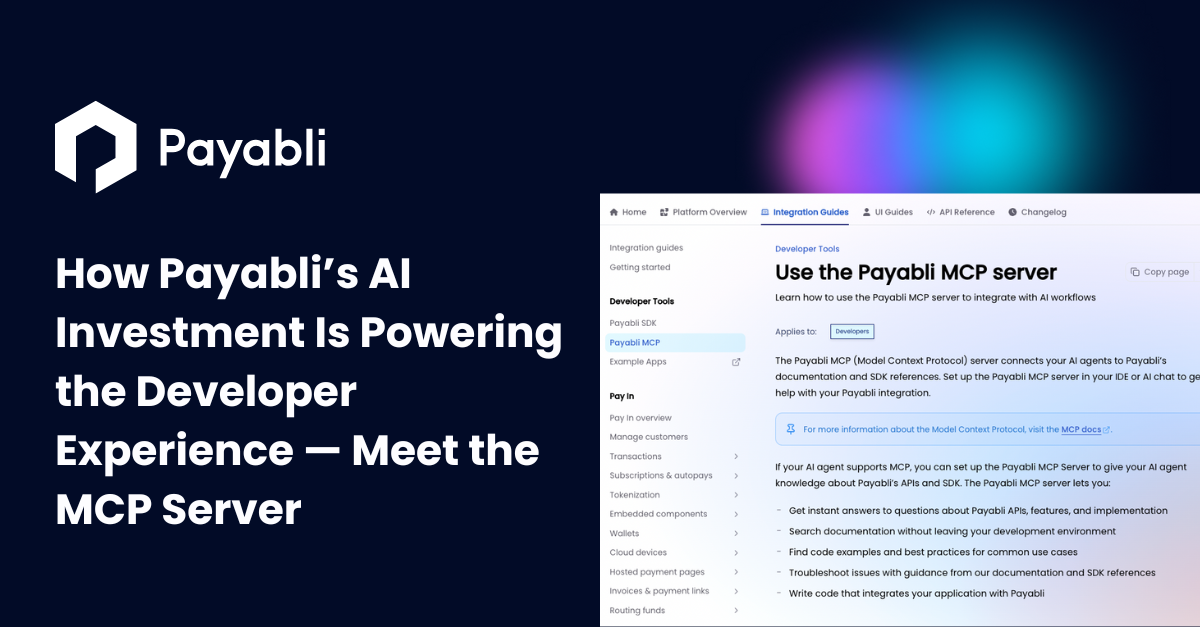
When we announced our $28M Series B funding, we shared our vision for the future of payments—one where AI plays a central role in how developers build and interact with payment infrastructure. Today, we’re bringing that vision to life with the launch of the Payabli MCP (Model Context Protocol) Server—the first of several AI-powered tools that mark the beginning of a new era in AI payment infrastructure and fundamentally change how developers integrate with our platform.

The Problem We Set Out to Solve

Every developer building with payments APIs faces the same frustrating workflow: code for a few minutes, switch to documentation, search for the right endpoint, copy code samples, switch back to the Integrated Development Environment (IDE), repeat. This constant context-switching kills productivity and slows down innovation.

We knew AI could solve this, but existing AI coding assistants lack the deep, real-time knowledge of payment systems that developers actually need. Generic responses don’t cut it when you’re handling sensitive financial data and complex compliance requirements.

AI Payment Infrastructure: Investment in Action

The Payabli MCP Server represents exactly the kind of AI innovation we promised investors and developers. Instead of building another chatbot or documentation search tool, we created something fundamentally different: a direct pathway between AI assistants and our live payment infrastructure.

We’re also early adopters of the Model Context Protocol (MCP) – an emerging standard for connecting AI assistants to external data sources. By staying ahead of this technology curve, we’re ensuring that developers on our platform get access to the most advanced, context-aware AI tools as they become available.

Here’s what makes it revolutionary:

  • Real-Time Documentation Sync: Your AI assistant accesses the same live API references in the Payabli Docs – no outdated examples or deprecated methods.
  • MCP-Powered Payment Intelligence: Your existing AI agents can leverage our MCP server to deliver precise, context-aware guidance about the Payabli API, including payment flows, compliance requirements, and more.
  • Zero Context Loss: Developers never leave their IDE. The AI brings Payabli expertise directly into their development environment.

What Developers Are Building

Early adopters are already using MCP to accelerate development across various industries:

  • Construction software platforms implementing contractor payment workflows
  • Educational technology companies setting up subscription billing for course platforms
  • Government software providers integrating secure payment processing for public services
  • HOA management platforms building automated dues collection systems
  • Field Services software processing mobile payments for service appointments

Why AI-Enabled Payment Infrastructure Matters for the Industry

In today’s fintech landscape, many companies are bolting on AI as an afterthought – typically in the form of customer service chatbots or surface-level analytics dashboards. But these limited implementations miss the bigger opportunity: rebuilding the developer experience from the ground up with AI at the core.

We’re pioneering a new category: AI-native payment infrastructure. Instead of simply making payments “AI-enabled,” we’re flipping the paradigm—making AI development payments-native. This approach deeply integrates payment capabilities into AI systems, opening up transformative possibilities for automation, personalization, and scale.

As early adopters of Model Context Protocol (MCP) – an emerging standard for connecting AI assistants to external data sources – we’re staying ahead of the curve. MCP ensures that developers working within our platform can seamlessly build intelligent, context-aware payment applications using the most advanced tools as they emerge.

By embracing these AI-first principles, we’re not just improving fintech infrastructure—we’re reshaping the future of how AI and payments work together.

The Developer Impact

What excites us most isn’t the technology – it’s what developers will build with it. When integration friction disappears, innovation accelerates. We’re already seeing:

  • Faster time-to-market for payment features
  • Reduced errors with AI-guided implementation
  • Higher quality integrations with built-in best practices
  • More experimentation with advanced payment capabilities
  • Reduced technical debt from cleaner, AI-guided implementations

Getting Started

Already using Payabli? Try the MCP Server and start building with AI-powered integrations today.

New to Payabli? Book a demo to see our embedded payment infrastructure and AI-powered developer tools.

This is just the beginning of AI-powered development at Payabli. Stay tuned as we continue rolling out more AI-powered tools.

Why SDKs Are a Game-Changer for Embedded Payments

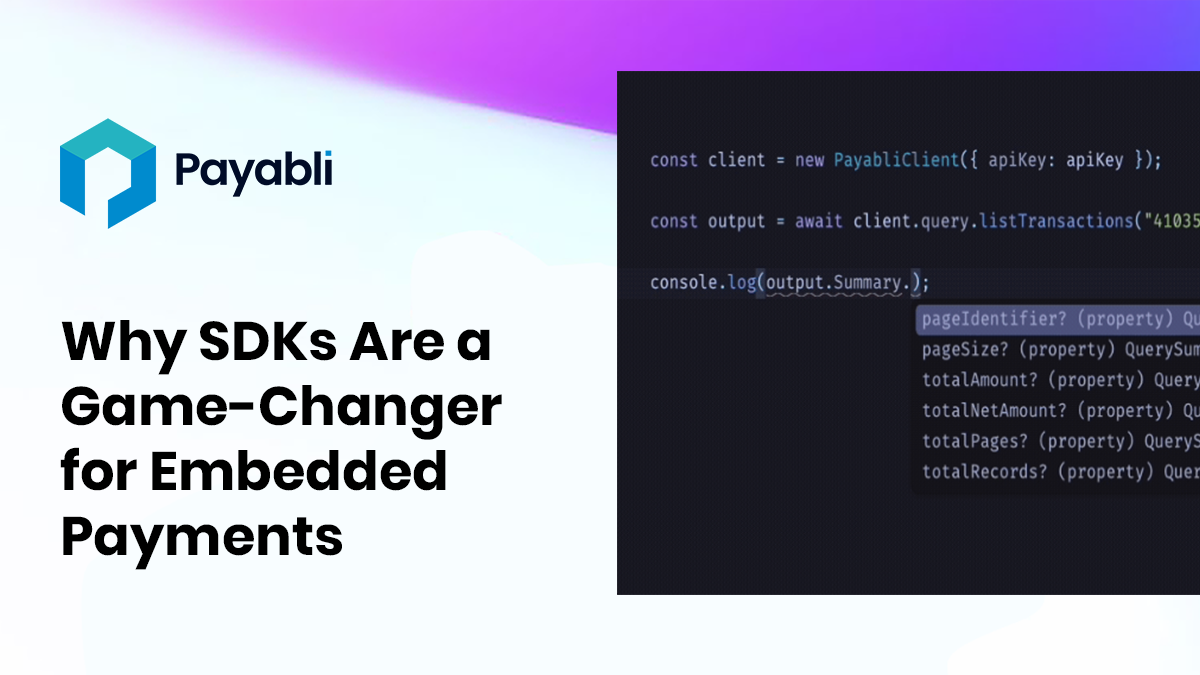
Building payment infrastructure is hard. Integrating it into your SaaS platform shouldn’t be.That’s why we built the Payabli Software Developer Kit (SDK) for  for C#, Go, Java, PHP, Python, and TypeScript – a tool that gives developers everything they need to build embedded payment solutions quickly, reliably, and without the typical headaches of custom integrations. Whether you’re launching new features or scaling your platform, the right SDK isn’t just a convenience – it’s a competitive advantage.

The Problem: Payment Integration Slows Teams Down

Let’s face it: developers have better things to do than wrangle complex APIs, debug authentication flows, or troubleshoot errors after production. Payment integration, while essential, can often drain business resources. It takes time, introduces risk, and pulls engineers away from core product work.

This becomes even more painful as your company scales. Custom-built integrations tend to break, APIs change, and the surface area for bugs only grows.

The Payabli SDK Solution: Build Once, Launch Fast

A well-designed SDK changes the game. Instead of spending weeks building and testing a payment flow, developers can compose straightforward methods and go live in hours. The SDK takes care of the heavy lifting, so your team can focus on building the features that move your product forward.
Check out how our Payabli SDK improves both speed and developer experience:

  • Accelerate Development
    Quickly embed authentication, payment initiation, and API calls with just a few lines of code so you can get up and running faster.
  • Catch Issues Early
    Includes built-in error handling and retry logic that automatically flags issues before production – saving time and ensuring smoother launches.
  • Works With Your Tech Stack
    Designed for modern back-ends across C#, Go, Java, PHP, Python, and TypeScript – no rewrites or awkward workarounds
  • Build Fast from Sandbox to Production
    Production-ready in hours instead of weeks building a custom API integration, so you can launch confidently without rewriting your payment logic later. 

Why It Matters

An SDK is more than just a shortcut. It’s a developer quality-of-life upgrade.

By simplifying the most repetitive, error-prone parts of building embedded payment solutions, the Payabli SDK gives developers confidence and control. It reduces mental overhead, cuts down on bugs, and lets your team focus on building what actually moves the needle for your business.

In short, it makes shipping payments feel as seamless as any other modern developer task – which is exactly how it should be.

Who It’s For

We designed this SDK for high-growth SaaS and ISV platforms looking to embed and monetize payments. Whether you’re just starting out or scaling across verticals, the Payabli SDK is built to support you every step of the way – in whatever language your team works in.

If developer velocity is key to your success (and let’s be honest – when is it not?), then this is the tool you’ve been waiting for.

Ready to Build Smarter?

Our SDK is fully self-serve and ready for you to explore. Just head to the Payabli Developer Docs to start building embedded payment solutions. 

Interested in helping us make the best developer experience in payments? If you have ideas, questions, or want to be part of upcoming user research, we’d love to hear from you at docs@payabli.com

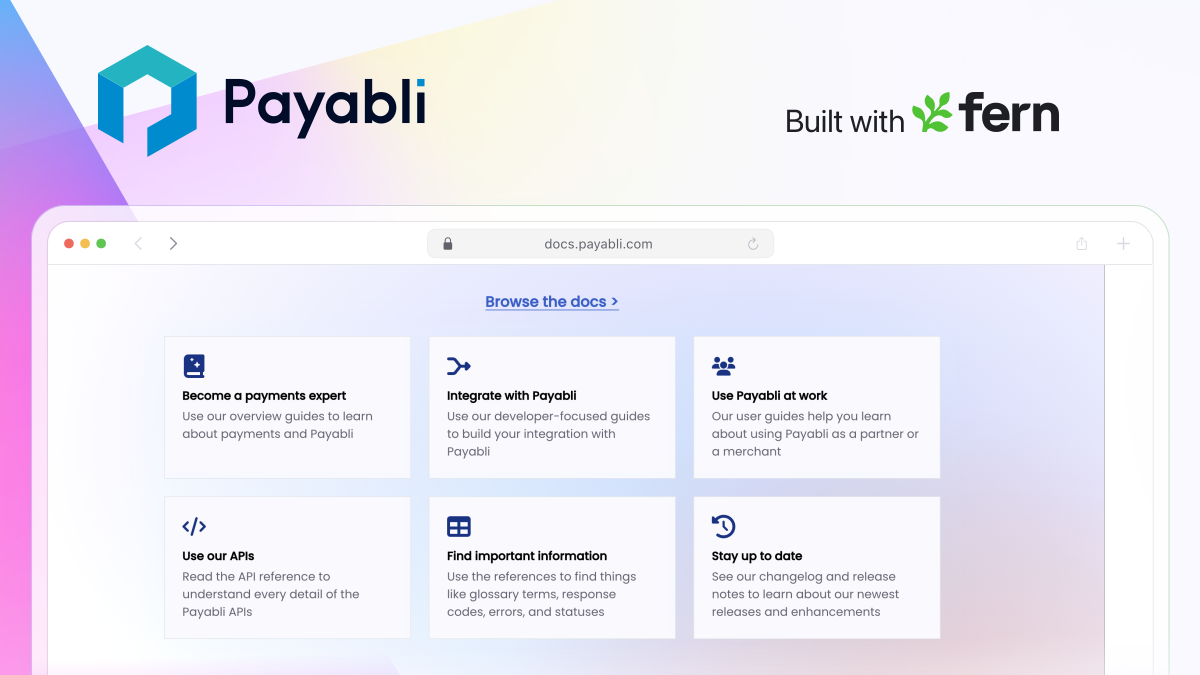
Payabli’s New and Improved Payment Documentation – Powered by Fern. 

We’re excited to announce a major upgrade to Payabli’s payment documentation and developer site — making it faster, clearer, and easier than ever for developers to build on our platform and accelerate their API payment integration.

This is more than a visual refresh. It’s a foundational investment in how we support you—our builders—and a key milestone in our mission to make Payabli the most seamless, developer-friendly payments experience for SaaS platforms. Whether you’re building a full payments stack or just getting started, our improved payment documentation is designed to help you get there faster.

To bring this vision to life, we partnered with Fern — a company reimagining how engineering teams build, maintain, and scale high-quality API documentation and SDKs. Inspired by internal tooling at companies like AWS and Palantir, Fern’s platform powers some of the cleanest, most developer-friendly experiences we’ve seen — and now it powers ours at Payabli, too.

What’s New (And Better)

We didn’t just change platforms—we rebuilt the experience with developer usability at the core. For you as a developer, this means:

  • Logical, cleaner navigation
    Endpoints are now grouped by the objects they belong to — not hidden in broad “reporting” sections. For example, the Pay In transaction query endpoints now live in the Pay In section instead of the general queries section.

  • Code examples that stay in sync
    Many examples are sourced directly from our API spec. That means one source of truth — and no more outdated copy-paste errors.

  • Smarter search functionality
    Tabbed search results separate guides, endpoints, and references — so you can quickly zero in on what you need.

  • Interactive, developer-first API playground
    With Payabli’s API Playground you can try endpoints with pre-filled examples, helpful error responses, and a cleaner interface that makes it easier to test and understand endpoints.

  • Auto-generated Postman collections
    Our Postman collection is now kept in sync automatically — no more mismatches between tools and docs.

  • Improved readability for complex data
    Tables expand to fullscreen and custom components make scanning large datasets or request structures much easier.

  • Community feedback
    Every page of our new Docs site includes the ability for our users to give direct feedback on the content

Building What’s Next

This launch sets the foundation for even more developer-centric enhancements we’re working on:

  • Official SDKs (coming soon!)—automatically generated and always aligned with our API spec
  • More interactive features—think guides, tutorials, and hands-on flows
  • Community feedback loop—we want to hear what’s working and what’s not

Try the New Docs!

Big thanks to the team at Fern for being an incredible partner throughout this rollout. Their platform has helped us level up the way we deliver payment documentation and their support made the transition smooth from start to finish — and we’re proud to be building alongside them. 

Check out the new Payabli Developer Docs and let us know what you think. We’re always looking to make the developer experience even better — so if you have feedback, questions, or want to help shape what’s next, reach out to us at docs@payabli.com. We’re kicking off user research soon and would love to include you. This launch is just the beginning, and we can’t wait to show you what’s next!