
Key takeaways
- AI vendor enrichment builds a vendor’s payment profile automatically: reading the invoice, searching the web, and calling to confirm how the vendor takes payment, so your merchants can shift more payouts onto cards.
- The outbound voice agent makes the vendor call for your AP team, who rarely have time for it. It confirms whether the vendor accepts a card, captures the email, and saves the transcript as the record. It only makes outbound calls.
- Manual vendor setup is slow and expensive. It costs time and resources spent on confirming details, which can be avoided with the help of AI vendor enrichment.
- Card payments are the ones your platform earns on, and checks bring in almost nothing. Every vendor you move onto a card adds payment volume you make money on, so enrichment is a direct way to grow revenue.
Before a vendor gets paid, someone in accounts payable has to work out how that vendor wants to receive payment, whether by card, ACH, or a mailed check. For most teams, the answer is hidden in an email, an old invoice, or a call no one wants to make. AI vendor enrichment does that work automatically. It reads the invoice, searches the web, and calls the vendor to confirm card acceptance. For software platforms whose merchants run AP, the payment method a vendor accepts decides how much the platform earns on that payment.
What is AI vendor enrichment?
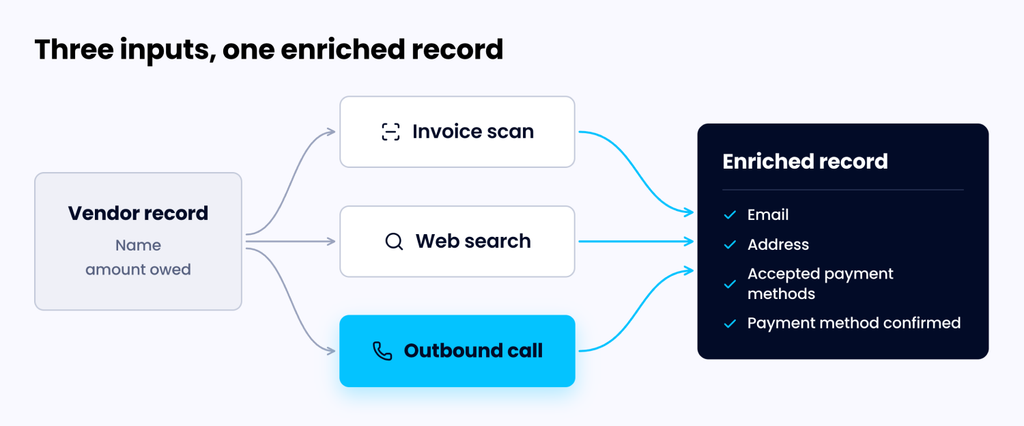
AI vendor enrichment automatically collects the details needed to pay a vendor the right way, so no one on the AP team has to track them down by hand. A new vendor record usually holds almost nothing useful, often just a name, an amount owed, and maybe an address. Enrichment adds the parts that actually matter for paying them: the contact email, the methods the vendor accepts, and the portal or link they use to get paid.
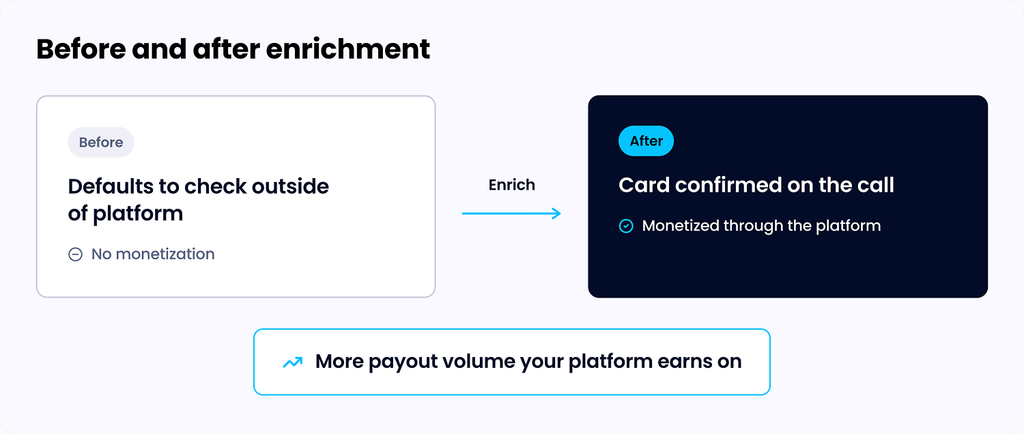
All of those lead to a single decision: “Can this vendor be paid by card instead of a check?” For a platform running embedded payables, that question is not minor, because the card is the method the platform earns the most margin on. Most vendors are not attached to checks. They stay on them because no one has offered another option, and many would take a card once they see that it gets them paid faster.
How does an AP voice agent work?
Two parts matter here: how the call runs, and what happens to the result once the vendor hangs up:
Outbound call workflows
The agent calls only when invoice scanning and a web lookup miss details it still needs. If those steps return enough, no call goes out.
When it does call, the attempts are time-boxed rather than left to a person:
- Up to three tries, about two hours apart, during the vendor’s local business hours
- A handoff to a backup method if no one answers, so an unanswered phone never stalls the payment
On the call, the agent says a payment is owed and captures what it takes to pay the vendor right:
- The methods the vendor accepts, and whether they prefer card, ACH, or check
- Any fee or surcharge tied to paying by card
- The email or mailing address the payment should go to
- A callback from a person, logged when the vendor asks
The agent reads the details back to confirm, and every call is recorded and transcribed as the payment record. In one live run, it reached a vendor for a merchant, ran through the options, confirmed the vendor takes cards, captured the email, and read it back before hanging up. Each call shows a status in the UI: Scheduled, In Progress, Completed, or Unable to Contact.
Integration with payment and AP systems
A confirmation only matters once it reaches the systems that pay the vendor. The value shows up when the result is written back into your embedded payments platform, so the email, the confirmed method, and the transcript all attach to the vendor record, and the next payment routes to the card automatically. The call is the visible step. The write-back is what changes how the vendor gets paid, because a captured, structured result is what lets the platform move that vendor from a check to a card without anyone rekeying it.
How does AI enrich a vendor record?
Enrichment runs in layers: the fastest first, before escalating to the next only when the easier paths fall short.
Invoice scanning
It starts with the document. Upload an invoice and the system reads it, pulls the payment details off the page, and creates the vendor record on its own, with no manual keying. The fields a clerk used to copy by hand are filled in seconds.
Web search and data lookup
When the invoice leaves gaps, a deep web search fills them, returning the vendor’s email, business address, the payment methods they advertise, and any payment portal or link they run. Often, the search alone confirms accepted payment methods, and whether the vendor accepts virtual cards, so no call via the voice agent is needed.
The outbound voice agent
When the document and the web still leave the question open, the AI voice agent picks up the phone. It is an outbound caller with one narrow, useful job: reach the vendor, confirm their accepted payment methods while encouraging virtual card adoption, and capture the details needed to pay them that way. This is the piece people picture when they hear the words voice agent, and it is the call an AP clerk rarely has time to make.
Why does the payment method decide your payables revenue?
Here is the part that matters to whoever owns the platform’s profit and loss. Checks still make up a meaningful share of B2B payments, down from 81% two decades ago to 26% today, and they cluster in exactly the vendor-heavy industries software platforms serve. Every one of those payments is a chance for the platform to earn, and how much it earns comes down to the method the vendor accepts.
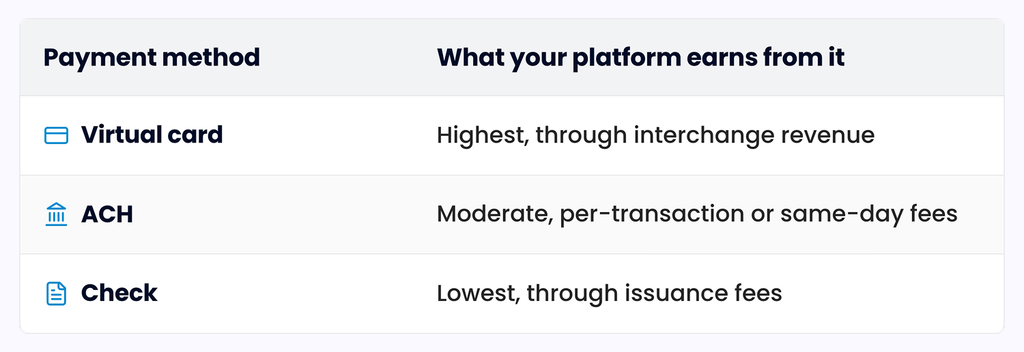
This is why platforms push virtual card adoption so hard. Virtual cards are the highest revenue generator, because the platform earns interchange revenue that can be significant. ACH is often the preferred method for recurring vendor relationships, and while the margin is lower than a virtual card, platforms can still monetize it through per-transaction fees or premium options like same-day ACH. And some vendors only take a check, which is fine. Enrichment still works and still earns, because platforms can capture margin through check-issuance fees while meeting those vendors where they are.
Beyond the revenue a platform earns, there is the cost of setting each vendor up by hand. Ardent Partners finds the best-in-class AP teams process invoices 78% cheaper and 82% faster than everyone else. Most of that gap is one person on the phone, working out how a vendor wants to be paid. Doing that automatically across a whole vendor base is how a platform gets to monetize payments instead of absorbing the cost.
Which need-to-pay verticals will adopt AI vendor enrichment first?
This lands first in the industries where merchants pay a long list of vendors and still lean heavily on checks, like field service, community management, construction, healthcare, fitness, and education.
The pattern repeats across all of them: a field service company pays a tail of suppliers, then a construction platform’s merchants pay subcontractors every week. A community management company writes checks to landscapers, plumbers, and contractors all month. What they share is high vendor counts and heavy paper, which is exactly where digital payment optimization and confirming card acceptance pay off most. Vertical SaaS platforms sit on top of thousands of these relationships, and enrichment turns each one into a card candidate.
What payment infrastructure does AI vendor enrichment need?
An enrichment agent has to do two things against the platform beneath it. It has to pull invoice and payment data to know who a vendor is and what is owed. It also has to push the result back onto the vendor record, so a confirmed email and method reroute the next payout on their own.
Doing it in-house means owning document parsing, a web-search pipeline, a voice model wired to live telephony, retry logic, transcript storage, and a compliance trail, all kept in sync with the rails that move money. Few software companies should spend a year on a voice stack just to learn whether a vendor takes a card. AI is already reshaping embedded payments, and the platforms that come out ahead will be the ones that buy that infrastructure rather than build it.
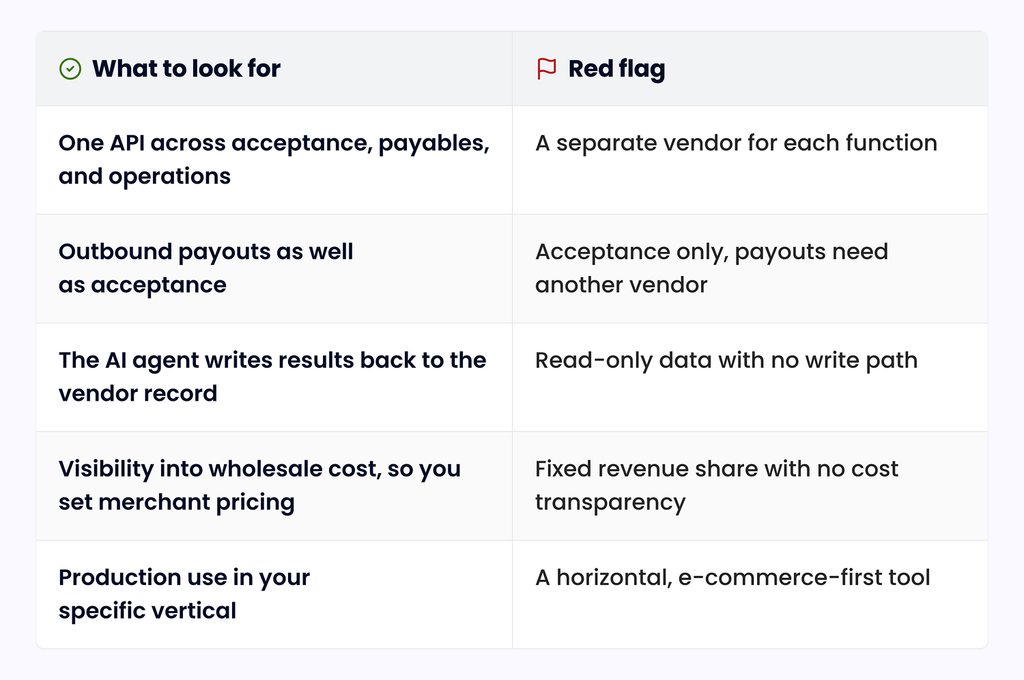
Before signing with a payments partner offering AI vendor enrichment, here is what to check:
How Payabli powers AI vendor enrichment
Payabli’s AI vendor enrichment is a pre-built, embedded solution that runs inside your AP workflows, so your platform does not have to build a voice agent or wire one in to get started. Through the same single, unified API behind Pay In, Pay Out, and Pay Ops, it pulls invoice and payment status, confirms payee changes, and updates payouts based on what enrichment surfaces.
For platforms whose merchants spend hours on the phone with vendors every week, AI Vendor Enrichment lets voice agents take those calls off their plate entirely.

Frequently asked questions
Here are the questions platforms raise most when they first consider putting an agent on the phone:
1. Will vendors trust calls from an AI voice agent?
The call carries details only a real caller would have. The agent references the exact invoice number and the merchant company the vendor already works with, so the vendor can confirm it is tied to a real, known transaction. It then explains why it is calling, offers a card, ACH, or check, and repeats the details back to confirm. That specificity earns the vendor’s trust, and faster payment is the payoff.
2. How does AI vendor enrichment fit into my existing payment setup?
There is nothing separate to integrate. It works through the same API that already moves your merchants’ money, so the agent reads the invoice and payment data to know who it is calling and why, then writes the confirmed email and method back onto the vendor record. That write-back is the part that matters, because it stores the confirmed method so future payouts route to the card on their own, without anyone re-entering the result.
3. Are AI voice calls compliant for B2B vendor communications?
The agent identifies itself as an AI assistant at the start of every call, which several states now require, and explains that it is calling on a merchant’s behalf about a payment the vendor is already owed. Because each call is documented, AP can point to exactly which method a vendor confirmed and the email they gave, the trail a compliance team expects whenever a payment detail changes.