

Guest Post by Ershad Jamil | Former CGO, ServiceTitan
AI Shouldn’t Just Automate Work. It Should Help Businesses Get Paid.
Vertical SaaS companies were built to meet the discreet operational, workflow, and regulatory needs of a specific industry, like healthcare or construction. With the rise of embedded payments, these software companies soon became payments platforms. Now, the question for Vertical SaaS platforms is how to leverage AI to help your customers become payments driven revenue engines.
While AI and automation can significantly improve industry-specific work deliverables – from scheduling appointments to generating industry-formatted proposals, those applications focus on reducing administrative overhead or simplifying workflows. What would be even more valuable? Expediting how quickly a business gets paid. That’s where the Vertical SaaS companies will become Vertical AI companies and truly differentiate themselves.
For years, software platforms have treated payments as the final step in a workflow. The job gets completed, an invoice gets generated, and eventually someone gets paid. AI gives us an opportunity to rethink that sequence. Instead of viewing payments as something that happens after the workflow, they should become part of the workflow itself. The next generation of Vertical AI companies won’t simply automate operations. They’ll help customers get paid faster—and in doing so, create entirely new revenue opportunities for themselves.
Every AI Workflow Should End With a Payment
No matter the industry, most service businesses follow a remarkably similar customer journey. A customer requests a service. A quote is generated. An appointment is scheduled. The work gets completed. An invoice is created. Payment is collected.
Today’s AI products are becoming incredibly effective at improving nearly every operational step leading up to payment. AI can answer inbound calls, qualify prospects, recommend pricing, schedule technicians, summarize job notes, generate estimates, and even draft invoices. But in many cases, once the invoice is generated, the workflow simply stops.
(I’ve written before about how this gap between operational and financial workflows slows down cash flow.)
Imagine an AI sales agent preparing a quote for a homeowner. Instead of emailing a proposal and waiting for a response, the AI presents financing options, answers questions, and captures a deposit the moment the customer approves the estimate. Or imagine an AI scheduling assistant booking a service appointment. Before confirming the visit, it automatically secures the required deposit, reducing cancellations while improving cash flow. After the work is complete, the AI reviews technician notes, generates an invoice, explains the charges, answers customer questions, and securely collects payment before the conversation even ends.
In each case, AI isn’t replacing the payment infrastructure. It’s eliminating the friction that normally exists before the payment occurs. The faster businesses convert completed work into collected cash, the healthier those businesses become.
Better Customer Outcomes Create Better Platform Economics
This shift has implications that extend well beyond customer experience. Historically, software companies monetized subscriptions. In the past 10+ years, vertical SaaS companies embedded payments and began participating in payment volume generated on their platforms. As Brad Weekes of Software Equity Group says, “If you give me a pure SaaS company versus a SaaS plus payments company with the same strong financial metrics, I’m all over it.” Vertical AI companies have an opportunity to take that model one step further.
Every time AI helps a customer close another job, capture another deposit, recover another payment, or reduce the time it takes to collect an invoice, the software platform creates measurable economic value for its customer. If payments are embedded directly into those AI-driven workflows, the platform benefits alongside its customers.
Revenue becomes directly aligned with customer success. As customers process more payments, collect cash faster, and improve their businesses, the software platform grows with them. That’s a fundamentally different business model than simply charging another monthly subscription. You’re no longer monetizing software usage—you’re participating in customer outcomes.
The Next Generation of Vertical AI Platforms
Over the next several years, I believe we’ll see a growing number of AI-native software companies build products that don’t stop once work has been completed. They’ll own the entire lifecycle—from customer acquisition and quoting to scheduling, payment collection, reconciliation, and financial operations.
The most valuable AI won’t simply answer questions or automate administrative work. It will help businesses improve cash flow, accelerate collections, and generate more revenue.
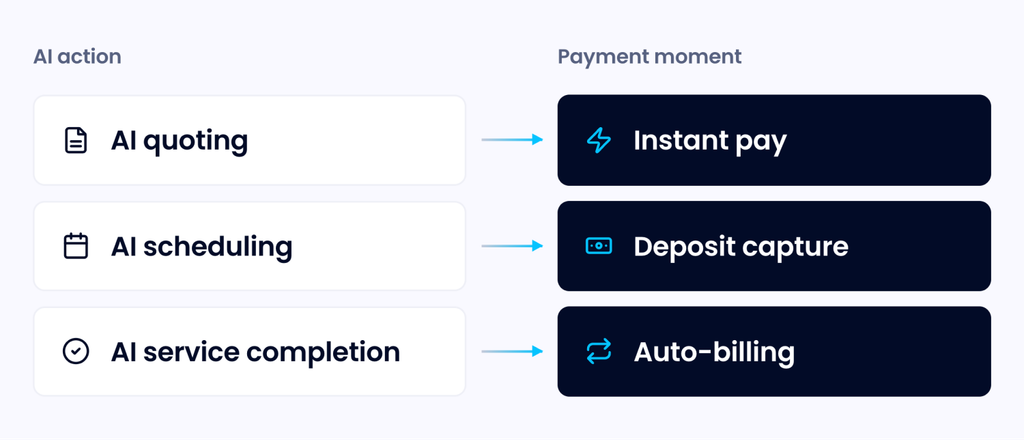
Here’s a view of how AI will change the revenue collection workflows for Vertical AI companies:
- AI quoting → instant pay
- AI scheduling → deposit capture
- AI service completion → auto-billing
As founders think about building the next generation of vertical AI companies, payments should no longer be viewed as a separate feature that’s added later. They should be considered part of the product from day one. Payments become the mechanism that converts AI-driven activity into measurable business outcomes.
None of this is easy to build. Embedding deposits, invoicing, financing, and reconciliation directly into an AI agent’s conversation requires real financial infrastructure — money movement, compliance, reconciliation — sitting underneath the product, not bolted on top of it.
That’s the layer companies like Payabli exist to provide: Pay In, Pay Out, and financial operations built to be embedded into AI-native experiences from day one, so platforms can focus on the workflow instead of rebuilding payments from scratch. Get that infrastructure right, and the result isn’t just better software — it’s a platform that helps customers complete more work, collect more revenue, and improve cash flow, while creating a powerful new monetization engine for the software company itself.
The next generation of Vertical AI companies won’t simply automate business workflows. They’ll automate business outcomes.