
Key takeaways
- AI merchant onboarding automates document review, identity verification, and risk scoring to approve merchants in minutes instead of days, with people handling only the exceptions.
- Slow onboarding is a revenue leak: approvals take 3 to 7 days, and 70% of financial institutions say it has cost them clients. Every day of waiting is a merchant who can churn before they transact.
- AI does not remove your compliance obligations. It runs KYC, AML, and risk checks consistently with a full audit trail, so you stay fully compliant without the manual queue that stalls approvals.
- The platforms that monetize payments own onboarding through one API that also runs payment acceptance, payouts, and payment operations, instead of stitching together separate vendors.
A merchant signs up, uploads documents, and waits. For many software platforms, that wait is where the deal quietly dies, and the applicant walks away before processing a single transaction. Traditional merchant onboarding runs for days while someone reviews paperwork by hand. AI merchant onboarding changes the order of operations: it reads documents, verifies identity, and scores risk at once, often in minutes. When approval is the gap between signup and revenue, speed is not a nice-to-have. It decides whether that revenue starts at all.
How does AI merchant onboarding work?
Onboarding is everything between “a merchant wants to accept payments through your platform” and “that merchant is approved and transacting.” It means collecting business and ownership details, confirming the applicant is real, screening risk and compliance, and making a decision. Each of those steps is a place where a merchant can stall or quit.
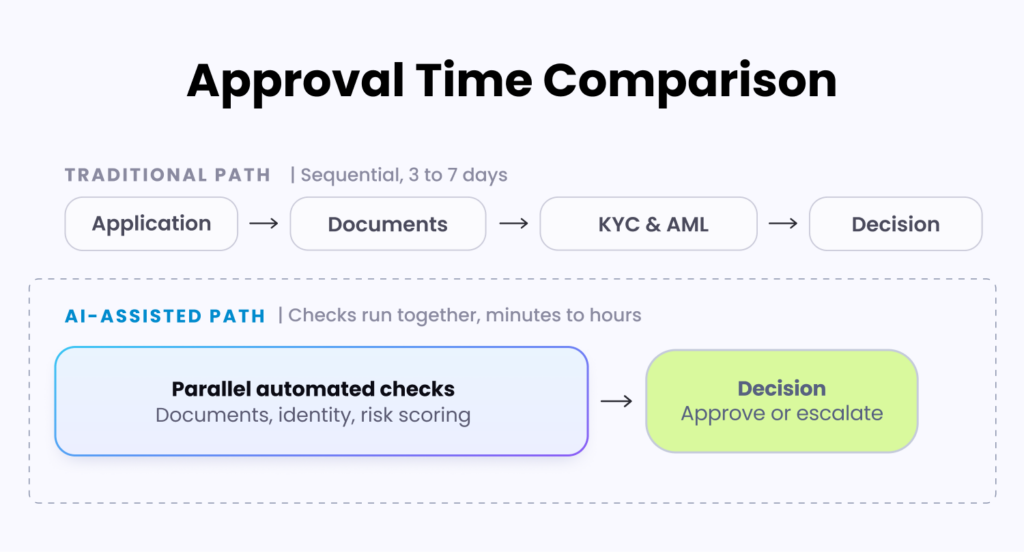
AI runs across all of them at once. It structures the documents a merchant submits, matches identity and business data against trusted sources, screens against watchlists, and produces a risk score that either approves automatically or routes the file to a reviewer. The work does not disappear. The sequence does. Instead of an analyst pulling each application through a queue, the checks run in parallel while the merchant sees a short, clean form and a fast yes. For your platform, that is the difference between an applicant who activates today and one who never comes back.
This is one piece of how AI is reshaping embedded payments, and onboarding is where the payoff shows first, because the old version is so visibly slow.
How AI cuts merchant approval times
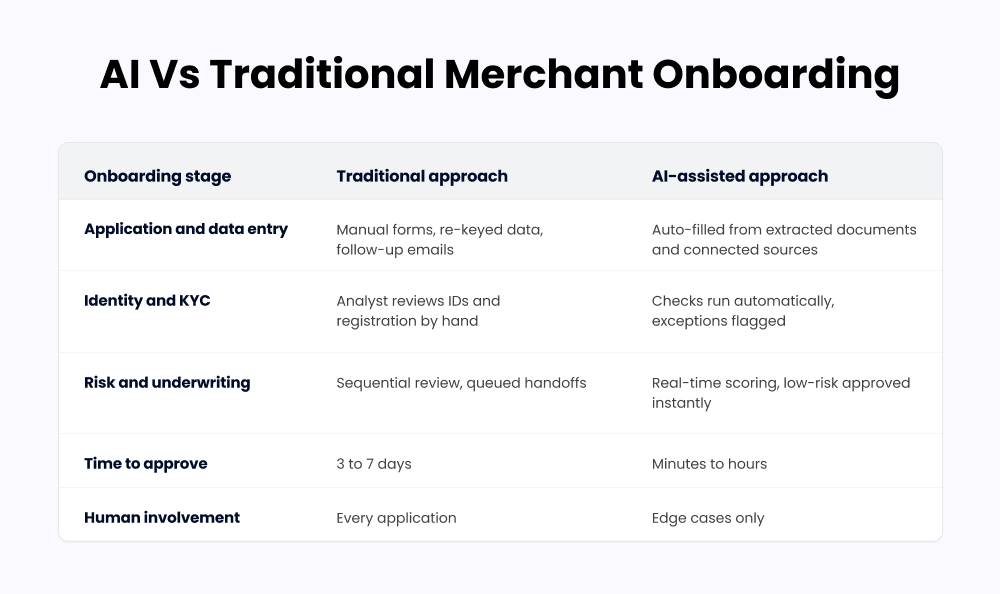
Traditional onboarding works like a relay, with each stage waiting in a queue for the one before it. AI-assisted onboarding collapses that wait, as the comparison below shows.
Document parsing and data extraction
Most of the delay starts with paperwork: business licenses, voided checks, bank statements, and articles of incorporation. AI reads each document, extracts the relevant fields, validates them, and flags mismatches before a reviewer ever opens the file. It is the same OCR extraction that powers modern payment operations, where invoices are parsed automatically instead of being keyed in by hand.
Identity verification and KYC automation
Next, the platform confirms the applicant is who they say they are and that the business is real. That means checking document authenticity, matching identity and beneficial-ownership details against authoritative sources, and screening against sanctions and politically exposed person lists. None of this lowers the compliance bar, because KYC and AML obligations stay the same whether a person or a model does the work. What improves is consistency, since automated checks apply the same rule to every applicant and leave the audit trail that underwriting and verification tooling is built to produce.
Real-time risk scoring and underwriting decisioning
The last step is the decision itself. AI turns the extracted data, identity results, and external signals into a risk score, then applies your rules: low-risk merchants get approved on the spot, and the rest go to a reviewer. FICO notes that automation can underwrite a merchant in minutes rather than days when the decisioning logic holds up. You decide where those lines sit, which thresholds clear automatically, and which get a closer look, so you are not putting every applicant through the same heavy review.
Why traditional merchant onboarding is slow
Traditional onboarding is slow by design. It was built for caution in an era when every check happened by hand, and while the caution still matters, the manual execution no longer does. Three bottlenecks explain where the days actually go.
Manual data entry and document chasing
The first is data collection. Applicants retype the same details across forms, send documents, get asked for them a second time, and wait, and that friction is exactly where they quit. Every drop-off is a merchant you already paid to acquire, lost at the form.
Sequential underwriting and risk review
The second is the relay itself. An application moves to document review, then to KYC, then to underwriting, with each stage sitting in a queue until the one before it clears. That is why traditional acquirers are still so slow to approve a merchant, and almost none of that time goes to hard decisions, it goes to waiting.
KYC, AML, and compliance bottlenecks
The third is compliance work no one can skip: sanctions screening, beneficial-ownership verification, and document authenticity. Manual review also stops scaling once volume climbs, which is why regulators increasingly expect automation, and the stakes are high, with AML enforcement reaching $4.6 billion in fines in 2024. Faced with that, teams default to slow and careful. AI keeps the rigor and removes the wait, applying every check consistently and clearing low-risk applications automatically.
Where does AI merchant onboarding pay off first?
Traditional onboarding pays off first where document sets are predictable, and risk profiles repeat, since that is where extraction and scoring are most accurate. That fits need-to-pay verticals like property management, utilities, education, government, and field services, where payments sit inside the workflow, merchants are often small operators, and no one can wait days to get paid. These platforms already move the most volume, so faster onboarding turns straight into revenue you capture sooner.
| Vertical | Why onboarding stalls today | What AI accelerates |
| Property management | Multiple entities, owners, and accounts per portfolio | Extracting and matching ownership data |
| Utilities | High volume of small, ACH-heavy accounts | Bulk identity and bank verification |
| Education | Seasonal signup spikes, varied documents | Scaling reviews without adding headcount |
| Government and municipal | Strict compliance, layered approvals | Consistent, auditable KYC and screening |
| Field services and trades | Sole operators who will not wait | Instant approval for low-risk merchants |
The same advantage runs outbound. When a platform adds embedded payables so its merchants can pay vendors and subcontractors, every one of those recipients has to be onboarded too, and applying the same automated checks there keeps the payout side from turning into the next bottleneck.
What it takes to deliver an AI merchant onboarding
Fast onboarding is not one feature but several working together, and bolting them together from separate vendors usually brings back the slowness you were trying to fix. It starts with a single API across boarding, verification, and underwriting, so data moves between steps without re-keying, with risk rules you set yourself. The flow runs white-labeled inside your product, with a person on the real edge cases and an audit trail that holds up when an underwriter or sponsor bank reviews it.
Get those right, and onboarding stops losing you merchants and starts winning them. It is also what lets a platform monetize the payments running through it instead of handing that margin to a processor.
Payabli’s Pay Ops already gives your platform embedded merchant onboarding on one unified API, alongside payment acceptance, payouts, and operations. Boarding, verification, and underwriting sit in one place, with risk rules you set.
The AI decisioning layer is next. Amigo Insights is being built to read KYC packets, verify identity and business registration, score risk in real time, and route only the edge cases to a reviewer, so your team will not build a parsing or decisioning stack in-house. Need-to-pay verticals like field service, community management, construction, healthcare, fitness, and education come first, where predictable documents and repeating risk profiles make automated decisioning more accurate.
See what is live now and what is coming next. Book a demo.
Frequently asked questions
How long does AI merchant onboarding take?
Low-risk merchants can clear in minutes to a few hours, against the three to seven days a manual process usually takes. Higher-risk applications route to a reviewer and take longer, but even those move more quickly because the routine checks are already done before a person opens the file.
Can AI fully approve merchants without human review?
For clear low-risk merchants, which are usually the majority, yes, and that straight-through approval is the point. Complex or higher-risk applications should still escalate to a person, and since compliance accountability stays with your platform regardless, the strongest setups automate the easy decisions and keep human judgment for the exceptions.
How does AI onboarding handle high-risk verticals?
It scales the scrutiny to the risk: light checks and fast approval for low-risk merchants, deeper diligence and manual review for the rest. The better systems also keep monitoring after approval, so risk is reassessed as a merchant’s behavior changes rather than only at signup.