
Key takeaways
- A card account updater automatically refreshes expired and reissued cards on file, recovering the largest preventable category of failed recurring payments, without asking the customer to do anything.
- Updaters run on card-network programs (Visa Account Updater and Mastercard Automatic Billing Updater) that sync issuer changes to your stored credentials before the next charge.
- Failed payments are a major, recoverable revenue leak: involuntary churn accounts for an estimated 20-40% of all subscription churn, and most of it can be recovered.
- A CAU only fixes credential-related declines. Pair it with network tokens and a sound retry strategy for full payment continuity.
- For platforms, the value depends on placement: an updater built into the payments layer refreshes every merchant’s cards in place, with nothing extra to wire up.
Recurring billing rests on one assumption: that the card on file still works the next time it’s charged. It often doesn’t. Cards expire, are replaced, and are reissued during routine bank activity. Each card change invalidates the credentials a merchant has on file, causing payments to fail for reasons unrelated to the customer’s ability to pay. A card account updater keeps those credentials current automatically.
This guide explains what it is, why it matters, and what platforms should look for.
What is a card account updater?
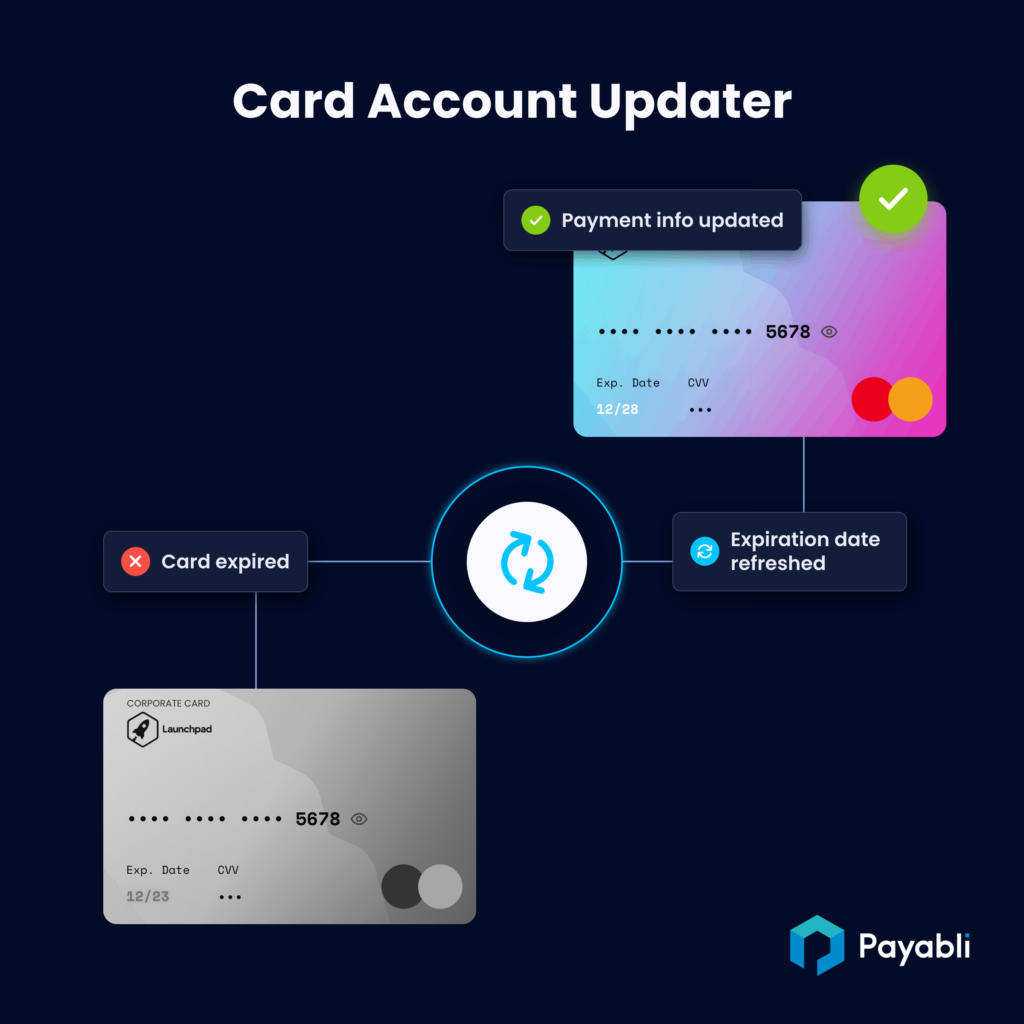
A card account updater (CAU) is a service that automatically keeps stored card details accurate. When a customer’s card expires, is replaced, or is reissued, the card account updater refreshes that card on file on the merchant’s behalf without requiring the customer to re-enter their information or take any action. The result is a stored payment credential that stays valid over time instead of a static record that quietly goes out of date.
It runs on programs that the card networks built for exactly this purpose:
Both work the same way at a high level. When a bank issues a new card, it communicates the change to the network. The updater retrieves that change and refreshes the stored credential before the next charge is attempted.
Why stored cards fail, and why it costs more than it appears
Payment cards change for routine reasons: they reach their expiration date, get replaced after loss, theft, or fraud, and are reissued during product upgrades, portfolio migrations, and bank mergers. Each event changes the card number or expiration date and immediately invalidates the version a merchant has stored.
When that card is charged, the transaction declines even though the customer never chose to cancel and may not know anything has changed. This is involuntary churn: revenue lost to a payment failure rather than a customer decision.
The reason it’s costly is that it is difficult to see, surfacing in decline reports rather than cancellation data, where it is easily mistaken for ordinary attrition. Yet unlike a customer who deliberately leaves, this revenue is recoverable. Industry data puts failed payments drive between 20-40% of subscription losses, and because these customers never meant to leave, a large share of it can be won back. A card account updater targets that loss directly, converting a preventable decline into a successful payment, retaining revenue for the merchant, and preserving processing volume for the platform.
How the card account updater works
The underlying process is straightforward, and most of it occurs automatically in the background:
- The platform submits stored cards to the relevant network updater program.
- The network checks with each card’s issuing bank for any changes.
- When an update is available, the network returns the new card number or expiration date.
- The stored credential is refreshed, and the next payment is processed using the current details.
Most updaters run on a defined schedule (typically monthly or twice monthly), while some also support real-time inquiries triggered by a declined authorization.
A well-designed updater returns a specific outcome for each card rather than a simple pass or fail. That distinction lets merchants respond correctly, continuing to bill an updated card while ceasing attempts on a closed account, which prevents wasted retries and avoidable chargebacks. Sending the right stored-credential indicators on each transaction supports this and helps keep approval rates high.
The benefits for merchants and platforms
For merchants, a card account updater delivers:
- Higher payment success rates by reducing declines caused by outdated card data
- Reduced administrative effort by eliminating the need to contact customers for new card details
- An improved customer experience since cardholders are never asked to re-enter information, and service continues uninterrupted
- More predictable revenue by stabilizing recurring income
For the platform, the benefits extend to:
- Greater processing volume as recovered payments remain on the platform’s rails and contribute to payments revenue
- Stronger merchant retention because fewer payment disruptions reflect positively on the platform
- A more competitive payments offering since credential management is an expected capability among mature recurring-billing platforms
Which businesses benefit most
Any organization that stores a card on file and charges it again later stands to benefit, particularly those built on recurring billing:
| Business type | Typical recurring charges |
| Subscription & membership businesses | Monthly or annual subscription fees |
| Property management & HOA | Recurring rent, dues, and assessments |
| Healthcare practices | Scheduled payment-plan installments |
| Fitness studios & gyms | Recurring membership dues |
| Field service companies | Recurring maintenance or service-plan charges |
| Government utilities | Monthly utility or service bills (water, energy, internet, waste) |
| Any card-on-file business | Any repeat or stored-credential charge |
Understanding the limitations
A card account updater is valuable, but understanding its boundaries is essential to using it effectively. The simplest way to think about it is which failures it can and can’t recover from. Below is where each common decline type falls and why:
What a card account updater recovers
Expired and reissued cards are exactly what the updater is built for. When a card reaches its expiration date, or a bank sends a replacement after loss, or a routine upgrade, the new number or expiry flows through the network program and refreshes the stored credential before the next charge. The customer never has to re-enter anything, and the payment that would have declined goes through instead. This is the bulk of credential-related failure, and it resolves without any manual work.
What it flags but can’t fix
A closed account is different from a changed one. When a customer closes the account behind a card, there’s no new credential to retrieve, so the updater can’t recover the payment. What it does do is return a “closed” response, which is its own kind of value: instead of retrying a card that will never work, you can stop billing it, suppress further attempts, and prompt the customer for a new method. Acting on that signal prevents wasted retries and the extra decline fees and chargeback risk that come with them.
What sits outside its scope
Some declines have nothing to do with the credential being out of date, and no updater can address them. Insufficient funds is a temporary state of the account, not a problem with the card details, so recovery there depends on retry timing rather than an update. Fraud holds, and other issuer declines are decisions the bank makes in the moment, which sit entirely outside the updater’s reach. Both are better handled by a smart retry strategy and clear customer communication.
Where coverage has gaps
Two practical limits are worth planning around. Issuer participation isn’t universal. Coverage depends on which banks take part in the network programs, so a portion of cards simply won’t return updates. And network coverage is concentrated in Visa and Mastercard, the two programs most updaters connect to. American Express and Discover run their own separate update services, so full coverage means accounting for those rails too.
Even so, expired and reissued cards remain the single failure type that a platform can fix most reliably, and a card account updater addresses it reliably. Combined with network tokens, which automatically refresh tokenized credentials, and a sound retry strategy for other declines, it forms part of a comprehensive approach to payment continuity.
Why placement matters in embedded payments
For a platform, how a card account updater is implemented determines how much of its value is actually realized. An updater can only refresh credentials it can reach.
Bolted on as a separate service, it adds integration work and reconciliation overhead, and may miss cards stored elsewhere. Built into the same embedded payments environment where cards already live, the updater reaches those credentials directly, so there’s no separate integration to build or maintain. The recovered revenue, the smoother customer experience, and consolidated billing arrive as part of the platform rather than as a separate project.
Card account updating is easy to overlook precisely because it works quietly, recovering payments that fail when no customer ever chose to stop paying. For any platform built on recurring revenue, keeping cards on file current is among the most efficient ways to protect merchant income and platform processing volume, and the real question is where that capability lives.
Card account updating with Payabli
At Payabli, it’s built directly into the payments layer rather than bolted on, but whatever the approach, treating credential freshness as core infrastructure is the right starting point.
Ready to see how built-in credential management works on a single platform? Book a demo to get started.