
Key takeaways:
- A white-label payment gateway is payment infrastructure your vertical SaaS platform rebrands as its own, so your software customers onboard, pay, and reconcile inside your product while you earn on every transaction they process.
- Payment processing revenue through US software vendors reached $16 billion in 2025, growing 20% annually, and now represents roughly 60% of all SME acquiring revenue.
- 90% of US merchants now use software-led payment solutions, up from 48% in 2022, and the shift is largely one-directional: merchants who have not adopted are 3 times more likely to switch to a software platform than current users are to leave.
- Vertical SaaS platforms in property management, construction, education, and field services hold a structural advantage because their software customers cannot operate without moving money through the platform.
If you run a vertical SaaS platform, your software customers are already processing payments. Every time they do, a third-party processor collects the transaction margin, owns the data, and puts their name on the experience. That is revenue and control your platform is giving away with every transaction.
A white-label payment gateway solves both. You take pre-built payment infrastructure, rebrand it as yours, and embed it directly into your SaaS product. This guide covers what that looks like in practice for vertical SaaS, how the economics work, and what separates a white-label partner worth signing from one that will cost you.
What is a white-label payment gateway?
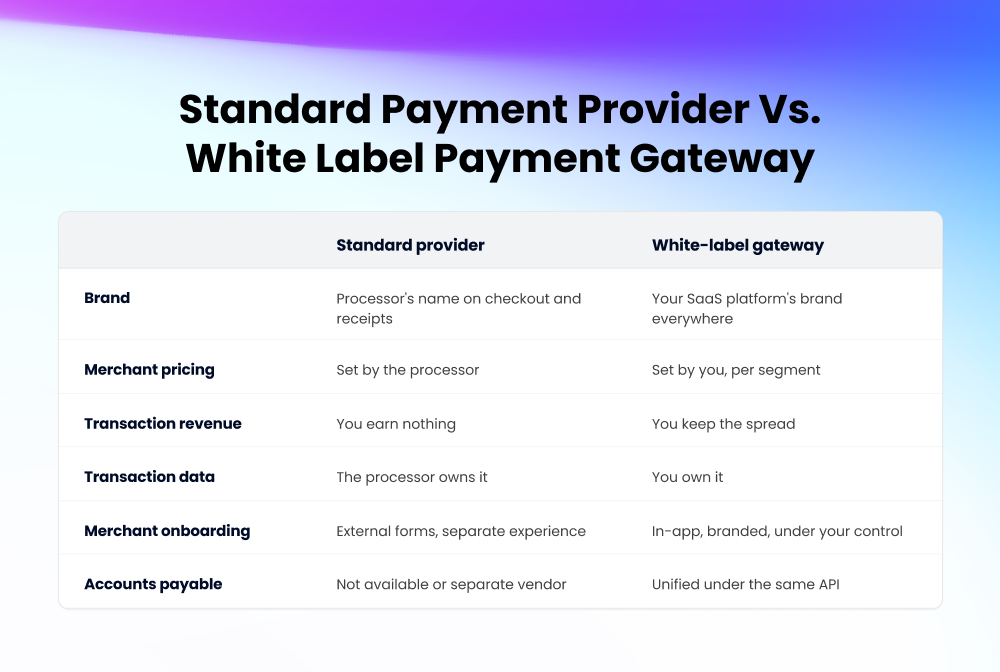
A white-label payment gateway is a payment processing infrastructure that a SaaS platform licenses, rebrands, and embeds directly into its product. Your software customers onboard, transact, and reconcile inside your interface, with no redirects and no third-party logos. You set the merchant pricing, the infrastructure partner processes at wholesale, and you keep the spread.
For vertical SaaS, white-label payment gateways solve a problem that generic processors cannot. When a property manager collects rent or a contractor invoices a homeowner, the payment is your product. A white-label gateway lets you own that transaction, earn on it, and become the financial system of record that your software customers run their business through.
How does a white-label payment gateway differ from a standard payment provider?
With a standard provider, your software customers leave your platform to complete a payment and the processor keeps the margin. With a white-label payment gateway, your SaaS platform owns both.
 Which model scales better for vertical SaaS?
Under a referral model, a SaaS platform processing $100 million annually earns 5 to 15 basis points — roughly $50K to $150K. Under a white-label payment gateway, that same volume at 70 to 90 basis points generates $700K to $900K. McKinsey’s ISV maturity analysis confirms the gap: traditional partnerships cap platforms at 30 to 50% of processing revenue, while PayFac models deliver 70 to 90%. The retention math compounds too. When invoicing, acceptance, and reconciliation all run through a single API, every software customer that activates raises the switching cost.
How does a white-label payment gateway work?
You control everything the merchant touches: onboarding, checkout, dashboards, and reporting. Your infrastructure partner handles everything behind it, including tokenization, authorization, clearing, settlement, fraud screening, and payment operations. Your software customers never leave your SaaS platform. The partner’s job is to make that possible without requiring you to hire a compliance team.
What happens between checkout and settlement?
Payment data is tokenized and routed through secure rails (card networks or ACH), and funds settle through the sponsor bank. Your branded dashboard updates with transaction status, settlement timing, and disputes in real time. Your SaaS platform gets full operational visibility without owning PCI scope or managing the settlement infrastructure.
Where does your brand appear inside the payment experience?
Everywhere a software customer or their end user touches payments: onboarding, checkout pages, invoices, customer portals, receipts, and dashboards. The best white-label payment gateway partners also offer no-code component builders so you can launch branded payment experiences without pulling engineers off your core SaaS product.
Why are vertical SaaS platforms switching to white-label payments in 2026?
The market has already shifted. That $16 billion in ISV payment processing revenue did not exist five years ago. It grew from $6.5 billion in 2020, and the software-led channel is expanding 3 times faster than traditional acquiring. The global embedded payment market was valued at $24.7 billion in 2024 and is growing at a 30.3% CAGR through 2034 (Global Market Insights). Vertical SaaS platforms without white-label payments are already competing at a disadvantage.
What does embedded payments revenue actually look like?
A SaaS platform with 500 software customers, each processing $500,000 annually, sits on $250 million in volume. At 50 to 100 basis points, that is $1.25 million to $2.5 million in net new revenue per year, scaling automatically as your software customers grow.
At a smaller scale, the math still works. A platform with 100 software customers processing $200,000 each generates $20 million in volume and $100K to $200K in payment revenue. That is revenue your subscription model cannot produce without adding new customers. Payment revenue grows when your existing software customers grow.
Which vertical SaaS categories are capturing the most payment volume?
The verticals leading white-label payment adoption share one trait: payments are the workflow, not a feature attached to it. Property management, HOA, construction, education, fitness, and government all process high recurring volumes where software customers cannot operate without moving money through the platform. That dependency is also what drives retention. When payment acceptance, invoicing, and reconciliation all run through your product, switching becomes operationally prohibitive.
What to look for when choosing a white-label payment gateway for vertical SaaS
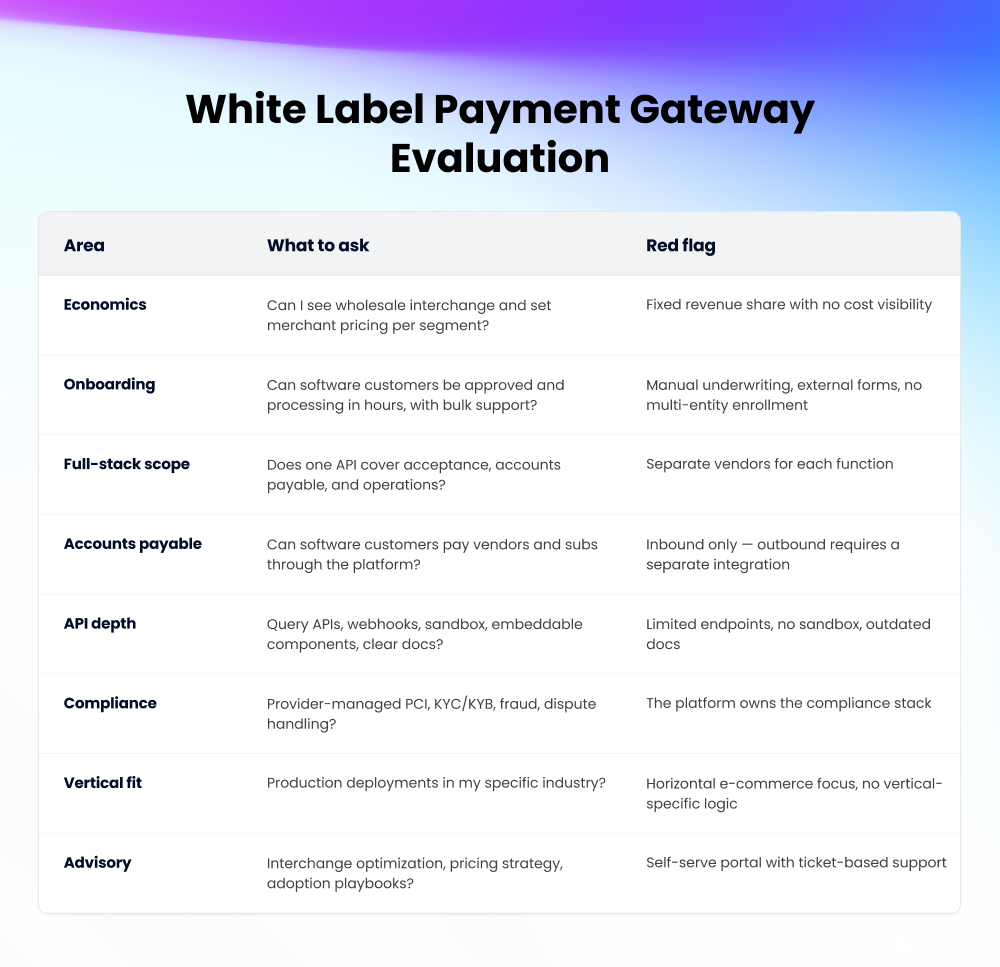
Choosing a white-label payment gateway is a long-term infrastructure decision. The partner you sign will shape your payment economics, your software customer experience, and how fast your payments program scales.
 What does a fair revenue share agreement look like?
If you cannot see the wholesale cost stack before signing, walk. The right partner provides flexible pricing and billing tools with segment-level rate control, interchange optimization for B2B transactions, and compliant surcharge models.
Who handles risk, underwriting, and disputes?
Full PayFac registration means owning PCI Level 1 compliance, sponsor bank relationships, KYC/KYB, chargeback liability, and card network reporting. Most vertical SaaS platforms are better served by PayFac-as-a-Service. The partner holds the regulatory burden while you keep full branding and software customer control. That is the core value of a white-label payment gateway for vertical SaaS: PayFac-level economics without the PayFac-level overhead.
How Payabli helps vertical SaaS platforms launch white-label payments
Payabli is built specifically for vertical SaaS platforms. A single API covers Pay In (payment acceptance), Pay Out (accounts payable and disbursements), and Pay Ops (boarding, underwriting, billing, risk, and compliance). One integration. One dashboard. One partner.
Payabli works with vertical SaaS platforms across property management, field services, education, government, fitness, and waste management. If your platform has transaction volume flowing through it and you are not earning on it, request a demo to see what the economics look like for your vertical.